
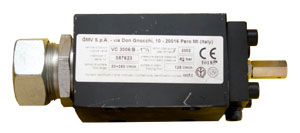
How to regulate a parachute valve
In the GMV parachute valve (VC) manual there are two ways to regulate the VC, but in practice the most useful way is to regulate the VC according to the flow rate of the plant, depending on the type or size of the VC and the number of turns of the screw.
We will explain this last method as an example.
Table for regulating the parachute valve

We take as an example the one indicated in blue in the table above:
To regulate a 1”1/4 VC valve to 125 l/min. the following steps would be carried out:
1) Close the adjustment screw (located in the center of the face opposite the hose connection) completely, until it stops, without tightening it.
2) Open the adjusting screw 7 ¼ turns.
The VC would be calibrated for a flow rate of 125 l/min. After adjusting the VC, it is advisable to check the correct operation of the valve.
Testing the parachute valve
To test the VC, the most unfavorable case must be simulated, a hose break or an uncontrolled speed or free fall. To do this, the following steps must be followed:
- Send the cabin to the top floor.
- Put the group into VC test mode.
- Group 3010: Close screw #5 (located on the side of the VRFP valve) completely.
- NGV Group A3: Activate menu 9.2 on the programming console.
- Send the cabin down one floor. In test mode, overspeed is achieved, which will activate the VC.
Note: The test must be carried out at full load as indicated by the current regulations EN 81.2 A3 Annex D section R and EN 81.20 section 6.3.8 which will come into force in August 2017.
For further information, you can consult the manual for the parachute valve included in all the VC's supplied by GMV or on our website: http://www.gmveurolift.es


4 Responses
thanks for the information
greetings
Hello, I have a hydraulic elevator and I have the problem that when it is cold, it goes to the ground floor.
«Hi Pablo, from what you've told us it could be a group adjustment issue, but to find out we need more data from the installation. Our technical department will contact you shortly to further define what the problem is»
Thank you very much for the information, I needed to know how the test was performed, it was great and everything was very well explained.