Other safety devices used in heavy load installations are:
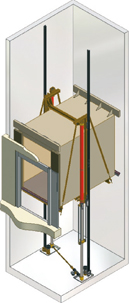
Limit switches: Limit switches must be installed at the upper and lower ends of the forklift's travel. It is also important to install another limit switch at the top of the structure so that it cuts off the power supply if, due to a fault, the forklift were to exceed the upper limit switch.
The forklift must be protected with a roof and side walls so that transported materials cannot protrude and there is no risk of materials falling.
Access doors : They must be equipped with a device that prevents the forklift from being started until they are fully closed. They must also have a clearly visible sign prohibiting the use of the forklift for transporting people.
In the following video you can see some of the safety devices we have discussed (installation of a 4-piston mechanically synchronized forklift).
Source: Text based on an article from Construpedia (construmatica.com)
We are Mechanical Engineering students and we have decided to carry out a hydraulic car lift as our Final Degree Project. The fact is that we are starting from a car lift that already exists on the market and we would like to be able to certify it in order to be able to lift people. We have been carrying out an exhaustive search for information but, as it seems, this subject is still a bit ambiguous, since it is neither a freight elevator nor an elevator, but a car lift with a person on board.
We have the UNE-EN 81-2 and 81-3 regulations regarding hydraulic lifts and the UNE-EN 81-31 regulations regarding forklifts for the transport of goods only. As we have said, people get on board our car lift and we do not know exactly which regulations to follow. Do you know any specific regulations for this type of installation?
So, in broad terms, we have deduced that the working speed must be moderated, the platform protected with side walls and safety mechanisms increased, but of course, we do not know to what level.
The car lift we are trying to certify is the following:
When several regulations affect an installation/machine, the most restrictive regulation must always be complied with. In the case you are mentioning, it is mandatory that the installation complies with the Machinery Directive 2006/42/EC or Directive 95/16/EC. – You must use Directive 2006/42/EC if your installation does not exceed 0.15 m/s. – If the installation exceeds 0.15 m/s you must apply Directive 95/16/EC. Both directives refer to installations for the vertical movement of people or loads. You can also follow the harmonized standard that you mentioned, UNE EN 81.2, which also refers to the movement of loads and people. For the movement of people, you cannot use a standard that refers only to the movement of loads because the health and safety standards are neither adequate nor sufficient for the movement of people.
We hope we have been able to help you. Remember that every two weeks we publish new articles, and the next ones may solve some other doubts for you.





3 Responses
Hi, we are Marc and David.
We are Mechanical Engineering students and we have decided to carry out a hydraulic car lift as our Final Degree Project. The fact is that we are starting from a car lift that already exists on the market and we would like to be able to certify it in order to be able to lift people. We have been carrying out an exhaustive search for information but, as it seems, this subject is still a bit ambiguous, since it is neither a freight elevator nor an elevator, but a car lift with a person on board.
We have the UNE-EN 81-2 and 81-3 regulations regarding hydraulic lifts and the UNE-EN 81-31 regulations regarding forklifts for the transport of goods only. As we have said, people get on board our car lift and we do not know exactly which regulations to follow. Do you know any specific regulations for this type of installation?
So, in broad terms, we have deduced that the working speed must be moderated, the platform protected with side walls and safety mechanisms increased, but of course, we do not know to what level.
The car lift we are trying to certify is the following:
http://www.elevadorslazaro.com/fot-plataformas/plataforma-montacoches.jpg
http://images04.olx.com.co/ui/5/61/41/1269400885_82546041_1-Fotos-de–ASCENSORES-MONTACOCHES-RAMPAS-DE-PARQUEADERO-ELEVADORES-MINUSVAIDS.jpg
Finally, I would like to congratulate you on your website and THANK YOU, as it has clarified many of our doubts and has been of great help to us.
Good morning Marc and David,
When several regulations affect an installation/machine, the most restrictive regulation must always be complied with.
In the case you are mentioning, it is mandatory that the installation complies with the Machinery Directive 2006/42/EC or Directive 95/16/EC.
– You must use Directive 2006/42/EC if your installation does not exceed 0.15 m/s.
– If the installation exceeds 0.15 m/s you must apply Directive 95/16/EC.
Both directives refer to installations for the vertical movement of people or loads.
You can also follow the harmonized standard that you mentioned, UNE EN 81.2, which also refers to the movement of loads and people.
For the movement of people, you cannot use a standard that refers only to the movement of loads because the health and safety standards are neither adequate nor sufficient for the movement of people.
We hope we have been able to help you. Remember that every two weeks we publish new articles, and the next ones may solve some other doubts for you.
Thank you for following us.
Greetings!