This new trend directly favours hydraulic lifts , positioned in facilities with up to 10 stops, since, by concept, in addition to offering solutions for new construction, they are specialised to act both in rehabilitations and modernisations . Among their advantages are the cost of installation and maintenance that take care of the design and functionality of the building. It should be said that, in terms of consumption, this does not generate much more than an electric lift given that the hydraulic lift only consumes when going up (gravity acts when going down) while electric lifts do so both when going up and down.
The space required to install a hydraulic elevator is optimal in this type of building for various reasons:
- The use of pistons and cabinet-based control units allows for space to be optimised without limiting the installation of the lift, as the control unit can be located inside a cabinet anywhere in the building (within a radius of approximately 20 m). As it does not require a counterweight and thanks to the reduced dimensions of the piston, the cabin gains in size without taking up additional space.
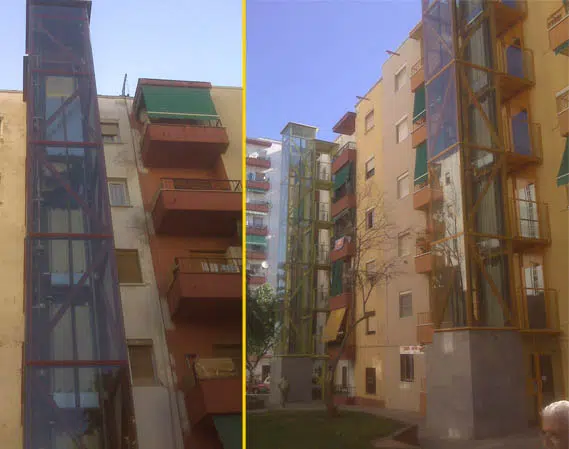
- Hydraulic lifts do not require load-bearing walls: if a concrete shaft has to be created, it is not necessary to build a concrete formwork cube, but a simple solid brick wall is more than enough. Where it is not possible to create such a shaft, the option is to attach a lightweight self-supporting metal structure to the building (see image). This translates into lower installation costs.
- Technological advances allow the installation of hydraulic lifts in historic buildings where there is a power limitation in the connections, since electronic valves have managed to reduce the power of this system. On the other hand, in old buildings where the structure itself cannot withstand the forces generated by an electric motor, hydraulics appears to be the most optimal solution in the rehabilitation process.
The fact that it does not require load-bearing walls or counterweights, nor does it take up additional space, implies a significant reduction in the installation and maintenance cost of any hydraulic elevator as well as a significant optimization of space.
Related Post: Installing an elevator when there isn't one: Rehabilitation




12 Responses
I wanted to know the approximate size of the hydraulic power plant (motor and hydraulic pump).
thank you so much
Good morning Graciana,
The dimensions of a hydraulic power station vary depending on the type of installation. For example, in a single-family home we would find one of the smallest power stations. If we are talking about special installations (forklifts, car lifts or stretcher lifts) we would find the largest power stations: the measurements range approximately between 400 and 700 mm wide. Between these two extremes there is a wide variety of power stations that, depending on the type of building, require a tank of greater or lesser capacity that determines its size.
As regards the hydraulic pump, it will always be found inside the tank of the power plant, whereas the motor can be located either inside or outside the power plant. The location of the motor will only affect the height of the power plant.
We hope we have answered your questions! Best regards!
In a quick and vague answer, you can say that it occupies 1 cubic meter.
Dear Sirs,
I would like to receive information about elevator maintenance
hydraulic verticals.
attentively,
Eng. Manuel Velez V
Good morning Manuel,
On our website ( http://www.gmveurolift.es ) you will find a section (SAT) dedicated solely to the maintenance of hydraulic equipment with very useful information. Several articles related to maintenance to improve the performance of hydraulic lifts have also been published on the blog.
Related blog posts:
– Maintenance of a hydraulic elevator: recommendations
– How can we extend the life of hydraulic equipment and improve its performance?
– Hydraulic fluid and reservoir maintenance
– Overall cost of an elevator: installation, maintenance and consumption
– Advantages of installing a hydraulic lift
You can also consult “The general inspection table” , a document on the periodic inspections that must be carried out on hydraulic equipment.
If you wish to receive more information, do not hesitate to contact us through the blog , website or at 902 34 52 34.
Greetings,