
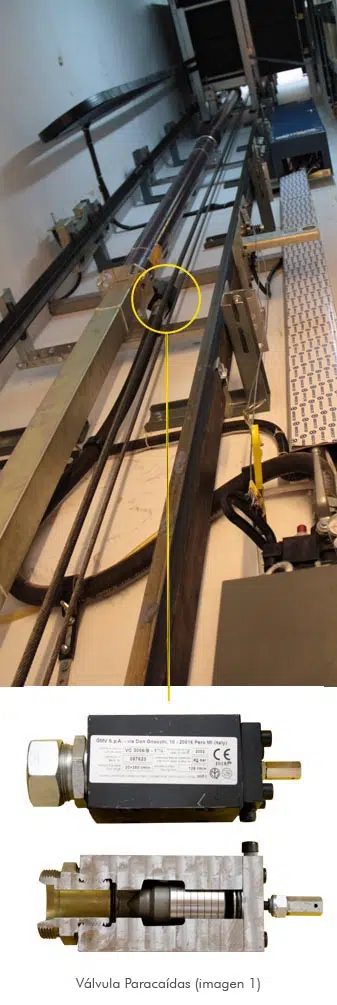
It is located at the piston oil inlet (see image 1), which can be either upper or lower depending on the location of the hydraulic unit . Its function is to cut off the fluid flow when the speed of the cabin is excessive when descending due to a break in the line. It is a valve that works autonomously, since it is completely independent of the valve group . In the hydraulic system, it is a safety measure required by Regulation EN 81.2, section 12.5.5, and therefore all parachute valves on the market must have CE approval.
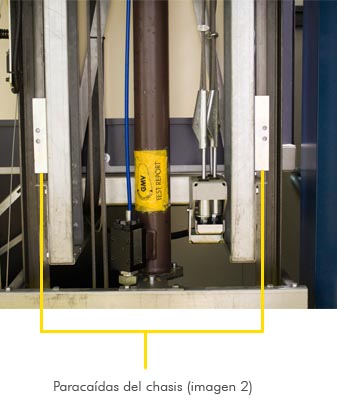
Element located on the chassis (see image 2). Its function is to prevent the movement of the cabin when the cables break or loosen. The parachute moves rollers that exert pressure against the guide and prevent its movement. It is also a mandatory safety measure according to EN 81.2, sections 9.8 and 9.10.3, and therefore must have the CE marking. The chassis parachute is a device that must be present in hydraulic and electric lifts .
Limit switch (EN 81.2, 10.5.3)
At the top of the guides there is an electrical contact that activates the cabin when it exceeds the level of the last stop. This is another mandatory safety element according to Regulation En 81.2, section 10.5.3. This system is also mandatory in electrical systems.
Continued in Safety measures for a hydraulic elevator (II)
Related posts:




32 Responses
CONGRATULATIONS FOR THE EXCELLENT INFORMATION YOU GIVE US. I WOULD LIKE TO KNOW HOW MUCH DIFFERENCE THERE IS IN PRICES. IN YOUR INSTALLATION IT IS RECOMMENDED FOR A 5-STOREY BUILDING. THE USE IS TO CARRY STRETCHERS SINCE THEY ARE FOR MEDICAL OFFICES. THANK YOU.
Good morning Rafael,
Thank you very much for your comment!
Regarding your query, we need to have the exact installation data (distance, load, speed, etc.) in order to make a calculation and know the price. You can provide us with the data by calling us at +34 902 34 52 34 or, if you prefer, you can send us an email to comunicación@es.gmvgrupo.com.
All the best!
I need to know if any law, decree or technical provision has been passed that modifies the maintenance work on elevators, specifically the elevator pit.
A worker refuses to clean the ditch, because according to him a law has been passed that requires shoring it up.
If anyone knowledgeable in the matter has information and can help me, I would appreciate it in advance.
Thank you
Good morning Monica,
Maintenance work in the pit at European level is stipulated in the EN81 Standard, which dictates the safety components necessary for the installation, inspection and maintenance of the elevator. The elevator manual must also include the correct way to carry out maintenance on all the elevator components.
With reference to access to the pit for maintenance work, in an elevator there must be different safety systems that allow safe access to the pit to carry out maintenance work, such as: pit lighting, stop system that causes the control panel to stop the operation of the elevator, stairs for access to the pit, etc.
There are also mechanical systems installed in the elevator that allow the cabin to be safely blocked so that it cannot move. In installations where the pit does not meet the minimum dimensions, mechanical blocking systems must be installed to prevent the cabin from descending, and thus allow maintenance to be carried out safely.
All this information must be included in the installation and maintenance manual of the elevator itself, since each manufacturer uses, designs and certifies the appropriate safety systems for its products.
In principle, we are not aware of any national law that indicates other ways of carrying out maintenance work.
We hope we have helped you!
Greetings,
Regarding Monica's question, I can tell you that in my city, Buenos Aires, since 1996 there has been a regulation that, among other maintenance obligations, requires cleaning of the pits on a monthly basis. This task does not present any risks for the personnel who carry it out, since there are also mandatory safety devices that prevent the operation of the installation while it is being carried out.
I congratulate you on the blog, I loved the philosophy of the dynamic. Thanks, Carlos.
Thanks for your comment Carlos!
sqlordial nodes
In my country there is a lack of hydraulic lift equipment
Most are electromechanical
I would like to know if you offer training courses on the installation of hydraulic elevators and how long they last. Sincerely.
alberto
country peru
Good morning Alberto,
First of all, thank you very much for your interest in our brand! We will respond directly to your email.
Kind regards.
Good afternoon, I would greatly appreciate it if you could clarify my doubt:
I understand that a lift must be equipped with certain safety components, including a safety gear. Considering a mixed hydraulic lift (for people and cargo), what type of safety gear should I use? Is there a recommended supplier? My problem is that all the safety gears I know of are actuated by a speed limiter system, but I consider that there is no way to install such a speed limiter on a hydraulic lifting system.
Would you consider a parachute valve and energy accumulation shock absorbers in the pit to be sufficient safety components for such an elevator? Considering also that the elevator will rise up to a maximum of 6 meters and at speeds less than 0.3 m/s
Good morning,
First of all, we would like to thank you for contacting us with your questions. We will respond to your comments as soon as possible:
In Europe, this type of parachute is common due to cable breakage; any chassis manufacturer uses this system, for example Technolift.
In all chassis, it is usual to use T-shaped guides, the C-shaped guide is an obsolete system.
According to European regulations, if people travel in it, it is considered an elevator.
If we use a differential system, traction by cables and a piston that pushes a pulley, a parachute system in the cabin is necessary to prevent the cables from breaking + a parachute valve in the piston to prevent the line from breaking.
Another solution to avoid using cables is to create a direct pull hydraulic system using a telescopic piston, which means that only a parachute valve is necessary.
Bibliography: Vertical Transport, Author: Antoni Miravete Publisher: Reverte
If you have any other questions, please feel free to contact us,
Greetings,
Please request information or some bibliography regarding the cable loosening parachute system.
On the other hand, does this system depend on the type of guides? Or could it be used with any type of guide (example: C profile)?
Good morning,
First of all, we would like to thank you for contacting us with your questions. We will respond to your comments as soon as possible:
In Europe, this type of parachute is common due to cable breakage; any chassis manufacturer uses this system, for example Technolift.
In all chassis, it is usual to use T-shaped guides, the C-shaped guide is an obsolete system.
According to European regulations, if people travel in it, it is considered an elevator.
If we use a differential system, traction by cables and a piston that pushes a pulley, a parachute system in the cabin is necessary to prevent the cables from breaking + a parachute valve in the piston to prevent the line from breaking.
Another solution to avoid using cables is to create a direct pull hydraulic system using a telescopic piston, which means that only a parachute valve is necessary.
Bibliography: Vertical Transport, Author: Antoni Miravete Publisher: Reverte
If you have any other questions, please feel free to contact us,
Greetings,
Thank you very much for the answer
Hello, I have a question. In our building there is a hydraulic elevator that is 20-025 years old. The other day the power went out and my mother was locked in and had to wait 20 minutes to be taken out. Is there a battery-operated system or something similar that, when the building loses power, the elevator goes down to the floor immediately next to the one where it was stopped and opens the doors? Is there anything I can recommend to the consortium?
Thank you very much in advance
Thank you very much for your question Gerardo,
The system you are referring to is the emergency valve. In hydraulic elevators that have this emergency valve, in the event of a power outage, the cabin descends to the floor immediately below and once there, it opens the doors, preventing the passenger from being trapped.
Without electricity, the cabin doors do not work, so the emergency valve is not enough. We would need a door operator with a power supply at the same voltage as the valve.
emergency.
Thank you for your comment Jose, Indeed, the battery is also necessary to open the door operator without power. This is an optional feature that is recommended for all hydraulic elevators.