Article updated: 14-10-2026
Summary:
Hydraulic elevators are among the most reliable lifting systems because they have no traction cables or counterweight, and concentrate heavy loads in the pit, reducing installation risks at height and allowing maintenance at ground level. In the event of a power outage or fire, they descend by gravity to the lower floor with a 12V or 24V battery and open doors without external help, and manual rescue with a lever, emergency button or pump by hand can be done by the building's own staff. They have a parachute, overpressure and non-return valve, downhill speed limitation and a chain of safety contacts, and must pass inspections of one OCA every 2, 4 or 6 years depending on the type of building (ITC AEM 1, RD 355/2024) in addition to monthly maintenance. Your ally for buildings that prioritize safety, with simple rescues, redundant mechanical protection, and regulatory compliance.
Choosing a lifting system in a residential or commercial building involves analyzing technical, economic and, above all, safety variables. Often, all elevators are placed on the same technical level. However, the physics and engineering behind a hydraulic elevator are different from those of electrical equipment.
In this article we analyze the security standards of the hydraulic elevators, its behavior in emergencies, its mechanical protection devices and the current regulatory framework in Spain.
Are hydraulic elevators safe?
The Hydraulic elevators are one of the most reliable vertical transport systems on the market. Its operating principle is based on the transmission of pressure through a driving fluid (hydraulic oil) that moves a piston to raise the cabin. To descend, the system gradually opens a valve that allows the controlled return of the fluid to the tank, taking advantage of the force of gravity.
Lacking traction cables subjected to constant wear due to friction and not requiring a counterweight suspended over the gap, The probability of mechanical failures is considerably reduced. If you want to delve deeper into the basic operation of this system, you can consult our article on hydraulic system: its basic idea.
Safety during installation and maintenance
The lifecycle of an elevator involves more than just end users; the safety of the technicians who install and maintain the infrastructure is one of the most important design factors
Advantages of low-rise mounting compared to electric elevators
In a conventional electric elevator, the traction motor and the heavier elements are located at the top of the shaft (or in a machine room above the deck), and the counterweight must be suspended along the entire height of the structure. This requires heavy work to be carried out at height during the installation phase.
On the contrary, The hydraulic elevator distributes the heavy loads directly onto the pit floor. The tractor unit (hydraulic power plant and fluid reservoir) is usually installed on the ground floor or on a lower level. This eliminates the need to maneuver large tonnage elements at the top of the gap during assembly, directly reducing the risk of falls at different levels and impacts from falling objects.
Ground level maintenance: lower risk for the technician
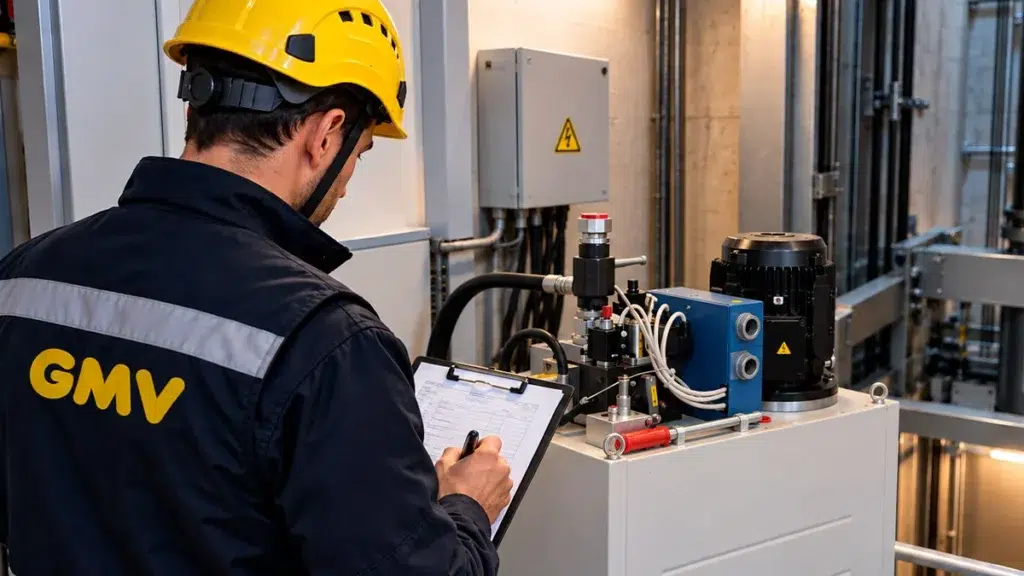
During maintenance work, whether routine or corrective, Technicians access the hydraulic power plant more frequently than the shaft itself. Since the power plant is located in an accessible space on the ground floor or pit, the tasks of checking pressure, adjusting valves and changing fluid are carried out from a comfortable and firm position at ground level.
To better understand the preventive work routine, you can consult our tips for it maintenance of a hydraulic elevator.
Emergency evacuation: how to free a passenger
Getting stuck in an elevator is one of the most uncomfortable situations for users. In the event of a power outage or breakdown, the rescue mechanism of a hydraulic elevator is noticeably more direct than that of electrical equipment. For more details on how to prevent and manage these emergencies, you can check out our article on qué do to avoid getting stuck in an elevator.
Power outage:
| With automatic rescue battery | No automatic rescue battery (manual) |
|---|---|
| Electromagnetic opening of the down valve | Manual operation of the emergency pulse |
| Descent by gavity at reduced speed | Controlled descent at slow speed |
Note: In both cases the cabin goes down to the lower floor with automatic door opening.
The manual pump integrated into the power plant
The hydraulic power plant has one hand pump mechanically integrated. In the event that the cabin becomes stuck above floor level or a specific movement without electrical power is required, the hand pump allows the elevator to be raised or positioned manually using a simple lever operation without excessive effort.
Gravity descent with emergency battery
To descend, the hydraulic elevator It does not require work from the electric motor; Simply open the down solenoid valve so that the fluid returns to the tank driven by the weight of the cabin itself.
Modern systems incorporate a small emergency battery (12V or 24V). If the main supply is interrupted, the battery powers the solenoid valve and emergency lighting system, causing the cabin to automatically descend to the lower floor, level and open the doors without human intervention.
Procedure that can be performed by non-specialized personnel
Releasing a passenger in an electric elevator is a complex task as it requires climbing to the top of the building, manually removing the brake, and controlling the engine's movement so that the cabin doesn't go down too quickly.
Instead, in a hydraulic elevator The process is much simpler and safer. Since the machinery is downstairs, Simply operate a lever to manually unlock the cabin or an emergency button to lower it to the next floor in the central office located on the ground floor. The elevator lets the oil out very slowly and the cabin gently descends under its own weight to the lower floor. Because it is such a controlled movement and without the risk of sudden falls, this maneuver can be performed by the building staff themselves or a family member in a single-family home.
Safety in case of power outage
A fault in the electrical network interrupts the operation of any appliance or lifting equipment. However, the behavior of the hydraulic elevator is noticeably more predictable in the event of this eventuality.
When the cut occurs, The system immediately locks the valves by spring pressure, keeping the cabin firmly in position. If the outage continues, the automatic rescue system or manual operation evacuates passengers to the lower floor in a few minutes. More information about this maneuver can be found in our article on the rescue in a hydraulic elevator due to power outage.
Safety in case of fire
In fire situations inside a building, conventional elevators are immediately taken out of service to prevent the cabin from being stopped on the floor affected by the fire or the opening from acting as a smoke chimney.
Hydraulic vs. electric elevator behavior in the event of a fire
In a electric elevator, if the fire destroys the main power supply while the cabin is in transit, it is immobilized at the exact point of the trajectory.
In this sense, the hydraulic elevator It presents a great advantage. The gravity evacuation maneuver does not depend on the high voltage network. If the building's fire protection system detects smoke or fire, the elevator automatically descends to the main floor (usually the ground floor), opens the doors for occupants to leave safely, and once empty, turns off with the doors closed to prevent smoke from spreading to the other floors.
Firefighter maneuver: regulatory requirements
European regulations EN 81-72 (elevators for firefighters) and EN 81-73 (behavior of elevators in the event of fire) establish direct return protocols. Hydraulic control panels integrate priority inlets that return the unit to street level in the event of any fire or smoke alert in the pit or engine room.
If you want to learn firsthand how emergency services handle these types of situations, you can read our interview with a team of firefighters on the blog.
Hydraulic circuit safety devices
The hydraulic circuit has a series of mechanical and hydraulic elements designed to act autonomously in the event of any pressure or flow anomaly.
| Safety device | Main function | Mode of action |
|---|---|---|
| Parachute valve | Prevents free fall due to conduction breakage | Instant mechanical closure due to excess flow |
| Overpressure valve | Protects the circuit against overloads | Fluid diversion to the tank upon exceeding the maximum pressure |
| Anti-return valve | Prevents unwanted descent of the cabin | Mechanical blocking of flow in the reverse direction |
| Speed limiter | Keeps download speed within safe margins | Progressive regulation of return flow |
Parachute valve
The parachute valve It attaches directly to the fluid inlet of the hydraulic cylinder. If the hose or feed pipe were to break, the sudden increase in fluid velocity causes the valve plug to mechanically seal by pressure in milliseconds. This blocks the oil inside the cylinder and stops the cabin on the spot, without relying on sensors or electrical current.
Overpressure valve
It is a relief device calibrated to a maximum working pressure. If an attempt is made to load the cabin with a weight greater than permitted, the circuit pressure opens this valve, diverting the oil back to the tank. The elevator will not lift the load, protecting the mechanical components and structure from dangerous stresses.
You can find more information about the mandatory rules to avoid overload by reading on our blog the Article 6 of the new ITC.
Non-return valve: why the cabin doesn't go down alone
One of the most frequent questions is whether the cabin can «go down» progressively due to the weight. The non-return valve will keep the oil column locked inside the piston until an explicit electrical command to open is received. If the pump is not working and the down solenoid valve is closed, the fluid cannot return to the tank, guaranteeing the immobility of the cabin.
Downhill speed limitation
The valve group mechanically limits the maximum speed at which fluid can exit the cylinder into the reservoir during descent. Even if the user activates emergency manual descent, the speed remains limited to safe ranges.
Electrical safety: safety chain and control devices
As in any modern elevator, the mechanical part is supervised by a chain of electrical safety contacts in series.
If any of these contacts open, the maneuver cuts off power to the solenoid valves and motor unit immediately:
- Landing and cabin door contacts: They prevent movement if the doors are not closed and mechanically locked.
- Race finals: Emergency stop sensors that prevent the piston from exceeding the maximum travel at the top or bottom.
- Security pressure switch: Controls the circuit pressure. To understand how it works in detail, read our specialized article on what the pressure switch is and how it works.
- Engine thermal probe: Monitors the temperature of the oil and the engine submerged in the hydraulic plant to prevent overheating during intensive use.
Mandatory periodic inspections according to ITC AEM 1 (RD 355/2024)
In Spain, the entry into force of Royal Decree 355/2024 approves the new Complementary Technical Instruction ITC AEM 1 «Elevators», which regulates the maintenance, inspections and commissioning of these devices. To obtain more information about this regulatory framework, you can review the latest developments in the ITC regulations for elevators.
Mandatory periodic inspections must be carried out by Authorized Control Bodies (OCA) independent of the maintaining company, with the following frequencies depending on the type of property:
| Time | Where it applies |
|---|---|
| Every 2 years | Industrial buildings and places of public attendance |
| Every 4 years | Buildings with more than 20 homes or more than 4 stops |
| Every 6 years | Other buildings (residential |
During these inspections, the OCA inspector rigorously checks the operation of the parachute valve, the condition of the fluid, the door interlocks, the wedging in case of indirect systems and the automatic rescue devices.
Frequently asked questions about safety in hydraulic elevators
Can a hydraulic elevator fall?
No. The presence of the parachute valve directly coupled to the cylinder prevents any uncontrolled descent, even in the event of a sudden break in the main hose. In indirect impulse systems (with cables and pulleys), the elevator also equips a mechanical parachute system on the chassis identical to that of electric elevators.
What happens if the hydraulic pipe breaks?
The moment the pipe suffers a massive leak or rupture, the increase in the speed of oil flow instantly activates the differential pressure parachute valve, blocking fluid in the cylinder and stopping the cabin.
Is a hydraulic one safer than an electric one?
Both systems are safe if they comply with European Directives and keep their inspections up to date. However, in terms of evacuation and rescue in case of emergency or network failure, the hydraulic elevator offers a simpler, faster and intrinsically safer rescue procedure for rescue personnel or the users themselves.
How often do you have to check a hydraulic elevator?
Ordinary preventive maintenance by the conservative maintenance company is carried out on a monthly basis (or as stipulated by the regulations for single-family homes). For their part, official OCA inspections They are carried out every 2, 4 or 6 years depending on the type of building.
Bibliography
- Ministry of Industry and Tourism. Royal Decree 355/2024, of April 2, approving the Complementary Technical Instruction ITC AEM 1 “Elevators”. Effective from July 1, 2024.
BOE-A-2024-7258 -
European Parliament and Council of the EU. Directive 2014/33/EU of 26 February 2014 on the harmonisation of the laws of the Member States relating to elevators and safety components for elevators.
Directive 2014/33/EU — EUR-Lex -
AENOR. UNE-EN Standard 81-20:2020: Safety rules for the construction and installation of elevators. Part 20: Elevators for people and people and loads.
File in AENOR store (payment rule):
UNE-EN 81-20:2020 — AENOR Store -
AENOR. UNE-EN Standard 81-73:2021: Safety rules for the construction and installation of elevators. Part 73: Behavior of elevators in case of fire.
File in AENOR store (payment rule):
UNE-EN 81-73:2021 — AENOR Store - GMV Eurolift SA. Technical documentation and maintenance manuals for power plants and hydraulic lifting systems.

Postgraduate in Product management at Eada Business School. Qualification in Project Manager and Community Manager from Cecot. Responsible for Marketing and Communication at GMV Eurolift SAU since 2010.



17 Responses