
Types of elevator shock absorbers
EN 81.1 standard distinguishes 3 classes of shock absorbers:
- Energy storage shock absorbers, which should only be used for lifts with a nominal speed not exceeding 1 m/s.
- Energy storage shock absorbers, with return movement damping, for elevators with a speed not exceeding 1.6 m/s.
- Energy dissipation shock absorbers, which can be used in elevators of any speed.
These shock absorbers must be equipped with an electrical safety device that prevents the elevator from operating until they return to their normal position.
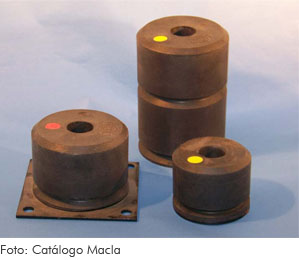
Where are the shock absorbers located in an elevator?
The shock absorbers shall be positioned so that when the car is at its lower stop, the distance between the stop plates at the bottom of the car and the top of the shock absorbers in their normal position (extended) is at least 8 cm for adhesion elevators and 16 cm for winding elevators.
Likewise, when the cabin is at its upper stop, the lower part of the counterweight shock absorbers must be at a distance from the lower part of the counterweight greater than 8 cm for adhesion elevators and 16 cm for winding elevators.
Energy storage or energy dissipation shock absorbers?
Energy storage shock absorbers
The main component of an energy storage shock absorber is a helical spring with circular or square section coils.
It is interesting to use two or three springs in parallel, since the height of the shock absorber in this case is lower than that required for a single spring.
Energy dissipation dampers
Unlike energy-storage dampers, this type of damper can be designed to induce a constant force during the braking maneuver of the load.
Although the construction of an energy dissipation damper is different from that of an accumulation damper, the general principle on which it is based is the same: the damper must be able to convert the kinetic energy of the cabin or counterweight at the instant of impact into heat and potential energy due to a decrease in the height of the damper.
In an energy dissipation shock absorber, when contact is made between the moving body and the shock absorber, the piston begins to descend, forcing the fluid to move from the inner cylinder to the outer cylinder through a number of holes. These decrease in number and size as the piston advances, slowing down the movement and causing the cabin or counterweight to stop in a progressive and smooth manner.
Other safety components can also be mounted on the underside of the cabin frame, such as the Pawl device : a safety device with a mechanical anti-drift system that provides greater safety during loading/unloading operations, always maintaining the cabin-floor level and preventing it from moving downwards during loading. The Pawl Device also acts as an energy dissipation shock absorber. Instead of being installed in the pit , it is located on the frame, performing both the function of a safety device and a shock absorber.
Source: Elevators: Principles and Innovations. Author: A. Miravete, E. Larrodé
Related posts:




One Response