

Article updated: 16-07-2026
Summary:
Steel elevator cables are used in electric traction cables, with drive pulley and counterweight, and in 2:1 indirect impulse hydraulics, where the piston pushes a pulley that doubles the travel. Each cable is constructed with wires that form braided torons on a fiber web (flexible, for residential use) or steel (stronger and more stable, for high height and heavy loads), and the most common designs are the 6×19 Seale, which resists abrasion better, and the 8×19 Warrington-Seale, more flexible and durable with the designation «A × BB diam. C with core D» (torons, wires per core, diameter and core). EN 81-20 and ISO 4344 require safety factors of 10 to 12 and a minimum of 2 independent cables, although the usual number is 3 to 6. They are replaced by broken wires, 6-7% diameter loss, corrosion or deformation, with a typical lifespan of 8 to 12 years in residential use and an extra risk of internal corrosion if the elevator remains stopped for a long time. Your ally in understanding the cables that support your elevator and planning their inspection and replacement in time.
Elevators have become an indispensable element of our daily lives, allowing for the vertical growth of cities and improving accessibility throughout type of buildings. However, very few people stop to think about the mechanical component that makes it possible for them to travel safely between floors. At the heart of the vast majority of lifting systems are steel cables.
In this article, we will explain everything you need to know about these components: what exactly they are, how they are manufactured, what types exist, how their technical codes are read, and what current regulations say about their safety and replacement.
What is a steel elevator cable
A steel cable for an elevator It is a highly engineered component specifically designed to safely lift, hold, and move an elevator car along with all its passengers or payload.
At first glance, it might look like a simple thick metal rope, but its design is extremely complex. Unlike generic cables used in heavy construction, mining, or common cranes, cables intended for elevators They are subject to much stricter manufacturing regulations. They must be able to withstand constant bending motion, sudden emergency braking and continuous rubbing with the motor pulleys, always maintaining an optimal level of flexibility and extreme resistance to breakage.
What type of elevators use steel cables?
The use of steel cables varies depending on the traction technology that moves the elevator. They are mainly divided into two main groups:
- Electric or traction elevators: They are the main users of this component. In these installations, the motor rotates a drive pulley. The cables are placed over the channels of this pulley and move thanks to the friction generated between the metal of the cable and that of the pulley. The cabin hangs at one end of the cables and a counterweight at the other, which balances loads and reduces the energy needed to move the system.
-
Hydraulic elevators indirect impulse ratio (2:1 ratio): Although these elevators move thanks to the pressure of oil pushing a piston, this specific design requires steel cables to operate.
Instead of pushing the cabin directly, the piston pushes a pulley. The cables pass through that pulley and are anchored to the structure, which doubles the travel: for every meter that the piston is stretched, the cabin rises two.
Parts of a steel cable
To understand how a steel cable can support tons of weight without breaking, we must analyze its internal structure. Imagine the cable as a structure of braided layers similar to a Russian doll. From smallest to largest, these are its four fundamental parts:
Wire
It's him fine metal thread and the basic and indivisible piece of the entire assembly. It is manufactured with very high quality carbon steel and undergoes a cold drawing process to increase its hardness. Depending on the type of cable, wires can have different thicknesses and surface treatments (such as galvanizing) to protect them from oxidation.
Toron
It's a thick cord formed by a set of individual wires that are wound helically (spiral) around a common center. The number of wires in a ferret and the way they are arranged determine the mechanical properties of the final cable, such as its flexibility or its resistance to external wear.
Soul
It's him core or central axis of the cable. It functions as the «spine» on which the outer torons are braided and supported. Its main mission is to maintain the round geometry of the cable and serve as a damping support so that the torons do not crush or rub destructively against each other when the cable is under strong load stress.
Cable
It's him final and finished product. It is obtained by braiding several torons helically around the central web. The result of this multiple braiding process is an element that combines in a balanced way the flexibility of the fine threads with the mechanical robustness of the steel block.
Types of cable according to their construction
The way wires of different sizes are combined within each torque defines the type of cable. The most commonly used configurations in the elevator industry are:
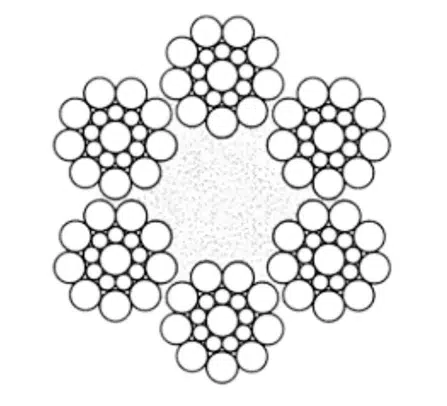
Cable 6×19 Seale
This design It consists of 6 outer torons, and each one has 19 wires. The main feature of the Seale configuration is that the outer layer of the toron uses thicker wires. This gives it excellent resistance to wear from friction (abrasion) against the pulleys, sacrificing some internal flexibility. It is ideal for robust installations at moderate speeds.
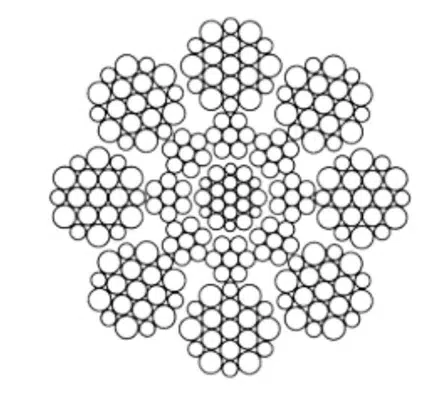
Warrington-Seale 8×19 Cable
This model is a little more complex. By having 8 torons instead of 6, the outer surface of the cable is rounder and more uniform, which better distributes pressure over the pulley grooves. Combine thick wires on the outside with thinner wires on the inside (Warrington). It offers a perfect balance between great flexibility and long service life, being the standard in modern and heavy-duty elevators.
Cable with steel core vs. fiber core
The choice of core material completely changes the behavior of the cable:
- Fiber Soul (FC): It can be made of natural fibers (such as sisal) or synthetic fibers. It acts similarly to a sponge: it absorbs the special factory lubricant and gradually releases it as the cable works, reducing internal friction. It makes the cable very flexible and is the preferred choice for standard residential elevators.
- Soul of Steel (IWRC): The core is another smaller steel cable. It dramatically increases the breaking strength of the assembly and reduces cable stretching over time. It is mandatory in high-rise, high-speed elevators or elevators intended for large tonnage loads.
How to read the designation of a steel cable
In the technical sector, cables are not ordered by trade names, but by standard nomenclature that summarizes their characteristics. The universal criterion follows this structure:
Cable A x BB diam. C con alma D
- A: Indicates the number of outer torons that make up the cable.
- BB: Indicates the number of individual wires inside each of those torons.
- C: It is the nominal external diameter of the cable, always expressed in millimeters (mm).
- D: Specifies the cable core material (whether it is fiber web or steel web).
Practical example: If a technician reads on a maintenance sheet «8 x 19 diam. 9 cable with fiber core«, knows instantly that he has in his hands a cable with a thickness of 9 millimeters, which has a core of natural or synthetic fiber, and which is surrounded by 8 torons that house 19 wires each.
Minimum safety factors according to regulations (EN 81.20, ISO 4344)
Vertical transport is one of the safest means of mobility in the world thanks to very strict international regulations, such as the European standard IN 81-20 or the international one ISO 4344. These laws prohibit calculating cables at the limit of their resistance; on the contrary, they require working with wide reserve margins.
The safety factor It is the mathematical relationship between the minimum breaking load of the cable (the extreme force required to break it) and the actual maximum load to which it will be subjected when the elevator is full of passengers in the worst possible scenario. Depending on the type of pulleys and the traction system, standards require safety factors ranging from 10 to 12. This means that the set of cables installed in the elevator is capable of holding between 10 and 12 times the total weight of the cabin at full load before it physically breaks.
How many cables does an elevator need?
For safety, An elevator can never rely on a single traction cable. If an installation had a single cable and it suffered from a hidden defect, safety would depend entirely on the chassis' emergency mechanical systems (the parachute).
To avoid any risk in suspension, the regulations require a minimum of 2 independent cables for low capacity elevators. However, the usual thing in the residential and commercial market is to find configurations that go from 3 to 6 cables working simultaneously and in parallel. The final number is calculated using engineering formulas that cross the cabin deadweight, payload, safety factor, and selected cable diameter. If one of the cables fails completely, the remaining cables have the ability to support the elevator on their own without problems.
When should an elevator cable be replaced?
Cable wear is a natural process due to daily use. Maintenance companies conduct regular inspections to detect when a cable has reached the end of its useful operational life.
Visible signs of wear
A qualified technician will decree the immediate replacement of the cables if it detects the following visual symptoms:
- Wire breaking: If cut or frayed metal wires appear on the surface of the cable. The rules dictate a maximum permitted number of broken wires per length; if this is exceeded, the cable is discarded.
- Diameter reduction: If the cable measures less than its nominal diameter due to frictional wear or collapse of the internal web. A loss greater than 6% or 7% of the original thickness is usually a reason for replacement.
- Corrosion: The presence of severe rust or red dust (known as «bleed» from the cable) indicates that moisture has destroyed the protection of the steel and the internal lubricant.
- Mechanical deformations: Ripples, crushes, twists or when the outer torons open revealing the soul.
Lifespan according to use and installation
There is no exact expiration date written on a calendar. The actual duration depends on the number of trips the elevator makes per day, the type of building, the alignment of the pulleys, and the quality of maintenance. While in a quiet residential building The cables can perfectly last between 8 and 12 yearsIn a shopping center, hospital, or skyscraper with intensive and continuous use, this period can be significantly reduced.
Risks of an aged cable or one with a long period of inactivity
An old cable It loses its elasticity and its ability to absorb impacts, becoming brittle. On the other hand, if an elevator remains stopped for months or years (for example, on stopped construction sites or seasonal buildings), the lubricating oil in the core dries out. The accumulated ambient humidity attacks hidden internal areas, generating invisible corrosion that weakens the cable from the inside, which poses a serious danger if restarted without a thorough inspection.
Literature
UNE-EN 81-20 Standard: Safety rules for the construction and installation of elevators. Elevators for transporting people and cargo. Official file in AENOR store (payment rule): UNE-EN 81-20:2020 — AENOR Store
ISO 4344 standard: Steel cables for elevators. Minimum requirements for suspension and speed regulator cables. Current edition (3rd ed., December 2022) at ISO.org: ISO 4344:2022 — ISO.org
FEEDA — Spanish Business Federation of Elevators. Technical documentation and inspection criteria. FEEDA official website: feda.es Article on periodic inspection of elevators (with reference to the review of cable condition): Periodic elevator inspection — FEEDA
Elevator World technical article in Spanish Elevator cable inspection: regulations, state of the art and statistics — Elevator World

Postgraduate in Product management at Eada Business School. Qualification in Project Manager and Community Manager from Cecot. Responsible for Marketing and Communication at GMV Eurolift SAU since 2010.



3 Responses
Very good information! The structure of the cable is very important. I always read them, keep it up. Greetings
RAFAEL JIMENEZ SIERRA
CIA: MOREVA TEL: 04455-3242-5983 MEXICO CITY
rafael.moreva@yahoo.com.mx
I HEREBY WANT TO ASK YOU IF YOU SELL 11′′ DIAMETER PULLEYS WITH 4 AND 5 SLOTS FOR 3/8 STEEL CABLE
THEY ASK ME FOR 2 STEEL PULLEYS CODE TPR 1250, THEY ALSO ASK ME FOR A 100 METER ROLL OF 3/8′′ STEEL CABLE WITH A FIBERGLASS CORE THAT WILL BE USED IN THE PULLEYS
PLEASE QUOTE AND SEND THE TECHNICAL SHEET OF THE PULLEYS
IN CASE YOU NEED PHOTOS I HAVE THEM
THANKS
SINCERELY
Hello, I would like to know how long a cable of this type lasts? In my building there is an elevator that has been disabled for more than 25 years, the counterweight has been kept at a height of 5 floors since then. It is a 6-story building that is more than 50 years old. What type of risk does this represent for the building? Is there a possibility that the cables will break? If the counterweight falls, could it cause an implosion of the building?