
Article updated: 14-09-2026
Summary:
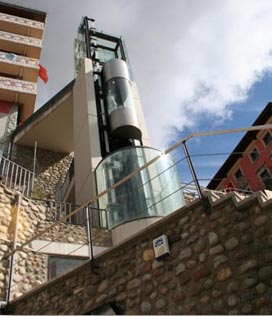
An elevator accessible in public space is the piece that keeps the pedestrian route continuous, and must comply with RDL 1/2013, DB-SUA 9 and UNE-EN 81-70:2022, with leveling at a stop of ±10 mm, maximum strike of 35 mm, 1 m free passage doors and minimum cabin of 1.10 × 1.40 m (1.40 × 1.40 m with two angled doors). Requires handrails at 900 mm, buttons between 0.70 and 1.20 m with Braille, voice and visual signals, magnetic induction loop, a free circle of 1.50 m on boarding and podotactile pavement, with reduced cabins of exception (1.00 × 1.25 m) only if justified with a technical report. The hydraulic system meets the standard just like an electric one and, without a counterweight, makes better use of the gap, levels precisely regardless of the load or temperature and descends only to a lower floor with a battery in the event of a power outage. Your ally for urban projects that need real accessibility, regulatory compliance and maximum reliability.
What is universal accessibility in urbanized public spaces
The Universal accessibility is the condition that environments, products, and services must meet to be understandable, usable, and practical for all people, in conditions of safety, comfort and in the most autonomous way possible.
In urbanized public spaces (streets, squares, parks, walkways and transport stations), accessibility goes beyond overcoming a specific difference in elevation. It involves guaranteeing a continuous accessible pedestrian route, where no element of street furniture or infrastructure poses a bottleneck to citizen autonomy.
A elevator Located on a public road, it is not an isolated element but rather the piece that connects two levels of an urban route. If that piece fails or has barriers inside, the entire accessible route is broken.
Current regulatory framework in Spain
The regulatory framework for accessibility in public elevation has evolved significantly to move from a purely welfare-based approach to one based on fundamental rights.
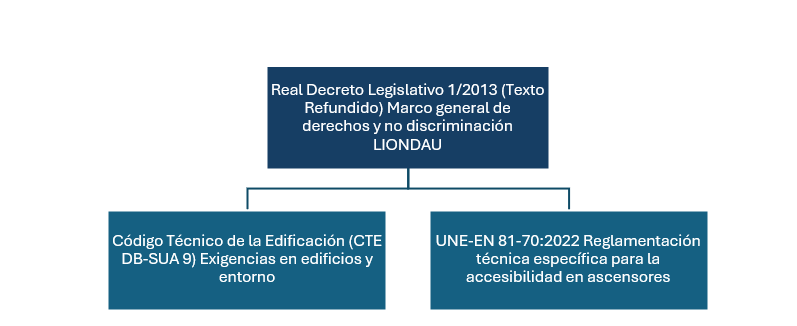
Royal Legislative Decree 1/2013: rights of people with disabilities
The Consolidated Text of the General Law on the rights of persons with disabilities and their social inclusion It unified previous legislation (including the historic LIONDAU). It establishes the legal mandate to guarantee access to public spaces and obliges Administrations and infrastructure owners to make «reasonable adjustments» to eliminate any indirect discrimination.
Technical Building Code — DB-SUA Section 9
The Basic Use Security and Accessibility Document (DB-SUA), in its Section 9 (Accessibility), dIt outlines the operating conditions that buildings and their urban access points must meet. It sets guidelines for sizing accessible routes and connecting public spaces to the lifting network safely.
UNE-EN 81-70:2022: specific accessibility in elevators
It's the technical reference standard throughout Europe for the design and installation of accessible elevators. The revised version UNE-EN 81-70:2022 specifies the minimum cabin dimensions, button strength and arrangement, color contrasts, door opening time and the integration of auditory and tactile signals adapted to functional diversity.
Technical requirements for accessible elevators in public spaces
For a public elevator to be considered regulatory and accessible, it must meet very specific technical specifications in each of its components:
Access without highlighting: the importance of leveling at a standstill
The passage between the floor of the urban space and the interior of the cabin must be completely continuous.
- Vertical highlight: There must be no step or unevenness between both pavements (stop leveling accuracy of ±10 mm).
- Horizontal strike: The separation between the cabin floor and the outer curb cannot exceed 35 mm. This prevents the wheel of a chair, cane or foot from getting caught.
Minimum cabin dimensions according to door configuration
The size of the cabin varies depending on the arrangement of its access points to allow the turning and maneuvering of a wheelchair:
- A single door or two facing doors: Minimum dimensions of 1.10 m wide × 1.40 m deep (capacity for one person in a wheelchair and one companion).
- Two angled doors (90°): Requires a minimum space of 1.40 m × 1.40 m to ensure that the wheelchair can maneuver inside and come out head-on.
Door requirements: opening, transparency and closing sensor
- Free passage width: Minimum 1 m of free light.
- Opening and closing: Automatic, with programmable time setting.
- Visibility: They must include partially transparent panels to allow visual contact between the interior of the cabin and the public road, increasing safety and reducing the feeling of claustrophobia.
- Closing protection: Infrared or photoelectric curtain sensor that covers the entire height of the door to avoid impacts with pedestrians or objects.
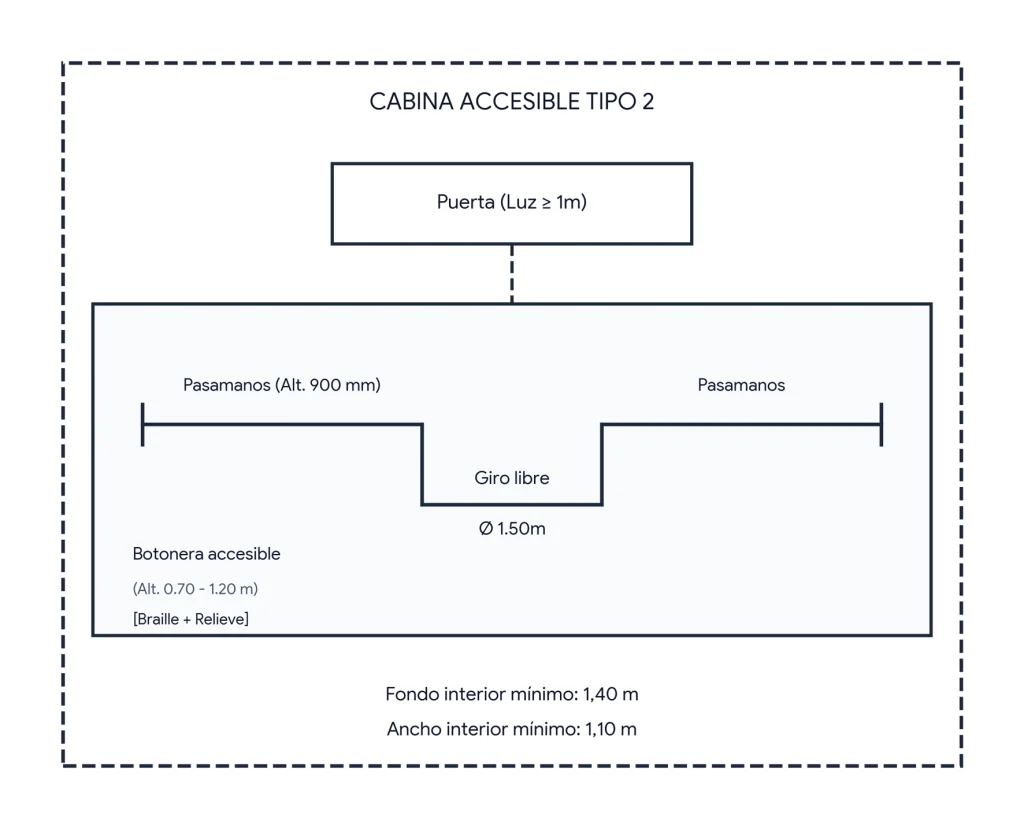
Handrail: position, section and regulatory height
- Location: They are installed on walls where there are no doors.
- Geometry: Round or oval cross section with dimensions between 30 and 45 mm in diameter, free of sharp edges.
- Distance to the wall: Minimum 35 mm separation to ensure a comfortable grip.
- Placement height: The upper edge should be located 900 ± 25 mm from the cabin floor.
Accessible button panel: height, braille and chromatic contrast
- Height of use: All buttons (indoor and outdoor) must be located at a height between 0.70 m and 1.20 m from the ground.
- Tactile signage: Identification in Braille and Arabic characters in relief with color contrast with respect to the plate. The main level or output button (usually «0» or «5» depending on the building) must include a differentiated touch signal (notch or prominent relief).
Sound and visual signaling and magnetic induction loop
- Audible and visual warnings: Acoustic indicator of arrival and direction of travel, accompanied by a clear voice announcing the floor where the cabin stops. High contrast visual displays.
- Hearing accessibility: Provision of a magnetic induction loop integrated into the cabin for people with hearing aids or cochlear implants, guaranteeing clear listening to alarms and emergency intercoms.
Free outdoor space and tactile pavement indicator
The elevator does not start at the door, but in the space around it:
- Boarding areaOn each floor, in front of the elevator, a circle at least 1.50 m in diameter must be able to be inscribed, completely free of obstacles, which does not interfere with the passage of other pedestrians.
- Tactile pavement: Podotactile pavement strips (groove strips transverse to walking) should be installed in front of doors to guide visually impaired people.
Summary table of dimensions and minimum requirements
| Parameter/element | Regulatory requirement (public spaces) |
|---|---|
| Free passage of door | Minimum 1m wide |
| Cabin dimensions (1 door or 2 entrances) | Minimum 1.1m x 1.40cm (Width x Bottom) |
| Cabin dimensions (2 doors at a 90o angle) | Minimum 1.4m x 1.4m |
| Horizontal separation (floor – curb) | Maximum 35mm |
| Leveling at a standstill (vertical) | Accuracy of ±10mm |
| Button panel height | Between 0.7m and 1.2m from the ground |
| Handrail (height/diameter/separation) | Height 900mm / Diameter 30-45mm / Wall gap ≥35mm |
| Free outdoor space (boarding) | Cicle of Ø 1.5m without obstacles |
| Assisted communication devices | Magnetic loop, synthesized vos and Braille/relief signaling |
What happens when the available space does not allow the minimum dimensions to be met?
In established urban environments or historic centers, there is not always the physical space necessary to install a 1.10 × 1.40 m cabin or a standard moat. The regulations provide for this scenario under the principle of «reasonable adjustments«:
- Alternative solutions with supporting report: When it is technically impossible to meet standard dimensions, a technical study must be written that details the impossibility and proposes the maximum achievable accessibility.
- Reduced exceptional dimensions: In interventions on existing infrastructure where the standard dimension is not feasible, the installation of smaller cabins is exceptionally permitted (for example, Type 1 of EN 81-70: 1.00 × 1.25 m), provided that it is justified that there is no other spatial alternative.
- Unique attached structuresVery common on walkways or urban slopes, the solution involves creating self-supporting glass and steel structures on the outside so as not to constrain the interior levels of the elevator.
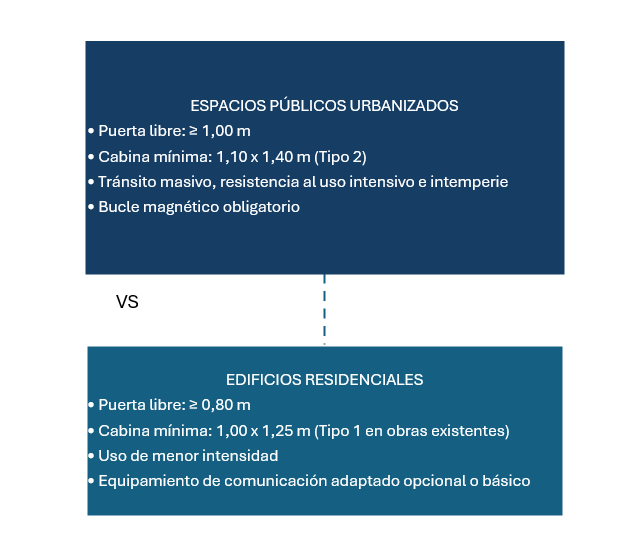
Differences between requirements for public spaces and residential buildings
Although the ultimate goal is always to eliminate barriers, the technical requirements vary significantly between the public and private residential sectors:
- Flow and durability: In public space, machinery must be prepared for continuous traffic, weather and potential acts of vandalism (robust materials, stainless steel, vandal-proof buttons).
- Door width: Public space requires 1 m of passage to allow rapid bidirectional flow or larger wheelchairs (e.g. motorized), while in private residential 0.80 m is frequently allowed.
- Accessory equipmentDevices such as the magnetic loop for deafness or advanced tactile signaling are strictly enforced on public roads, while in residential housing they are conditional on the age of the building or the agreements of the owners' association.
GMV solutions for accessible installations in public spaces
In urban projects where accessibility requirements converge with the need for maximum technical reliability, GMV hydraulic lifting systems offer ideal performance:
- High precision stop leveling: Thanks to the latest generation electronic valve technology, GMV hydraulic systems guarantee, with the leveling, a smooth stop and perfect ground level (zero protrusions), regardless of the installed load or temperature variations.
- Maximum use of gap space: By not requiring a lateral or rear counterweight, hydraulic technology makes it possible to maximize the useful size of the cabin within the same pit gap or structure, facilitating compliance with the regulatory dimensions of the UNE-EN 81-70 standard.
- Safety and rescue in case of electrical failureHydraulic equipment incorporates automatic systems for descending to the lower floor using a battery in case of a cut-off of the urban electricity supply, ensuring that no person is trapped inside.
Frequently asked questions about accessibility in elevators
Is it mandatory to install an accessible elevator in all public spaces?
Yeah. All public works of new construction or redevelopment must integrate accessible pedestrian routes. If to overcome a difference in level it is not technically feasible to build a ramp with a regulatory slope (normally less than 6%), the installation of an accessible elevator is mandatory.
What rule applies if the building or urban infrastructure predates current regulations?
The principle of progressive adaptation applies. Following the approval of the various accessibility regulations and the successive Complementary Technical Instructions (ITC), the Administrations must adapt the existing facilities through «reasonable adjustments» to the dates of renovation or modernization of the elevator.
Can a hydraulic elevator meet the accessibility requirements of UNE-EN 81-70?
Absolutely yes. The UNE-EN 81-70 standard defines the conditions of use, interface, dimensions and comfort for users, independently of the traction system (electric or hydraulic). A hydraulic elevator equipped with the required dimensions, buttons, doors and winding precision meets the standard exactly the same.
What is the difference between an accessible elevator and a stretcher rack?
A stretcher rack It is a special-sized elevator, much deeper (minimum of 1.20 × 2.10 m), specifically designed for the horizontal transfer of medical stretchers in health or care centers.
Bibliography
Royal Legislative Decree 1/2013, of November 29, Consolidated Text of the General Law on the rights of persons with disabilities and their social inclusion. BOE-A-2013-12632
Ministry of Transport, Mobility and Urban Agenda. Technical Building Code — Basic Document DB-SUA: Safety of Use and Accessibility. Official document with all current updates:
CTE DB-SUA — codigotecnico.org Full text in PDF: DB-SUA (PDF) — codigotecnico.org
AENOR. UNE-EN Standard 81-70:2022: Safety rules for the construction and installation of elevators. Accessibility to elevators for people, including people with disabilities.
File in AENOR store (payment rule): UNE-EN 81-70:2022 — AENOR Store
Ministry of Transport, Mobility and Urban Agenda. Order TMA/851/2021, of July 23, which develops the technical document of basic conditions of accessibility and non-discrimination for access and use of urbanized public spaces. Published in BOE no. 187 of August 6, 2021, in force since January 2, 2022. Repeals in full the previous Order VIV/561/2010, of February 1. BOE-A-2021-13488 Consolidated PDF: Order TMA/851/2021 (consolidated PDF)

Postgraduate in Product management at Eada Business School. Qualification in Project Manager and Community Manager from Cecot. Responsible for Marketing and Communication at GMV Eurolift SAU since 2010.


One Response