
Article updated: 07-02-2026
Summary:
Hydromechanics studies the forces on fluids and is divided into hydrostatics (fluids at rest) and hydrodynamics (fluids in motion), where flow goes from high to low pressure zones and, depending on viscosity, density, speed, and surface shape, can be laminar or turbulent. Bernoulli's principle (P + ½ρv² + ρgh = constant) states that if fluid velocity increases, its pressure decreases, which is seen in the Venturi tube, which accelerates the fluid in its narrowing and is used to measure flow rates. Torricelli's theorem indicates that a liquid exits through an orifice at the speed of a free-falling body from the liquid level, and in hydraulic power plants, it allows calculation of the return flow to the reservoir when the piston descends. Your ally for understanding the physics behind a hydraulic elevator and why its operation is so predictable and smooth.
What is hydrodynamics
Hydromechanics is the branch of physics that deals with the forces that act on fluids (liquids and gases). It is divided between hydrodynamics, which studies fluids in motion; and hydrostatics, which studies fluids at rest.
The principles of liquid hydromechanics are applied in the hydraulic system, which deals with water and other liquids at rest or in motion.
Concept of hydrodynamics
A liquid or gas flows from areas of high pressure to areas of low pressure. This happens, for example, when water is squeezed out of a sponge or when a “jet” of water comes out of a hose.
The flow of a fluid it is influenced by viscosity, that is, the resistance that opposes the movement of the fluid. Some fluids flow by capillary action, which depends largely on adhesion and surface tension.
The flow of a fluid or gas can also be laminar (smooth) or turbulent||The nature of the flow depends on: the viscosity and density of the fluid, the speed of movement of the fluid, and of the surface and shape of objects in contact with the fluid||For example, water flows turbulently through the river, but flows laminarly around a boat whose sides are curved and smooth||An object whose shape offers little resistance to the fluidity of a liquid is said to be efficient.
Bernoulli's Principle
The Bernoulli Principle, discovered by the Swiss physicist Daniel Bernoulli (1700-1782), states that the pressure exerted by a liquid flowing through the walls of a tube (for example, a flexible driving or hose) decreases when the velocity of the liquid increases (such as at the outlet of an opening). This Principle explains the «lift» obtained by hydrofoils and winged aircraft.
Bernoulli's equation is: P + ½ρv² + ρgh = constant
Where:
- P = static fluid pressure (Pa)
- ρ (rho) = fluid density (kg/m³)
- v = fluid velocity (m/s)
- g = gravitational acceleration (9.8 m/s²)
- h = height above a reference level (m)
Between two points of the same system it is expressed like this:
P₁ + ½ρv₁² + ρgh₁ = P₂ + ½ρv₂² + ρgh₂
What it states is that the sum of pressure, kinetic energy, and potential energy per unit volume remains constant along a flow line — if velocity increases, pressure drops, and vice versa.
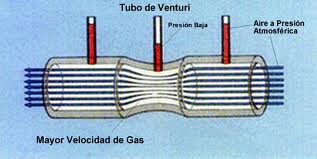
The effect explained by Bernoulli can be produced by sending a fluid through a Venturi tube (a short tube, the diameter of which narrows significantly in a certain section in the center, so that the sections before and after narrowing have a larger diameter).
The velocity of the fluid in the narrow section of the tube is greater and its pressure lower than in the rest of the tube. The Venturi tube is used in various devices, including instruments that measure fluid flow.
Torricelli's Theorem
Torricelli's Theorem, devised by the Italian physicist Evangelista Torricelli (1608-1647), is applicable to incompressible and non-viscous flows and calculates the output flow rate of a liquid through an orifice. «The speed of a liquid in an open vessel, through a hole, is what any body would have, falling freely in a vacuum from the level of the liquid to the center of gravity of the hole«.
In other words, let's imagine a tank full of water with a hole at the bottom. The higher the water level above that hole, the greater the pressure that pushes the fluid out and therefore the greater the exit velocity. If the level drops, the speed also drops.
In the hydraulic elevator plants, this principle allows calculating the flow rate that circulates through the valves and orifices of the circuit. When the piston descends and the fluid returns to the reservoir, the speed of that return depends directly on the difference in height and pressure of the system
Continue in The principles of hydromechanics (II)
Literature
Wikipedia, The Free Encyclopedia. (2025, March 7). Hydrodynamics. Wikimedia Foundation. https://es.wikipedia.org/wiki/Hidrodin%C3%A1mica
University of Salamanca. (sf). Fluid mechanics: Hydrodynamics, forced regime conductions and Bernoulli's Theorem. USAL Teaching Guides. https://guias.usal.es/node/222773

Is the current standard. The cables and relays are replaced by one or more electronic boards integrated with microprocessors, very similar to those of a current computer.



2 Responses