
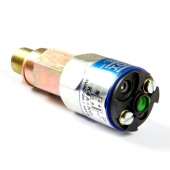
Typically, the GMV pressure switch is adjusted under load, but there may be cases where no weights are available in the installation. For these situations, it may be useful to know the theoretical method for adjusting it without load.
How to regulate a no-load pressure switch to comply with regulations
For a better understanding, we will summarize in a table the most characteristic cases, according to the elevator load and for the speed of 0.62 m/s, in differential draft 2:1
| Load Kg | Piston φ mm | Caudal l/min | Working pressure Atm. | Pressure switch adjustment |
| 300 | 80 | 100 | 32 | 35 |
| 450 | 90 | 125 | 35 | 39 |
| 600 | 100 | 150 | 37 | 41 |
| 1000 | 120 | 210 | 36 | 40 |
Regulation of the pressure switch without load in the cabin
To regulate the pressure switch without load and knowing the pressure to which it should be adjusted, we have 2 ways to simulate the pressure of 35 Atm, for example, in the valve group:
-
Regulation by means of the VS (safety valve).
We check the adjustment of screw 1 and note the value at which the safety valve acts, 40% more than the full load, in this case it should be adjusted to 45 Atm.
We regulate screw no. 1 to a pressure of 35 Atm. With the tap closed, we start the engine so that the pressure remains at 35 Atm. At this point we regulate the pressure switch screw until it activates. When the pressure switch activates, it will mean that it has reached the overload calibration pressure.
-
Regulation by means of the VS (safety valve) of the group's hand pump
We check the adjustment of screw 10 and note its value.
We adjust screw 10 to a pressure of 35 Atm. With the stopcock closed and using the hand pump, we will obtain a pressure of 35 Atm. At this point, we adjust the pressure switch screw until it activates. When the pressure switch activates, it will mean that it has reached the overload set pressure.
Unlike option 1, in this case we will not need to have voltage in the motor.
By regulating one of the two VS to a pressure of 35 Atm. we can adjust the pressure switch to the desired pressure.
IMPORTANT:
Note 1: Once the operation is completed, the screw used must be tightened as it was originally.
Note 2 : This method does not replace the standard regulation carried out with load in the cabin.


