
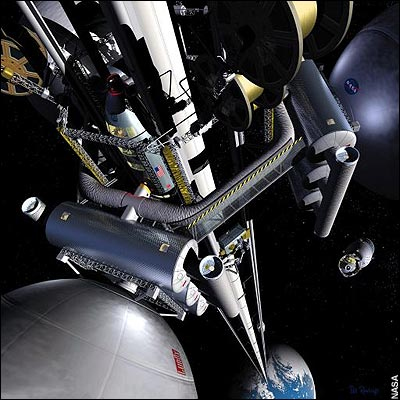
How can it be done?
The idea is this: Satellites orbiting around the Earth in the so-called geostationary orbit, such as communications satellites, maintain their position relative to a specific point on the Earth's surface, over the equator. This means that their angular speed is the same as that of that fixed point. All you have to do is stretch a cable between the point and a space station, and the cable will rotate along its entire length at the same speed: 36,000 kilometers of free path to the sky.
It defies logic, but it is entirely possible. The cable would be suspended as if by magic, supported by the inertia of the station's rotation, and anchored to a maritime platform in the Pacific Ocean. And once there is a cable, all you have to do is climb it, little by little. The result, according to studies by NASA's Flight Projects Directorate, is that people and goods could be put into orbit for less than 8 euros per kilo.
Nanotechnological magic
A few problems, however, stand in the way of the space elevator. The first and most important is how to lay the cable. The most convincing proposal is to launch about 10 rockets laying small cables one next to the other until the resulting cable can withstand the ascent of climbing robots, which drag another 300 cables along it. Three years later, the line would be ready to carry ships weighing up to 20 tons every four days.
Such a cable would also have to be very strong, made from materials that do not occur spontaneously in nature: carbon nanotubes. Developed only in a laboratory, they are light and strong, making them ideal for the project. The problem is that they are still very expensive and only fibres a few millimetres long have been produced.
There are many other challenges, but they all seem surmountable. NASA and scientists have agreed to set a deadline for making this idea a reality: 2020. Fifteen years to continue dreaming of conquering space, at a bargain price.
Source: elpais.com


