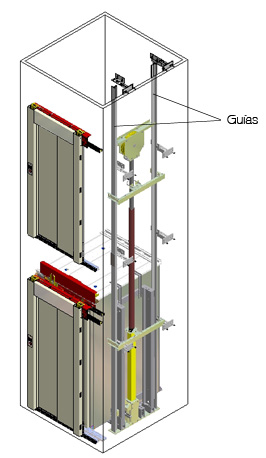
Guides are rigid profiles with a specific section whose mission is to guide the cabin or the balancing mass (counterweight) in hydraulic elevators and electric elevators throughout the entire journey.
The guides were originally made of wood, but nowadays, due to the high performance offered by the elevators, all guides are made of steel, with the quality of the steel varying according to the needs of each installation.
During the manufacture of guides, there are factors that determine their quality as well as their finishes, which must guarantee the proper functioning of the elevator. Factors such as the orthogonality between the core and the angles; the straightness of the bar to reduce distortions and torsion to a minimum; and the roughness of the guide in contact with the slides that guide the cabin or the counterweight, determine the quality of the product and the manufacturer.
How they are made
The guides are normally manufactured in sections of 2.5 or 5 metres to allow for correct handling during installation, where the different sections are joined together to reach the full height required inside the opening . To ensure the correct alignment of the guides, they are designed with a fit that ensures the alignment of the union of all the sections. The different sections are joined together by means of joining plates that ensure that the resistance of the guide is maintained.
The choice of guide type is determined by various factors of the elevator: type of elevator, load to be transported, weight of the cabin and the balancing mass (counterweight, in the case of electric elevators), elevator travel, guide fixing distance and cabin speed.
The number of guides and their position are determined by the type of lift and its dimensions. Thus, we can find from 2 guides placed in parallel in residential buildings to 6 or more in large installations or freight elevators.
Types of guides for a hydraulic elevator
There are two main aspects by which we classify the guides:
Types of guides based on their profile (section)
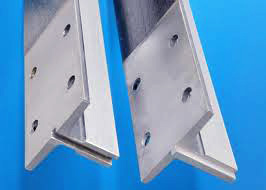
T-PROFILE GUIDE
Currently these profiles are the most used to guide elevator elements||They offer good mechanical resistance thanks to their considerable section||In addition, the contact surface with the chassis parachutes is larger than in other types of guides, and makes it easier to stop the elevator in case of emergency (actuation of the chassis parachute)||On the contrary, these profiles are the least economical to manufacture.
V PROFILE GUIDE
Like T-profiles, these profiles offer good mechanical resistance but due to their inclined faces they are not suitable for the operation of the chassis parachute. For this reason they are not used today.
CIRCULAR SECTION PROFILE GUIDE
These profiles were previously frequently used due to their low cost. However, due to the small contact surface in the action of the parachute wedges on the chassis, the guide showers have fallen into disuse.
Types of guides depending on the surface finish
It is important to determine the roughness of the surface of the guide on which the cabin moves (surface finish), since it directly influences the wear of the skids or guides on which the cabin slides and the behavior of the chassis parachute when it has to stop the cabin. The roughness range is between 3.2 and 6.2 µm. Depending on the type of surface finish, there are two ranges of guides:
CALIBRATED
In these guides, the final surface finish is produced in a calibration process by stretching the material. They are recommended for speeds not exceeding 1 m/s.
BRUSHED
In contrast, the final surface finish of these guides is achieved by a machining process using chip removal, achieving an optimal surface finish. They are used for high-performance elevators with speeds greater than 1 m/s (speeds of up to 20 m/s).
More than two years ago, a new lift was installed in the community. We wanted to change everything, but Thyssen Group insisted on leaving the guides because (after 20 years) they said it wasn't worth changing them. The lift has been making a horrible noise since it was installed, and the company hasn't been able to fix it or give us a solution. What could be causing the noise?
In this situation, we understand that ThyssenKrupp assessed the condition of the guides, as well as their material wear, alignment, etc., in order to advise that it was not necessary to change them, and therefore a financial saving for the community. Even so, the noise you mention may be due to different components that do not have to be directly related to the guides, since there are different factors that can alter the correct operation of an elevator.
From here we can only advise you to contact Thyssenkrupp again to report this claim and try to resolve the situation. Please note that if it is a problem that arises from the origin of the installation, it must be covered by the warranty and by consumer protection laws.
I would need someone to help me with a question I have regarding the guides for a stacker crane that I am designing for my final year project. It is a double-load twin-column stacker crane for Euro pallets and I don't know what type of guides I should use for the lifting cradle. The most logical thing for me would be to use guides on the inside of the columns, but my tutor insists on using rollers that would need guides on the front and back of the columns. I don't know what to do, all the lifting systems seem to work with guides on the inside of the column and I don't know why my teacher insists on not using them.
GMV Eurolift is dedicated to the lifting sector, so I regret to inform you that we cannot advise you on your query regarding wood for guides in mine shafts. In any case, we thank you for taking us into account in trying to resolve your need.
Good morning David, the size of the guides will depend on the installation. A member of our sales department will contact you shortly to advise you. Best regards.





9 Responses
More than two years ago, a new lift was installed in the community. We wanted to change everything, but Thyssen Group insisted on leaving the guides because (after 20 years) they said it wasn't worth changing them. The lift has been making a horrible noise since it was installed, and the company hasn't been able to fix it or give us a solution. What could be causing the noise?
Thank you, Helen.
Good morning Helen,
In this situation, we understand that ThyssenKrupp assessed the condition of the guides, as well as their material wear, alignment, etc., in order to advise that it was not necessary to change them, and therefore a financial saving for the community. Even so, the noise you mention may be due to different components that do not have to be directly related to the guides, since there are different factors that can alter the correct operation of an elevator.
From here we can only advise you to contact Thyssenkrupp again to report this claim and try to resolve the situation. Please note that if it is a problem that arises from the origin of the installation, it must be covered by the warranty and by consumer protection laws.
We hope we have been able to help you.
Greetings!
Good morning,
I would need someone to help me with a question I have regarding the guides for a stacker crane that I am designing for my final year project. It is a double-load twin-column stacker crane for Euro pallets and I don't know what type of guides I should use for the lifting cradle. The most logical thing for me would be to use guides on the inside of the columns, but my tutor insists on using rollers that would need guides on the front and back of the columns. I don't know what to do, all the lifting systems seem to work with guides on the inside of the column and I don't know why my teacher insists on not using them.
Thank you.
Good morning, I would like to ask for your help in finding suppliers of wood for guides in mining shafts.
Or otherwise some proposal with some other material or materials recently used for this purpose within the mining sector.
greetings
Good morning,
GMV Eurolift is dedicated to the lifting sector, so I regret to inform you that we cannot advise you on your query regarding wood for guides in mine shafts. In any case, we thank you for taking us into account in trying to resolve your need.
Greetings,
I see that they answer all the questions, and that is appreciated.
Where can I buy this type of guides and how big is it?
Good morning David, the size of the guides will depend on the installation. A member of our sales department will contact you shortly to advise you. Best regards.