Article updated: 07-13-2026
Summary:
The hydraulic piston transforms oil pressure into thrust and comes in three types: the conventional one-stage piston (direct 1:1 draft, with a piston of the length of the stroke, or indirect 2:1, with a pulley and cables that reduce the piston by half), the telescopic hydraulic synchronization piston (up to 3 stages coordinated by internal valves, with clean aesthetics ideal for panoramic views) and the mechanically synchronized telescopic (up to 4 stages with external chains, designed for forklifts and car lifts). The conventional one is the simplest, most robust and least maintained, but in 1:1 central it requires drilling under the pit, while the retracted telescopic ones fit in the gap without that work and reach about 20-25 m of travel, at the cost of more checkpoints and elements to check. The choice depends on the pit and escape space, viable civil works and load, under UNE-EN 81-20 and ITC AEM 1, and although all require a pit for safety, neither of the two telescopic ones nor the 2:1 require burying the shirt. Your ally to choose the right piston according to the route, pit space and load, without surprises in civil works.
The operation of a hydraulic elevator seems simple at first glance: a fluid pushes a cylinder to raise the car and withdraws to lower it. However, the piston, it has different technological variants and shooting ratios that determine the technical and economic viability of a project.
Whether to install an elevator in one single-family home, a forklift in an industry or modernizing existing equipment, understanding how different types of pistons work is key to making the right decision.
What is a hydraulic piston in an elevator
He hydraulic piston is the component responsible for transforming hydraulic energy into mechanical energy. It receives the pressurized oil sent by the motor pump group and, through this thrust, moves a stem (the moving part) that raises the elevator car.
Unlike electrical cable traction and counterweight systems, the ahydraulic sensor consumes energy mainly on the climb. The descent is done taking advantage of the force of gravity, regulating the opening of the valves so that the oil returns to the tank in a controlled and smooth manner.
Types of pistons for hydraulic lifts
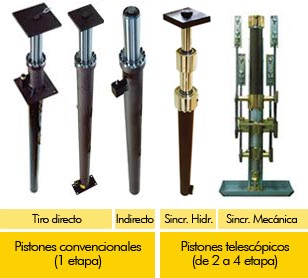
Pistons, also known as cylinders, are basically divided into two categories: conventional (characterized by being single-stage) and telescopic (which have 2 to 4 stages).
On the other hand, the type of traction of conventional pistons is also important; these can be direct traction (1:1) or indirect (2:1).
Conventional single stage piston
The 1-stage pistons (conventional) are designed for installations such as public or residential buildings, single-family homes, chalets, etc. Depending on the type of installation, the route and the load, we will install a direct or indirect draft piston.
It is the most classic and robust model. It consists of a fixed jacket and a single stem emerging from it. Its application changes radically depending on the type of traction used:
- Direct shot (1:1): The piston directly pushes the cabin. In this case, the stem and sleeve must measure the same as the total installation path.
- Indirect shot (2:1): The piston incorporates a pulley and a system of steel cables at its end. This mechanism multiplies the movement by two: for every meter that the stem moves, the cabin moves two meters. Thanks to this, the piston only needs to measure half of the actual travel of the elevator, avoiding having to dig deep into the ground.
Hydraulic synchronization telescopic piston
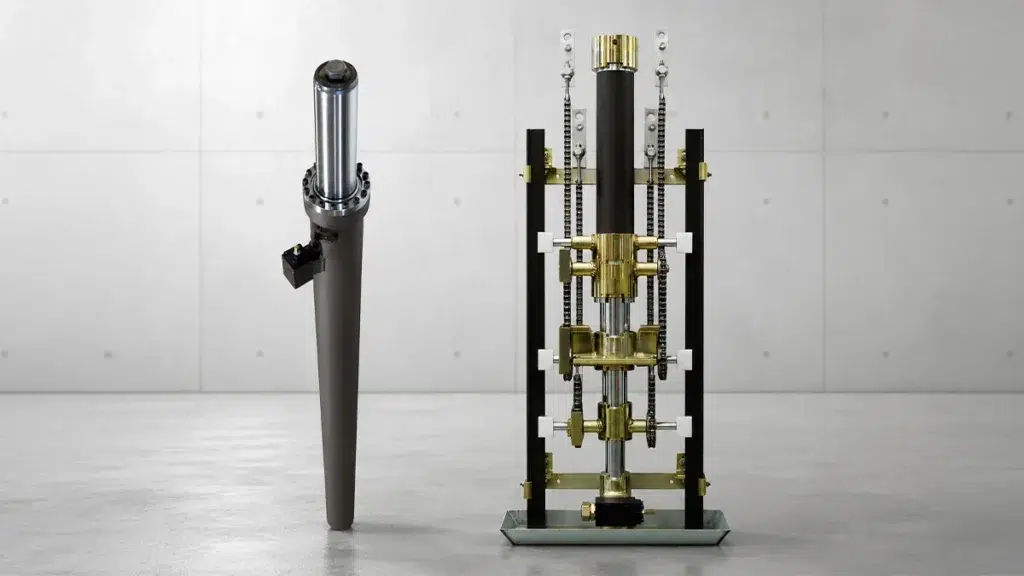
When the travel increases but there is no physical space to house a conventional cylinder, telescopic pistons are used. These cylinders are composed of several stems (stages) that enter one inside the other, similar to a telescope or a selfie stick.
In the telescopic hydraulic synchronization model, the synchronization of the stages is internal. Pressurized oil enters the cylinder and a system of internal valves regulates the passage of the fluid so that all stages deploy and retract at the same time and at the same relative speed as each other. This ensures a smooth ride with no noticeable jerks for passengers.
Telescopic mechanical synchronization piston
Unlike the previous one, this type of telescopic piston use external elements to ensure that the stages move in unison. It has a system of chains fixed to the outer sides of the cylinder.
This design it allows the structure to be extremely resistant to mechanical stress. Its construction is usually inverted (with the stem protruding downwards), which optimizes guidance and force distribution. It is an optimal solution for industrial facilities and heavy vehicles
Technical differences between conventional and telescopic piston
The main difference lies in the construction design and how they manage the space in relation to the total distance that the elevator can reach.
A conventional single-stage piston stands out for its mechanical simplicity. If installed in a direct (1:1) central draft, it requires deep drilling under the elevator pit to house the jacket. However, if mounted in indirect draft (2:1), its size is reduced by half and it becomes a very competitive option that does not require deep drilling in the ground, directly competing in versatility with multi-stage systems.
The telescopic piston breaks height limitations by dividing its body into 2, 3 or even 4 stages. When folded, its total closed length is drastically reduced. This allows considerable travel to be achieved, keeping the cylinder completely within the standard dimensions of the hole and pit, eliminating underground work even in installations where a conventional piston (even at 2:1) would be too long.
Comparative table: conventional vs hydraulic telescopic vs mechanical telescopic
| Feature | Conventional piston | Hydraulic telescopic | Mechanical telescopic |
| Not stages | 1 | up to 3 | up to 4 |
| Length/travel ratio | 1:1 (same size) or 2:1 (half size) | Reduced (according to number of stages) | Very small (minimum closed space) |
| Synchronization system | Not required | Internal (valves) | External (chains) |
| Need for interior drilling | High in 1:1/Null or low in 2:1 | Null | Null |
| Visual aesthetics | Simple and clean | Clean (idea for panoramic views) | Complex (mechanisms in sight) |
| Main application | Single-family homes and low and medium-rise buildings | Residential and commercial buildings | Forklifts, car lifts and large loads |
When to install a telescopic piston instead of a conventional one
The choice is mainly defined by three factors: the free space in the pit, the viability of the civil works and the loading needs.
- Extremely restricted space: When there is no physical space either in the pit or at the top of the hole to house a conventional piston (not even halving its size with a 2:1 system), the telescopic piston is the only viable technical solution because its compacted size is unmatched.
- Transparent panoramic elevators: In shopping malls o hotels where the elevator shaft is visible, the hydraulic telescopic piston offers impeccable aesthetics. When synchronizing inside the cylinder, it has no cables or outer chains that dirty the visual design of the environment.
- Large loads with medium distances: To lift vehicles (car lift) or stretchers in hospitals with multi-story routes, the mechanical telescopic offers the necessary robustness without compromising the building structure with deep excavations that could affect the foundations or water tables.
Installation position: side piston vs center piston
The way the piston is positioned relative to the cabin defines the configuration and efficiency of the gap:
- Central Piston (1:1 Direct): The piston is placed just below the center of the cabin. It offers perfect and balanced vertical thrust, minimizing wear on the scrapers and guides. Its great drawback is that it necessarily requires a gap under the pit identical to the elevator path, so its current use is residual.
- Side Piston (Direct or Indirect): The piston is installed on one side of the gap (or one on each side for large loads).
- In the direct shot, directly push the side chassis.
- In indirect shooting (2:1), the piston incorporates the pulley and cables mentioned above. By doubling the movement, it dramatically optimizes space and avoids having to drill into the ground under the pit in the vast majority of mid-rise residential installations.
Regulations applicable to hydraulic pistons
Any hydraulic component intended for lifting people must strictly comply with the legal framework to ensure safety against falls, overpressures or fluid leaks.
- UNE-EN 81-20: It is the European standard of reference for the design and manufacture of elevators. It dictates the requirements for the mechanical resistance of the cylinder, the calculation of breaking pressures, the guidance of the rods and the protection systems against overspeed on the way down or uncontrolled movements of the cabin.
- ITC AEM 1: Refers to the Complementary Technical Instruction of the Regulation of Lifting and Handling Devices in Spain. Regulates maintenance, mandatory periodic inspections and structural modifications of elevators, ensuring that hydraulic systems maintain their original safety levels throughout their useful life.
Frequently Asked Questions
What maximum travel does a telescopic piston allow?
Hydraulically synchronized telescopic pistons usually optimally reach up to 25 meters of travel (about 8 floors). Mechanical chain models can reach up to 20-25 meters in height in specific industrial applications.
Is a pit necessary for a telescopic piston?
Yes, the elevator always requires a safety pit to house the shock absorbers and provide shelter for maintenance technicians. What the telescopic piston (and also the conventional one in 2:1 indirect draft) avoids is the need to make an additional perforation below that pit to bury the cylinder liner.
Which one has more maintenance, conventional or telescopic?
The telescopic piston requires slightly more extensive maintenance. By having multiple stems, it has more sealing gaskets (retainers) to monitor possible oil leaks. Furthermore, in the case of the mechanical telescopic, the external moving elements (synchronization chains and pulleys) must be checked and lubricated. The conventional one, having a single mobile stage, is mechanically simpler and its revision needs are lower.
Literature
AEN/CTN Technical Committee 41. UNE-EN 81-20 Standard: Safety requirements for the construction and installation of elevators. Official file in AENOR store (payment rule): UNE-EN 81-20:2020 — AENOR Store
Ministry of Industry, Commerce and Tourism. ITC AEM 1 «Elevators» (RD 355/2024). BOE.
Consolidated text in the BOE, in force since July 1, 2024: RD 355/2024 — ITC AEM 1 Elevators (BOE)
ISO 4344:2022 — Steel cables for elevators. Minimum requirements. This standard is the specific international reference for elevator cables (suspension, compensation and speed regulator). It complements EN 81-20 in everything related to manufacturing, testing and cable rejection criteria. Official file in ISO:
ISO 4344:2022 — ISO.org
EN 12385-5 — Steel cables for elevators (harmonized European standard).
Complementary standard to ISO 4344, harmonized with EN 81. File in AENOR store:
UNE-EN 12385-5 — AENOR Store

Postgraduate in Product management at Eada Business School. Qualification in Project Manager and Community Manager from Cecot. Responsible for Marketing and Communication at GMV Eurolift SAU since 2010.



9 Responses
Hello good!
I'm David, I'm designing a forklift, specifically a double mast indirect action car lift.
The distance between plants is 5 meters, so the piston travel must be 2.5 m.
I have a problem, I can't find any website, catalogue or manufacturer where conventional 1-stage pistons of these dimensions are listed.
I would appreciate it if anyone knows of a manufacturer or a link where I can see the features, prices, etc.
Greetings and thanks.
Good morning David,
In our Product Catalog you can consult the technical specifications of a wide range of single-stage pistons. To access the catalog you only need to register (free of charge) and you will be able to download all the content you need.
As regards prices, you should contact GMV's Sales Department, where they will provide you with this type of information. You can do so via comercial@es.gmvgrupo.com .
Greetings,
DEAR SIRS.
I AM WRITING TO YOU FROM NICARAGUA TO ASK YOU TO PROVIDE ME WITH A RETAINER KIT FOR A GMV PISTON. IT IS AN INDIRECT TRACTION PISTON. WHAT INFORMATION DO YOU NEED IN ORDER TO PURCHASE THE KIT?
THANK YOU VERY MUCH IN ADVANCE.
Good day.
We are requiring a multi-stage hydraulic piston for the design of a hydraulic lift. The cylinder stroke is 5.0 meters. It should be 3 or 4 stages, telescopic. The load to be moved is 500-600 kg.
I look forward to your response.