Article updated: 28-07-2026
Summary:
Direct traction (1:1) allows the piston to push the cab without intermediaries, with few moving parts, little maintenance and a large load capacity (forklift, car lift, runs of up to about 24 m), but with a central piston it requires drilling a pit as deep as the run. Differential traction (2:1) uses a pulley and cables so that the cabin travels twice as far as the piston, which goes laterally and measures half, without excavating the pit and with routes of up to about 34 m and 7 floors, in exchange for more mechanical complexity, cables to check and double the thrust effort. GMV covers both with the 1000 and 1001 series and the 9100/9110 and TCS/EC telescopic 1:1 and the 1008 series for residential 2:1, all under UNE-EN 81-20 and ITC AEM 1, with solutions such as automatic re-leveling against oil drift, the flow divider to synchronize two pistons and the retainer leak collector. Your ally to choose well between 1:1 and 2:1 depending on the terrain, route and load, and avoid design errors in the pit and escape.
The hydraulic elevator It remains one of the most efficient, safe and robust solutions for vertical transport in low and medium-rise buildings, single-family homes or high load capacity facilities. However, behind the apparent simplicity of a cabin going up and down lies a careful engineering design where two factors define everything: the physics of traction and the location of the piston within the gap.
What is the type of traction in a hydraulic elevator?
The type of traction determines how the thrust force generated by it is transmitted hydraulic piston towards the elevator car.
In a basic hydraulic system, a pump drives high-pressure oil into a sealed cylinder, forcing the plunger to rise. The way in which this linear movement of the piston translates into the cabin travel divides elevators into two major technologies: direct traction (1:1) and differential traction (2:1).
Choosing one or the other is not merely a matter of preference; it directly influences the dimensions of the building's civil works, the depth of the pit, the height of the escape, and the cost of maintaining the equipment.
1:1 direct drive
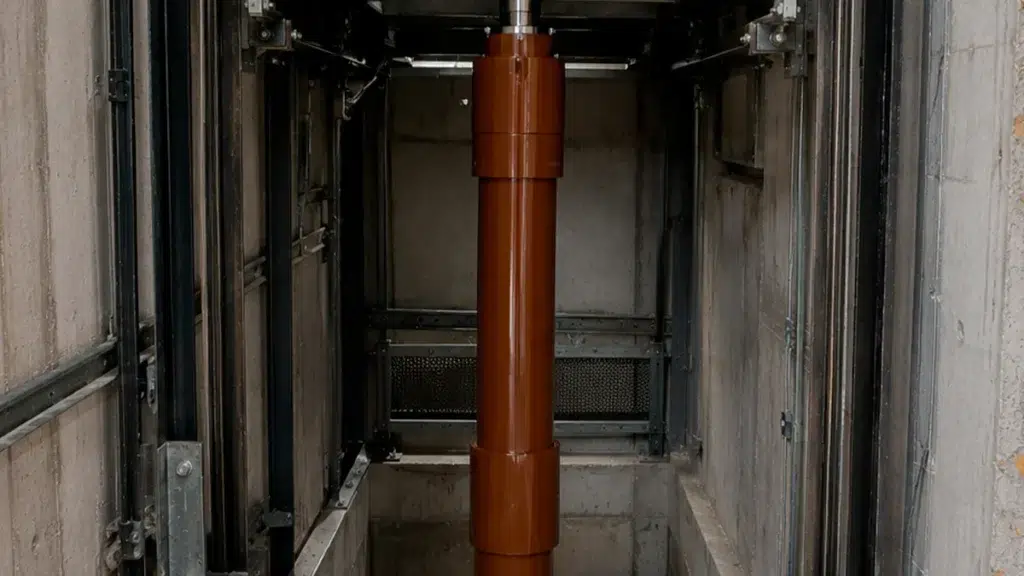
Direct traction represents the transmission of force in its purest and most elemental state. There are no intermediate load transmission elements; the piston directly pushes the chassis or cab structure.
How it works
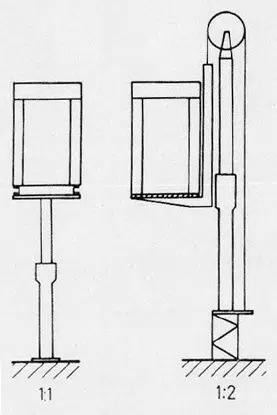
The mathematical relationship 1:1 describes a linear equivalence of motion.
• For each 1 centimeter as the piston extends inside the cylinder, the elevator car moves 1 centimeter.
• The speed The piston is identical to the cabin's travel speed.
Piston position: central and lateral
Depending on the architecture of the building and the available space, the direct piston can be placed in two positions:
- Buried central: The piston is installed vertically just below the center of gravity of the cabin. It requires the excavation of a deep pit to house the cylinder.
- Direct lateral: The piston is placed on one side of the gap (or two pistons parallel to both sides of the cabin). Push the chassis from the side. (Depending on travel needs, additional excavation may also be required to house part of the cylinder).
Advantages and disadvantages
Advantages:
-
Mechanical simplicity: Since it does not exist steel cables, diverter pulleys or additional parachute systems for suspension, the number of moving parts is reduced to a minimum.
- Minimal maintenanceFewer mechanical components mean fewer critical inspection points and less wear on traction cables, and that reduces the maintenance.
- Ideal for heavy loads: Transmits the load directly to the floor of the pit, making it ideal for forklift heavy industrial vehicles or car elevators.
Disadvantages:
- Complex civil works in a central position: Requires drilling the ground to a depth equivalent to the total elevator travel to insert the piston sleeve. This is impractical if there are complex foundations, rocks, or groundwater (water table).
- Route limitation: Limits system use to short strokes due to the physical length a one-piece piston would require.
When it is the right option
1:1 direct traction is the preferred solution in heavy tonnage industrial forklifts, car lifts, short-haul elevators (1 or 2 stops) and single-family chalets in which the terrain allows easy excavation or the direct lateral arrangement is used in very short routes.
2:1 differential traction
To overcome the physical limitations of space and travel of direct traction, engineers resort to a simple and highly effective element: the pulley.
How it works: the pulley and cable system
In the differential system (or indirect traction), the hydraulic piston does not come into contact with the cabin. The upper end of the piston incorporates a deflection pulley. A set of high-strength steel cables passes through this pulley: one end of the cables is fixedly anchored to the floor or structure of the shaft, while the other end is firmly tied to the elevator chassis.
This assembly exerts a mechanical multiplier effect:
- For each 1 centimeter when the piston rises or falls, the cabin makes a travel equivalent to 2 centimeters.
- Likewise, the cabin moves at twice the speed from which the piston moves.
Piston position in differential traction
In differential installations, the piston is placed in a lateral position (inside the gap, next to the cabin guides). It does not invade at any time the lower walkable space under the cabin chassis, completely freeing the central area of the pit.
Advantages and disadvantages
Advantages:
- No need for a deep pit: When placed on one side, It does not require drilling into the subsoil from the pit.
- Shorter pistons: As the travel doubles due to the effect of the wiring, the physical piston only needs to measure about half of the elevator's travel height.
- Suitable for longer journeys: Allows the use of hydraulic technology in residential buildings up to 7 floors in a viable way.
Disadvantages:
-
Greater mechanical complexity: It incorporates diverter pulleys, bearings, differential suspension chassis and a set of steel cables.
More demanding maintenance: The cables suffer wear due to friction and fatigue, requiring visual inspection, greasing and periodic replacement according to regulations. - Double load on the piston: By laws of physics, to raise the cabin to double speed, the piston must perform twice the thrust effort as in an equivalent 1:1 system.
When it is the right option
It is the industry standard for medium-rise multifamily residential buildings (up to 7 stops), rehabilitation projects where the slab of the existing building cannot be drilled, and in all those gaps with severe space restrictions in the pit.
Comparative table: traction 1:1 vs 2:1
| Feature | 1:1 direct drive | Indirect traction 2:1 |
| Motion ratio | 1 cm piston=1 cm cabin | 1 cm piston=2 cm cabin |
| Cabin speed | Same as the piston one | Twice that of the piston |
| Piston location | Central (underground) or lateral | Lateral |
| Pit drilling | Yes (mandatory at central) | Not required |
| Steel cables and pulleys | Not required | Yes (essential) |
| Force required | Lower (1:1 force ratio) | May (2:1 strength ratio) |
| Usual maximum travel | Up to approximately 24 meters (depending on the load) | Up to approximately 34 meters (depending on the load( |
| Maintenance frequency | Low | Average |
Implications in the design of the gap and the pit
The type of traction selected determines the dimensions of the building's civil works. An error in the technical design phase of the shaft may physically prevent the installation of the projected elevator model.
Pit depth according to the type of traction
- In central direct traction (non-telescopic), the pit must house the completely buried cylinder, which requires vertical perforations that can exceed 10 meters depending on the stops.
- In lateral direct traction, the pit is reduced to the measurements necessary for the chassis structure.
- In differential traction (2:1)The required pit depth is standard (usually ranging from 1,000 mm to 1,200 mm), requiring only clearance to accommodate the shock absorbers and the lower part of the chassis.
Escape height required
The escape height is the safety space that remains free on the top floor (the roof of the gap) when the cabin is at its highest stopping point. In the 2:1 systemsThe pulley and cable tie-down on the chassis require a slightly larger upper safety space than in direct 1:1 systems, to avoid any risk of collision of the suspension elements against the roof of the gap.
Piston space according to position
- Central Piston: The useful cabin gap is optimized to the maximum in plan, since it does not require free lateral space for the piston.
- Side Piston (whether 1:1 or 2:1): Requires a larger gap width on the guide side (usually an increase of between 200 mm and 350 mm on one side or rear) to securely accommodate the cylinder body and wall fixing brackets.
GMV piston models compatible according to the type of traction
As an internationally renowned manufacturer of hydraulic components, GMV has a specific range developed to adapt to both power transmission technologies:
| Type of traction | GMV pistons | Features and recommended use |
| Direct drive (1:1) | Series 1000 | The great GMV classic. It is a single-stage piston, ideal for simple and robust direct installations. |
| Direct drive (1:1) | Series 1001 | Cylinders specifically designed for direct lateral or central placement on short runs. |
| Direct drive (1:1) | Hydraulic synchronization telescopic range (9100/9110 series) | They allow for longer direct travel by reducing the length of the piston when it is retracted, which decreases the need for a large pit or escape. |
| Differential traction (2:1) | Series 1008 | Designed and optimized to push indirect traction chassis onto cables in residential and single-family installations (Home Lift range). |
| Differential traction (2:1) | Telescopic mechanical synchronization range (TSC/EC) | Mechanically coordinated models that are installed laterally in gaps where the travel is long, but sufficient escape height is not available for a conventional single-stage piston. |
For 1:1 Direct Drive
- Piston 1000: GMV's great classic, ideal for simple single-stage direct installations.
- Series 1001: Single-stage pistons specifically designed for direct lateral or central placement.
- Hydraulic Synchronization Telescopic Pistons (Ranges 9100, 9110, etc.): They allow longer direct strokes by reducing the length of the folded piston. Its stages are coordinated by relating the oil thrust areas, reducing the need for a large pit or escape.
- Chain Mechanical Synchronization Telescopic Pistons (TCS and EC Series): Designed to move large loads (forklift, car lift). The chains coordinate the constant output of the stages (up to 4), which makes it possible to dispense with pulleys, external cables and wedges in the chassis, optimizing the gap space to the maximum.
For Differential Traction 2:1
o Piston model 1008: Specifically optimized for pushing indirect traction chassis to cables in residential and single-family installations.
Applicable regulations (UNE-EN 81-20, ITC AEM 1)
Hydraulic elevators installed in Spain must be governed by a strict European and national legislative framework to guarantee the active and passive safety of the user and maintenance technicians.
- UNE-EN Standard 81-20: It is the harmonized safety standard for the construction and installation of elevators. In the hydraulic field, it defines the calculation thicknesses of rigid pipes and hoses, overpressure protection systems, safety valve requirements, and safety free distances in pit and escape for technicians performing work next to the piston.
- ITC AEM 1 (Supplementary Technical Instruction): This national regulation strictly governs the commissioning, periodic official inspections (maintained by authorized control bodies or OCAs) and maintenance of lifting equipment. It requires rigorous control of the state of conservation of suspension cables in 2:1 elevators and the performance of the tightness test of cylinders and oil pipes to avoid contamination of the subsoil.
Frequently Asked Questions
Why does the elevator go down only slowly when it reaches the floor?
This phenomenon is technically known as «drift». Hydraulic oil heats up due to continuous use and cools down during periods of inactivity. The change in temperature modifies the density and volume of oil inside the piston, causing the cabin to drop slightly from its plant level.
To solve this, modern control maneuvers incorporate a electronic re-leveling system automatic that detects this deviation and briefly activates the pump to recover the exact stop level.
What can cause the parachute valve to trip downhill?
The parachute valve It is a direct-lock hydraulic safety system mounted at the piston oil inlet. It fires if it detects an excess flow of outgoing oil (which would be equivalent to a drop at excessive speed of the cabin, for example, due to a pipe break).
The causes of its accidental activation are usually related to a technical mismatch in the regulation of the lowering speed of the main control valve, or to extreme variations in the viscosity of the hydraulic fluid due to low temperatures.
How do two pistons synchronize in the same installation?
In large elevators or car elevators, it is common to place a piston on each side of the cabin. The challenge is to get both of them to go up at exactly the same time so that the platform doesn't tilt.
There are two ways to do it, but not all of them offer the same result:
- Cable shooting (2:1): Not recommended. For it to work well, you have to divide the oil to the millimeter and also adjust the tension of the cables on both sides.
- Direct shot (1:1): The recommended option. Since it does not have cables or pulleys, the system is much simpler. It all depends solely on the passage of the oil.
One is installed valve called flow divider between the pump and the pistons. Its function is to collect the flow of oil and distribute it equally. Upon receiving the same volume of oil per second, both pistons rise at the same speed, even if the weight inside the cabin is poorly distributed.
What happens if the piston retainer leaks oil?
The retainer is the rubber gasket responsible for keeping the oil under tight pressure at the outlet of the cylinder plunger. If the retainer wears out, a slight oil drip occurs.
GMV hydraulic cylinders feature a leak collection manifold in its upper part that channels this excess oil back to a small transparent tank in the pit. If the loss is abundant, the oil level of the plant will drop and the elevator will stop working at its highest stops for safety when the tank is emptied, requiring the immediate change of the checkpoint by technical personnel.
Can the route of an already installed elevator be modified?
Yes, but with major limitations. In a facility of 1:1 direct traction, It would require completely replacing the physical piston with a longer one and carry out a deeper excavation of the pit if it is central.
In a facility of 2:1 differential traction, modification can be mechanically simpler, always under the approval of a technical engineering reform project.
Literature
AENOR. UNE-EN 81-20 Standard: Safety rules for the construction and installation of elevators. Part 20: Elevators for people and people and loads.
Official file in AENOR store (payment rule):
UNE-EN 81-20:2020 — AENOR Store
BOE. Royal Decree approving the ITC AEM 1 «Elevators» of the Regulation of Lifting and Maintenance Appliances.
The ITC AEM 1 in force in Spain is the one approved by Royal Decree 355/2024, of April 2, in force since July 1, 2024:
RD 355/2024 — ITC AEM 1 Elevators (BOE)
GMV Eurolift SA Technical manuals for gap design, chassis selection and piston range.
GMV's internal technical manuals are not directly publicly accessible, but there are two linkable official resources:
- GMV Quick Product Guide (downloadable technical catalog with full range of pistons, chassis and components):
GMV Eurolift Quick Product Guide (PDF) - Resources and downloads section from gmveurolift.es, where technical installation manuals are hosted by product:
Resources and technical documentation — GMV Eurolift Note: For specific manuals for the 1000 SL, 1008 SL and telescopic series pistons, full access requires registration in the GMV customer area.
Miravete, A., & Larrodé, E. Elevators: Principles and innovations. Reverté Publishing House.
File in the publisher (the title published by Reverté is «Elevators: Principles and innovations», no «Analysis, design and installation»
Elevators: Principles and innovations — Reverté Editorial

Postgraduate in Product management at Eada Business School. Qualification in Project Manager and Community Manager from Cecot. Responsible for Marketing and Communication at GMV Eurolift SAU since 2010.



42 Responses
Hello good evening, my question is why the inlet of the bucket that joins the oil installation with the valve is broken, this is the second time that I have had this problem, it is a GMV equipment provided at the time by Soimet industries of Argentina, this is installed in the Boca Jrs. Club and is used for journalism and executives, it has an approximate extension of 20 meters, 2 in 1 traction, it has only one door and all the stops (four) are all on the same side, this valve is the one that has the oil drain that the piston releases, the engine room is on the 3rd floor and from the central to the piston it is connected by a 2-inch galvanized pipe. I thank you in advance for your valuable information. Oscar Carmona
Thank you for your comment, Oscar. From your observations, we understand that the leak is occurring due to the piston seal, which we call the TSE seal. If the piston is installed in a high-traffic elevator (as is your case) and has been in operation for a few years, it is possible that this seal has worn out and needs to be replaced. We hope that the answer has been helpful.
Hello, good evening. I have an elevator that does not go down because the parachute valve is being released. How can I lower it so that all the oil comes out of the piston so I can check the parachute valve? Or why might the valve be being released?
Hello Jorge!
In order to give you a more precise answer to your question, we would need you to specify how many stops the elevator makes before the parachute valve is triggered. To go down and remove the oil from the piston, you must press the red emergency button. In any case, remember that the adjustment of the parachute valve must be carried out by a professional in the sector, and under no circumstances should it be done by a user. If you prefer, you can call us at 902 34 52 34 or leave us your answer here so that we can resolve your query. Best regards.
Good morning, It hardly goes down at all, you push it up a little and then when you go to make it go down either with the down valve, or with the contactors or with the emergency valve, the parachute valve is immediately released. My question is, could the parachute valve have become stuck? And if not, what could be done to remove the oil from the piston to see what is happening to the valve?
Good morning Jorge,
This is probably because the parachute valve core has come loose. The only solution is to loosen the bleed screw (located on the top of the cylinder) without removing it, and let the oil drain into the pit. We hope you can fix it! Regards.
Hello, the question I wanted to ask was that I have a 7-stop elevator and it is a GMV hydraulic elevator. What happens is that when this equipment goes down it feels like a shock that seems to me to be the parachute valve that is activated; and immediately when I do it, it goes uphill and it goes up very slowly, and this happens to me all the time as if due to this shock of activation of the parachute valve it loses pressure and does not want to go up normally but very slowly.
To remedy this I do the maximum pressure regulation that the GMV manual tells me and it begins to function normally until the knock appears again and returns to the previously mentioned condition, what I would like to know is if there is any way to discard this valve since in my opinion it is damaged. I have already reduced the descent speed and opened the parachute valve more and this valve continues to activate, my doubt also comes because when I press the manual emergency descent button this valve does not activate, it is a bit strange.
Well, I hope you can help me with this problem. Thanks.
Hello Julio,
As the problem is presented, what is most likely happening is that there is a foreign body inside the circuit, and this causes the parachute valve to be triggered. When the parachute valve is activated, the speed of descent decreases, also causing that in order to go back up the pressure must be increased and the object that has been left in the parachute valve must be unblocked.
If the elevator is new, this body may be a plug from the pipes that was left inside during assembly. If the elevator is old, the ring at the bottom of the stem may have come loose. In any case, it must be removed from the circuit, and to do so, follow these steps:
– fully open the parachute valve adjustment screw (until it stops)
– take several trips in the elevator (the last one to the lowest floor)
– close the stopcock and release the pressure
– remove the filter inside the stopcock and remove the foreign body from the side opposite the pipe connection
We hope you can resolve this issue. If not, please do not hesitate to contact us again.
Greetings!
Hello, I would like to know how deep the pit is for the side piston elevator specifically, hoping for a prompt response. Best regards.
Hello Rocio,
If we are referring to a lateral direct pull piston, it will depend on the route that the elevator has to travel, although normally the pits are around 1.2 m.
We hope this answer helps you. Best regards!
I have a problem, the elevator goes up but when it reaches the second level it stops because of the limit switches. The question is, once it reaches the indicated stop it starts to slowly descend. What could be happening?
Good morning Gerardo,
The fact that the elevator starts to descend slowly when it reaches the floor level may be due to several circumstances that should be checked. If it is an electric elevator, it should be checked that the brake closes the traction pulley correctly and does not cause the pulley to turn. Likewise, it should also be checked that the cables do not slip.
On the other hand, if it is a hydraulic lift, it must be checked that there is no internal or external leak in the valve group, or any associated component (hand pump, emergency button, etc.), or the solenoid valves that control the descent of the cabin (dirty filters or a seal in poor condition). Finally, it must be verified that the closure of the non-return valve of the valve group, which keeps the cabin on the floor, is in good condition (check for worn seal, worn material or dirty filters).
In the event of an oil leak, at the two points I have detailed, this will cause the elevator to slowly descend when it reaches the floor. If these points are not repaired, this descent will progressively increase over time.
The best thing to do in these situations is to contact the elevator installer or manufacturer so they can inform you of the actions to be taken.
In the case of a hydraulic lift with GMV equipment, you can send us more details about the installation so that we can send you the most appropriate documentation and resolve the problem. If you prefer, you can also contact us at +34 937 745 455 or info@es.gmvgrupo.com .
Greetings!
Hello good evening:
Recently one of the pipes that connects the two parachute valves (there are two cylinders) came loose and all the oil leaked out, causing the elevator to lower itself at a very low speed to the stop:
Is this possible or is there something else? Shouldn't the parachute valves have been activated?
Good morning Jose Luis,
In the event of a break in the pipes of a hydraulic elevator, the cabin would always descend at a higher speed and, as a consequence, the parachute valve would be activated.
From the situation you describe, I understand that the line that came loose is not one of the main lines in the installation but rather a secondary line that is installed between the parachute valves.
Let me explain: in two-piston forklifts, a hose is installed that comes out of each piston and is joined by a central fitting or manifold in order to go to the hydraulic unit. In this situation, a safety valve, called a parachute valve, is installed on each piston, which prevents the uncontrolled descent of the cabin in the event of a break in the pipes. In this type of installation, a small copper pipe is also added that joins the two parachute valves. This last pipe guarantees the synchronization of the action of both valves to stop the cabin in a synchronized manner.
We understand that the cabin descended at a reduced speed, one of the main lines was not completely released, so the cabin did not descend at an excessive speed, which would cause the parachute valve to operate. Instead, it is possible that this secondary synchronization line was released or loosened.
To avoid this situation, it is always advisable to carry out a pressure test of the entire system to verify that there are no small leaks during installation and during inspections, in addition to verifying the correct calibration of the parachute valves.
We hope we have been able to resolve your doubts.
Greetings,
hello,
I would like to ask for your conceptual help to find a solution to a problem I have.
I have two elevators with a GMV valve and a double direct attack piston. What happens to me is that when the elevator is on the ground floor, one of the pistons goes up a little on its own. It could be a matter of pressure difference between the pistons. Then, when starting up, as one piston was already a little out, when starting up, the leveling of the pistons generates a sudden movement in the cabin and a knock is felt.
In some cases, when the piston is purged to remove any oil that may have entered the system, the equipment improves a little and the knock is felt less, but it happens again.
The thing is that I don't have any oil leaks on the pistons at the moment.
The pump outlet is divided in two to reach each piston, but its original route in a metal pipe was not equidistant, that is, the section of pipe to one piston is shorter than the other, but that was the way it was from the beginning and the equipment did not have the problem. Now we changed the pipe on one piece of equipment to a hose and put in the same length and the problem still persists.
any similar fault that you can describe to me or ideas of what I can check to try to fix it?
I look forward to your response and thank you in advance.
Good morning Alejandro,
Although it is difficult to make a diagnosis without knowing more details about the installation and the problem, it is unlikely that it is a pressure difference issue.
If the pistons were telescopic, there could have been a loss of synchronization, giving rise to the imbalance you are describing. If the pistons are telescopic, we recommend that you perform synchronization. Remember that to do this, you need to remove the shock absorbers and fully compress the piston.
If the problem persists, you can contact our SAT (Technical Assistance Service) by calling 902 345 234 or +34 937 745 455 (from outside Spain), where they will advise you and try to solve the problem.
We hope we have been able to help you.
Greetings!
Greetings
In a hydraulic elevator, when the cabin reaches the highest level, how many more cm can the piston extend?
Hello Diomer!
The piston's extra travel will vary depending on the clearance in the elevator shaft. Based on this variable and by calculation, it will be possible to determine how many extra centimeters the piston would need.
All the best!
Hello, I have a GMV 3010 central unit with a 22kw motor. I am just taking over an old installation and I notice too much dirt on the VMD solenoid valve filter, causing it to descend very slowly. Which filters should I check, the motor filter or the shut-off valve filter? Or should I change the oil? To check the motor filter, is there no other option than to send the elevator to the top floor and empty the installation until it is visible?
Atilio
We have a cylinder elevator that without passengers performs all functions normally. And with a load of approximately 100 kg it advances slowly and stops before the 1st level. We checked all the valves and they work normally. We noticed oil on the piston head. Could it just be that small leak?
Good afternoon,
Regarding your query, we have little information to be able to give you a more specific comment. We would need to know which valve group it is. In any case, we are more inclined to believe that it is a valve group regulation issue or a fault in the group, rather than the piston.
If you wish, you can call us at 93 774 57 98 and tell us more about your incident.
All the best.
Hello, I am glad to find this blog, as I am facing an important challenge. Due to a university project, I have been assigned to a project for the installation of a hydraulic elevator for the disabled, maximum 3 floors; which includes the description of an installation plan and the elevator.
The best one is the differential one since it would take up less space.
Therefore, I am turning to you so that you can help me with the above with the information you have.
Greetings.
We are very pleased to be of use to you. In order to provide you with more personalized assistance, we would appreciate it if you could provide us with a contact email where we can send you the information you request.
In the meantime, please accept my warmest regards,
Hello,
I have a problem with a three-story elevator in a home.
From the central to the cylinder there is only a 'T' with a pressure gauge, fitting, hose, fitting and elbow. (I have removed the check valve)
In manual operation (without electrical panel) the pump generates 40 bars.
The elevator doesn't go up.
With a tractel I raise it and the stem rises perfectly, (completely straight stem)
Could the pump be failing and still be giving 40 bars?
Greetings
Hello, please help, – I have a 7-stop GMV hydraulic elevator – the infrared door sensor has some cables on the top MODEL Memco Elite Model 618 – my problem was that during an ascent the cable on the right door broke off, I soldered the 4 cables it has inside but it doesn’t work – it detects an object with the usual sound, — but when there is no object the lower LED starts flashing and an intermittent bird-like sound.
According to the manual it seems that the error is “A diode has been timed out”, how do I fix it?
Please I ask for your help earnestly.
Thank you for your attention.
Hello,
Do direct or indirect traction elevators have an overweight, overcapacity or other sensor that prevents them from starting when the nominal capacity is exceeded?
Greetings
How much can a cylinder cost for a hydraulic lift with a cabin travel of 13m and a maximum load of 300kg?
Good afternoon Jose Luis, thank you for your query, our sales department will contact you shortly to give you an answer,
Good afternoon
We have a private hydraulic lift with two stops and we have a maintenance contract with the company that installed it for us. The fact is that they tell me that the piston seal needs to be changed to prevent oil loss and that the cost is around 1200 plus VAT. This seems excessive to me and since I don't understand this subject, could you help me and advise me on what we need to do and if that is the usual cost?
Thank you so much
I have a DHM-400 elevator. Currently it goes up to a height of 3.30 meters and now we have modified the floor where it goes up so that it has to go up to 4.60 meters.
I would like to know if with my current height of 1.80, I could grow to that height?
Thank you
Hi, could you explain to me how the 2in1 advance is achieved in hydraulic elevators? Thank you very much in advance.
Hello, the mechanism shown in the figure above that says 1:2, can someone tell me how the cabin doubles the distance traveled by the piston, I don't understand it, I do understand the principle of pulleys, reduction of forces, speeds, etc. (physical and mathematical concepts) but specifically this system I don't understand how it doubles the displacement, according to what I can analyze it seems to me that it is still 1:1, I would appreciate the help, Thank you and greetings!
Hello, I hope you can help me. Due to an oil leak, we have proceeded to change the piston seal of the hydraulic elevator of the GMV group and the oil leak continues and now even more than before changing it. Can you advise me and tell me why it happens? What must be the problem for this oil leak detected in the piston, oil in the cabin roof and elevator pit to occur? The new seal installed is not from GMV, I inform you, could it be the reason or is there another major problem in the piston head? Thank you for your attention.
Good morning,
I have a dumbwaiter that works with a piston and two pulleys, and it had a travel of 4 floors.
In order to gain space in the room on the top floor, we decided to eliminate that last stop, and our idea was to leave the other 3 in operation.
Now we are faced with the problem that no elevator company or manufacturer gives us a solution (unless it means changing the entire elevator).
But we don't know if it can't be fixed, or if they don't want to do it. I have the feeling that it can be fixed.
I would like to tell you that this dumbwaiter did not previously have a longer route above the 4th floor. I say this because 2 of the companies that have come have told us that the elevator probably had a longer route above the 4th floor, and this is not true. It ends at the ceiling of the 4th floor, and now it ends at the ceiling of the 3rd floor.
Thank you very much in advance.
Good morning, First of all, we would like to thank you for contacting us to resolve your query. With the information we have and without seeing the installation, we cannot give you a solution to your query. Our advice as a manufacturer is that you follow the instructions of your installation or maintenance company, since they know the installation. If your technicians have any questions, they can contact us and we will be happy to help them.
Hello, I am an industrial mechatronics student. My project is a hydraulic load elevator. I've been researching for months and haven't been able to find the information precisely and completely step by step. I'd like to be able to choose the elevator using your calculations, tables, and calculation diagrams from scratch.
Pressure, bone flow rate, hydraulic unit, component measurements, cylinder-piston diameters; pulleys, in my case 2:1 pull; cabin choice etc… until the mechanism is completed using buckling diagrams, monograms for hoses among others that you can provide me.
I am writing to you because you are a very renowned company and I would like to be able, together with your extensive experience and knowledge, to complete the missing part of my work.
I will also highlight your name as a collaborating company in the documentation.
I appreciate your help in advance
atte.: Kevin Johan Alfonso
kevinjohanalfonso@gmail.com