Article updated: 24-09-2026
Summary:
A hydraulic elevator is a lifting system that moves the cabin with the pressure of the oil that a pump drives towards a piston, with the hydraulic power plant up to 10-15 m from the shaft and a practical limit of 6 stops (about 18 m), expandable to 8 with 2:1 traction. It goes up with the engine running and down by gravity without consuming electrical energy, with a slow approach speed to level in the plant and the protection of the non-return valve, the overpressure valve, the parachute and the emergency manual descent. Your ally for low and medium height buildings, with flexible installation, smooth travel and redundant security.
Elevators are everyday elements in residential buildings, offices and shopping centers. However, not all of them work the same way. There are two main families: the electric elevators (cable traction) and thes hydraulic elevators.
In this article we will explain in detail how a hydraulic elevator works, analyzing the physics of its movement, its main components and the security measures that guarantee a smooth and reliable journey.
What is a hydraulic elevator?
A hydraulic elevator is a lifting system in which the force to move the cabin is obtained by the pressure exerted by a fluid (usually special oil) within a closed circuit.
Unlike traditional electric elevators, which use a motor above to pull cables with a counterweight, the hydraulic elevator push the cabin from below or from the side by moving a piston.
Its fundamental principle is based on the physics of Pascal's Principle: When pressure is applied to an incompressible liquid in a closed container, this force is transmitted equally in all directions.
We invite you to read our basic article about «how a hydraulic system works«.
Components of the hydraulic circuit
To understand the movement of the cabin, we must first know the parts that make up the hydraulic power plant and the lifting system.
Motor and pump
The electric motor drives the hydraulic pump (usually spindle pump). His The function is to transmit mechanical energy to the fluid to move it towards the cylinder.
Oil tank or central tank
The hydraulic power plant is he container where hydraulic oil is stored when the elevator is stopped on the ground floor or descending. The pump and motor are usually submerged inside to reduce noise.
Valve group
The valve group is he «mechanical brain» of the hydraulic circuit. This block manages the direction, pressure and flow rate of the oil on both the rise and fall.
Hydraulic conduits
The hydraulic conduits These are rigid tubes and flexible high-pressure hoses responsible for transporting the oil from the hydraulic plant to the piston.
Piston and cylinder
The cylinder is the outer tube that It serves as a guide and container; the piston (or piston) is the cylindrical inner bar that emerges to move the cabin.
How a hydraulic elevator works on an uphill climb
The upward travel of a hydraulic elevator requires an active contribution of electrical energy to overcome the force of gravity.
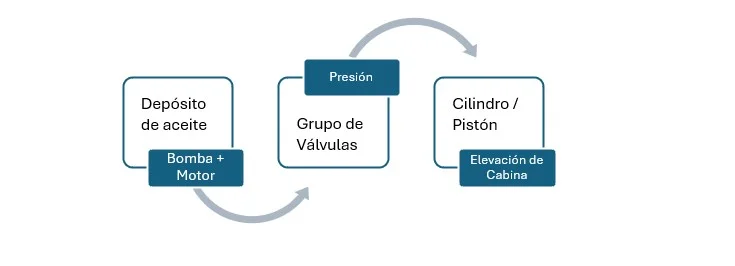
Engine start and pressure generation
When a user presses the button to upload, the elevator maneuver sends an electrical signal to the motor. The engine starts and drives the hydraulic pump, which begins to suck oil from the tank and send it at high pressure into the circuit.
Role of the valve group in the rise
The valve group is positioned to allow direct flow to the cylinder. As more volume of oil enters the cylinder, the pressure progressively increases until it exceeds the total weight of the cabin. At that moment, the piston begins to move upwards, raising the chassis and cab to the desired floor plan.
How the cabin stops on the floor
As the cabin approaches the destination plant, the maneuver activates an approach phase or «slow speed». The valve group partially throttles the passage of oil to progressively reduce speed. When the elevator reaches the exact floor level:
- The engine disconnects.
- The valve group non-return valve closes instantly.
- The oil trapped in the cylinder maintains pressure, leaving the cabin perfectly level.
How a hydraulic elevator works on a downhill slope
Downward motion is one of the greatest technical advantages of this system, as it takes advantage of the laws of physics in favor of energy efficiency.
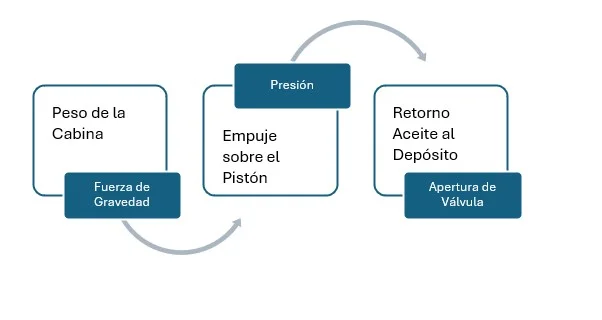
Opening of the lowering valve
To go down, The electric motor does not start. The maneuver It simply sends an electromagnetic signal to the lowering valve located in the valve group. When this exhaust path opens in a controlled manner, the oil retained in the cylinder begins to flow back into the tank.
Why the elevator does not consume energy when going down
The cabin It descends due to the direct effect of gravity and its own weight. Since it does not require the operation of the electric motor or the pump to propel fluid, the motor's electrical consumption during the descent is zero.
How the cabin stops on the way down
As you approach the selected floor, the lowering valve progressively reduces the passage of oil (slow approach phase). Upon reaching the exact plant level, the lowering valve closes completely. The oil flow stops and the remaining column of liquid once again supports the cabin stably.
The role of the non-return valve: why the cabin does not go down alone
A common question is what prevents the elevator from falling if the engine shuts off during the climb. The answer is the non-return valve. This valve It is a mechanical safety component installed in the hydraulic group that only allows the passage of oil in one direction: from the pump to the cylinder.
- During the climb, the force generated by the pump pushes the valve and opens the passage.
- When the engine stops, the pressure of the oil column itself pushes the non-return valve plug in the opposite direction, closing the track instantly.
In this way, the fluid is hermetically blocked inside the cylinder. The cabin remains suspended on an incompressible column of liquid without risk of moving on its own.
Hydraulic circuit safety systems
Hydraulic elevators have multiple redundant layers of protection to respond to pressure failures, mechanical breaks or power outages. The hydraulic safety devices are:
| Overpressure valve | Parachute valve | Manual descent |
|---|---|---|
| It causes excessive load or mechanical blockages. | Blockage in pipe breakage or overspeed. | Rescue during power outages. |
Overpressure valve
It's one relief valve or bypass. If the cabin is overloaded above its maximum authorized capacity or if the piston suffers mechanical blockage during ascent, the pressure in the pipes rises. The overpressure valve opens automatically to redirect the direct flow of oil to the tank, preventing damage to the pump or breakage due to excess force.
Parachute valve
It's a essential safety element mounted directly at the cylinder inlet. If an unforeseen breakage occurs in the high-pressure conduction or a sudden increase in the descent speed, the sudden pressure drop mechanically actuates the parachute valve. This suddenly closes the oil passage immediately, nailing the position of the piston and preventing the cabin from falling freely. You can find more information in the article about the parachute valve.
Emergency stop and manual descent
In case of a general power outage, the occupants they are not trapped between two floors. The hydraulic power plant has a button or manually operated emergency lever (usually a 12V solenoid valve connected to a rescue battery or mechanical lever). Pressing or activating it gradually releases the lowering valve so that the cabin slowly descends by gravity to the floor immediately below and opens the doors.
Operating differences depending on the type of traction (1:1 and 2:1)
The type of traction determines the relationship between the distance traveled by the piston and the distance traveled by the cabin.
- Direct drive (1:1): The piston directly pushes the cabin chassis. For every meter the piston rises, the cabin rises exactly one meter.
-
Indirect traction (2:1): The piston moves a pulley through which suspension cables fixed to the shaft bed and the cabin pass. For every meter that the piston advances, the cabin travels two meters.
(For comparative diagrams and to learn about the speed ratio according to the type of installation, see the article on traction).
How many floors can a hydraulic elevator reach?
The Hydraulic elevators are optimized for low to medium height journeys.
For physical and structural reasons, The practical limit is usually 6 stops (approximately 18 meters of total distance). In indirect traction installations (2:1) or using special telescopic ones, up to 8 floors can be reached.
Why does this limit exist?
- Piston length: A direct piston for 10 floors will require a plunger more than 30 meters long, which would require digging an underground well of that same depth or using very expensive telescopic cylinders.
- Oil dilation: On extremely long journeys, the large volume of oil required would suffer thermal fluctuations that would complicate the precision of plant leveling.
At what maximum distance can the central piston be?
One of the most notable advantages The flexibility of hydraulic versus electrical technology is location of the engine room or cabinet where the maneuvering panel and the central office are located.
The hydraulic power plant can be installed at a maximum indicative distance of 10 to 15 meters from the elevator shaft. It is not necessary to place it at the top or adjacent to the chassis. It can be located in a small room in the basement, in a storage room or in a closet under the stairs.
However, the greater the channeling distance:
• Athe loss of hydraulic load is present (fluid friction).
• Se requires increasing the diameter of the pipes to maintain travel speed.
• Se increases the total oil volume in the circuit.
Frequently asked questions about hydraulic operation
Why does the elevator go down slowly when it reaches the floor?
It is the normal functioning of the approach speed. To ensure that the cabin floor is smoothly at the same level as the building floor, the valves progressively reduce the oil flow just before stopping.
The elevator shouldn't be jerking: what causes a sudden bump when starting or stopping?
Usually due to mismatched regulation in the progressivity screws of the valve group or to a mismatch in the frequency converter (if the installation has one). It can also be caused by the presence of air in the hydraulic circuit or by inadequate viscosity of the cold oil.
What breakdown causes jumps or pulls during the journey?
This effect is usually caused by:
• Air trapped inside the cylinder which compresses and expands.
• Excessive friction between the piston retainer and the cylinder liner due to lack of lubrication.
• Dirty or misaligned cabin guides.
Can the elevator be stopped going up or down?
Yeah. The moment the stop button is pressed or the safety series is interrupted (for example, when opening a door), the maneuver immediately cuts off the current to the solenoid valves and the motor. The valves close due to the action of their internal springs and stop the passage of oil.
Why does the elevator stop going up with more than two people?
It indicates that the system cannot generate enough pressure to lift the load. The usual causes are:
• The overpressure valve is set too low and diverts the oil to the tank prematurely.
• The motor or pump is worn out and has lost drive capacity.
• There is an internal leak in the valve group.
What happens if the oil overheats?
Continued work (many trips in a row) raises the fluid temperature. When heated, the oil loses viscosity and becomes more fluid, which can cause:
• Worse precision in leveling with floors.
• Loss of speed on the climb.
To avoid this, hydraulic systems include a thermostat. If the temperature exceeds the safety limit (usually between 50 °C and 60 °C), the elevator ends the current journey, descends to the ground floor and keeps the doors open out of service until the oil returns to its working temperature. Optional oil coolers are installed in high-traffic buildings.
Bibliography
AENOR. UNE-EN Standard 81-20:2020: Safety rules for the construction and installation of elevators. Part 20: Elevators for people and people and loads. UNE-EN 81-20:2020 — AENOR Store
Ministry of Industry and Tourism. Royal Decree 355/2024, of April 2, approving the Complementary Technical Instruction ITC AEM 1 «Elevators».Effective from July 1, 2024: BOE-A-2024-7258
Ministry of Industry, Energy and Tourism. Royal Decree 203/2016, of May 20, which establishes the essential safety requirements for the marketing of elevators and safety components for elevators (transposition of Directive 2014/33/EU). BOE-A-2016-4493
European Parliament and Council of the EU. Directive 2014/33/EU on the harmonization of the laws of the Member States relating to elevators and safety components for elevators. Directive 2014/33/EU — EUR-Lex
Miravete, A. & Larrodé, E. Elevators: Principles and innovations. Reverté Publishing House. Elevators: Principles and innovations — Reverté Editorial
Janovsky, L. (1999). Elevator Mechanical Design (3rd ed.). Elevator World Inc. Elevator Mechanical Design — Elevator Books

Postgraduate in Product management at Eada Business School. Qualification in Project Manager and Community Manager from Cecot. Responsible for Marketing and Communication at GMV Eurolift SAU since 2010.

107 Responses
The hydraulic elevator is very necessary for human beings.
Thank you very much for your comment!
We hope that our blog will help you to better understand the operation and advantages of installing and maintaining a hydraulic lift.
Interesting, thanks for the information, but I do have a question...
How many floors can this hydraulic system cover?
thank you.
Hello Absolute,
Thank you for your comment. A hydraulic elevator can reach up to 8 stops without any problem. For more stops (for example 10 or 11) each case must be studied as it will depend on the characteristics of the building and the installation.
If you have any further questions, please do not hesitate to contact us.
Greetings!
We request information regarding the dimensions of the entire hydraulic elevator cubicle, including machines and elements for said elevator.
Thank you. Arch. Osmar Pascuale
Hello Osmar,
The dimensions required for the elevator shaft vary greatly depending on the type of elevator. Each manufacturer determines the dimensions required for a hydraulic elevator based on the dimensions of the cabin, the number of entrances, the type of doors and the design of the elevator.
Greetings,
It is very good to know, especially many things
Hello! I would like you to help me with which valves make up the valve group!
Could you explain to me why the elevator, when it reaches the required floor, starts to slowly descend on its own?
Good morning Gerardo,
The fact that the elevator starts to descend slowly when it reaches the floor level may be due to several circumstances that should be checked. If it is an electric elevator, it should be checked that the brake closes the traction pulley correctly and does not cause the pulley to turn. Likewise, it should also be checked that the cables do not slip.
On the other hand, if it is a hydraulic lift, it must be checked that there is no internal or external leak in the valve group, or any associated component (hand pump, emergency button, etc.), or the solenoid valves that control the descent of the cabin (dirty filters or a seal in poor condition). Finally, it must be verified that the closure of the non-return valve of the valve group, which keeps the cabin on the floor, is in good condition (check for worn seal, worn material or dirty filters).
In the event of an oil leak, at the two points I have detailed, this will cause the elevator to slowly descend when it reaches the floor. If these points are not repaired, this descent will progressively increase over time.
The best thing to do in these situations is to contact the elevator installer or manufacturer so they can inform you of the actions to be taken.
In the case of a hydraulic lift with GMV equipment, you can send us more details about the installation so that we can send you the most appropriate documentation and resolve the problem. If you prefer, you can also contact us at +34 937 745 455 or info@es.gmvgrupo.com .
Greetings!
A piston to lift 1500 kg, is it available on the market? Can it be easily arranged? It is for a freight elevator
Good afternoon Jose,
Indeed, there are pistons that can lift 1500 kg and much higher loads without any problem. The pistons, whether single-stage or telescopic, are designed to lift much heavier loads.
In any case, the choice of piston type (traction type, 1 stage, telescopic, etc.) will depend on the characteristics of your installation.
In the Product Catalogue (free registration) you can consult the different types of pistons, including those that are specific for forklifts. There you will find technical specifications, measurements, etc.
We hope we have resolved your doubt.
Greetings,
Hello! In a building with 6 stops, a hydraulic elevator similar to the one in the illustration was installed, measuring 1x1.2m and with a maximum load of 480kg.
When testing, we noticed that when ascending and reaching each level, a very sudden stop is felt and the cushioning of the liquid is felt when stopping.
The installer tells me that adjustments will be made to make it right.
The question is basically whether these lifts actually make smooth stops similar to the conventional pulley system or whether you will always have this shock absorption when stopping while ascending?
You will have to see that your hydraulic system has approximately a distance to the piston of approximately 3 to 4 meters with all turns?
What should I consider so that the elevator can be delivered to us in good working order?
How often does it require maintenance and how is it different in this respect from a conventional elevator?
Sorry for so many questions, but I didn't know about this system and I don't know if I've ever gotten into one. But I'm curious to know if it's a good system for people who have paid to live in good quality apartments and who generally demand good services, given that I have to hand over their apartments to them and I'm sure they'll ask these questions.
Thank you for your attention, your comments and the help you provide to all of us who find your website.
Successes!!!!
Good afternoon Luis,
Don't worry about asking, we wrote the blog specifically to help you solve these types of questions.
First of all, you should bear in mind that a hydraulic and an electric lift offer the same type of performance and comfort (smoothness and precision of stopping), so it is quite possible that, as you say, you have gotten into a hydraulic lift without realising it. Currently, both solutions are marketed depending on the type of installation. In the following article you can see the basic differences that exist between electric traction lifts and hydraulic ones.
You may also be interested in the following articles:
– The hydraulic system: the basic idea
– Operation of a hydraulic elevator
– Advantages of installing a hydraulic lift
From what you tell us, the problem is simply due to incorrect regulation of the valve group, which is responsible for regulating the precision and smoothness of the stop. We do not know what type of valve group the installation has, but today there are electronic valve groups on the market (which offer a high degree of comfort) and conventional mechanical ones, which also achieve a smooth and precise stop if a good regulation is carried out. As your installer says, it is only necessary to make the necessary adjustments to the valve group to achieve the smoothness and precision of the stop .
As regards maintenance, just like an electric lift, it must undergo a monthly inspection. In the following article you will find information regarding the maintenance of a hydraulic lift . If you prefer, you can also consult the optimal maintenance conditions on our website.
We hope we have resolved all your doubts.
Greetings!
Hello, a hydraulic elevator is being installed in my building. It turns out that the closet cannot be placed on the ground floor. Is there a difference between putting it on the first floor or the third? How does this affect its operation and maintenance? Is it better to put it as close to the ground floor as possible or not?
Thanks in advance.
Hello Yaidel,
Hydraulic lifts have the advantage of being able to locate their "machine room" in the lift shaft or in a cabinet. In the case of the latter, it does not matter which floor it is located on as long as a maximum radius of 15 metres is not exceeded between the piston oil outlet and the central oil outlet (located inside the cabinet). In this case, it will not affect its performance.
All the best.
Thanks!! It helped me a lot for a school project.
but you can't go up very high, that's the bad thing about this elevator.
Hello, I have a problem with a 5-stop hydraulic elevator in a building. The problem is the following, when more than 2 people get on it starts uphill, travels 5 cm and the board resets. My question is if it could be a valve problem. I am going to change the transformer, because I think that when the motor takes a little more amperage the transformer falls. The board power supply is 24v. Any suggestions?
Hello good morning,
I would like to know if it is possible for a hydraulic elevator to consume three times as much electricity as an electric one.
thank you
Dear Sirs. I have a problem with a side-piston hydraulic lift. After approximately a week of use following calibration, the lift loses its level. Sometimes it goes over the stop level and other times it doesn't reach it, and it is stopped. I think the problem has to do with the temperature of the fluid. How is the temperature of the fluid maintained? What other fault could the lift have?
Thank you very much in advance.
Felix
Hello, good morning, I would like to know what the energy consumption of an elevator of this type is! Thank you.
Can you weld an elevator pump?
Hello Victor,
First of all, we would like to thank you for the trust you have placed in our company to resolve your query. Regarding the question you asked us, we do not know which part is going to be welded, but we recommend not making repairs to the pumps since the pump has probably reached the end of its useful life. The pump is made of cast aluminium and can probably be welded, although we cannot guarantee that it will work correctly.
Greetings.
thank you
It is important to know the advantages and disadvantages of elevators so that we can choose the best option for each case.
I would like to know what preparation should be made, related to the structure of a building, for this type of elevator, especially the central hydraulic piston elevator.
What are the loads that I should take into account? I imagine that this requires a reinforced concrete slab or something similar. Also, from what I understand, the loads are not transmitted to the walls?
Thank you so much
Another thing is that I had the goal of continuing to work in this way,
which would be a frequent activity, and would have to
pay the contribution every month.
In any case, GMV advises you to contact your elevator company and discuss the issue with them.
Greetings,
I would like to know the power of the motor for a two-story elevator and if it can be a single-phase motor.
thank you
Hello,
To answer your question we need more data about the installation, as we need to make a calculation of it. You can contact us by e-mail: comercial@es.gmvgrupo.com We will be happy to answer your query.
Hello, my question is about the dimensions of the machine room (the minimum required) for an elevator of this type. And if it can be located both underground and in a machine room on the roof. I understand that the oil must have a route, and I think it would be optimal for it to be underground, is that correct?
Good afternoon, while searching a little on your page I found the article on “how a hydraulic elevator works” and I would like to know if you are interested in buying and/or could help me sell a hydraulic pump for a vertical elevator. I work in demolition and excavations. In the last project there was an elevator like the one shown in your article. The pump and parts that go inside the hydraulic oil tank were recovered, as well as the transmission. Well, without further ado for the moment and thanking you in advance for your attention, I say goodbye and remain at your service. Art. Gerardo Pedraza
Good afternoon Gerardo, first of all, thank you for visiting our blog. In response to your suggestion, we would like to inform you that our company is dedicated to the marketing of new components for hydraulic lifts, so we do not buy these same components second hand. In any case, we thank you for your offer.
Hello:
I have a GMV lift of up to 250 kg and when it goes over 100 kg.
It doesn't go up anymore. Could you tell me why?
Thank you.
Good morning Thomas,
The problem may be a bit more complex, so it would be ideal if a technician from the installation could call us. Our phone number is: 93 774 57 90.
Greetings.
Good morning Pserrano, I don't know if you could help me with an elevator that we are installing for my boss's house. We already have the components such as the structure for the pistons, pistons, hydraulic pump, tank. I would need the hydraulic valves and other accessories that a hydraulic elevator should have.
Thank you very much in advance.
Williams Chavez.
Good afternoon Williams,
In order to help you we need to know exactly all the materials you have and the details of the installation, such as loads, route, etc..., I provide you with our email so that you can contact us directly and solve your query: comercial@es.gmvgrupo.com
Good afternoon. I am a student at a technical college and I am working on a project for a 4-story building. I would like to know more or less the electrical consumption, its capacity and what kind of care it needs for its optimal use. Any information would be useful to me, thank you very much!
Good afternoon Alan,
In order to answer your question, we need more information about the installation.
In order to serve you more personally, I would appreciate it if you could provide us with an email address through which we can contact you,
Thanks for the reply! According to what I found: 12 meters of travel, 3 meters between floors (ground floor and three floors), a 1.50 pit for the protection of the piston and central machine. Capacity of 4 to 6 people if possible. Use is 2-3 times per hour.
Will it have a three-phase connection?
What is the electrical consumption of a complete trip to the top floor?
What is the average speed of the elevator?
If construction continues, what is the maximum height that the elevator can reach?
Thank you very much, any mistake of mine can feel free to correct me 🙂 alanpio2013@outlook.com
Our elevator does not go up, only manually but it restarts and does not do it anymore.
I don't know if it needs oil or if it needs to be purged, what can be done?
Good morning Juan Michel, the information you have given us is not sufficient to tell you the reason why your lift does not go up, as it could be due to several factors. As manufacturers, our advice is that you contact the company that maintains your lift, as it is this company that should be responsible for the inspection and, if necessary, the repair of the lift.
Good evening. How many pistons are needed for a four-story single-family home? I imagine the system is similar to that of a dump truck. Thank you.
Good morning, the elevator in my community, when it goes down, especially on the upper floors, goes down suddenly and the truth is that sometimes it scares me. It is dangerous and it could be faulty. Thank you very much.
Good morning,
First of all, we would like to thank you for contacting us to resolve your query. With the information you provide us, we cannot know what type of elevator your community has or what may be happening to it. I refer your query to our technical service who will contact you as soon as possible.
Good night!
I am Hugo, a student at the National Technological University (Argentina). I have to carry out a project on a hydraulic elevator, the design and calculations of the elements that make it up, for any installation, since it is only for a presentation.
I am writing to you in order to request any information you can provide me with on a model project that can serve as a basis for my project. Any information, whether calculations, plans or images, will be extremely valuable to me. Thank you very much! Best regards.
Hugo.
Email: hugo_silva_07@hotmail.com
Hello Hugo,
Our technical department will contact you shortly to help you in any way we can.
Greetings, first of all I would like to congratulate you for the help you provide by offering suggestions and clarifying doubts in the cases that are presented to you in this way. I would like to take this opportunity to explain my case. Is it true that the elevator should be sent to the ground floor as it reduces the tension in the cables? Or rather, by doing this practice am I contributing to the wear and tear of other components of the elevator (motor, pump, brakes...) and to the energy consumption? Keep in mind that I live in an 18-story building and I know that the elevator is currently working but with one less cable than it should have (I don't know how many it uses). Thanks in advance.
Hello Alfredo, thank you very much for your comment. We regret to inform you that, as this is an 18-storey building, this is an electric lift. We are manufacturers of hydraulic lifts, so in this specific case we cannot help you.
Greetings, how could the start and finish stroke be reduced in a single speed hydraulic elevator?
Hello Andres,
In order to answer your question, we need more information about the installation. Our technical department will contact you to provide it and resolve your queries.
Good afternoon. Regarding the hydraulic lift, I don't know if anyone can tell me where I can find a signal that comes from the oil temperature, since we have one that apparently stops working due to overheating. We just want to find the signal to bypass it and if that really is the problem, then we would install an oil cooler.
Thank you very much and I hope you can support me in this regard…
Javier Garcia Diaz
Hi Javier, "Bypassing" a central security device, whether it is a thermistor or a TºC probe, is not recommended. If what you need is to determine whether or not it is necessary to install a refrigerator, the following could be taken into account:
1) If the TºC protections are being activated, it is a clear indicator that it is needed.
2) If the TºC reading of the oil is around 70 ºC then yes it is necessary.
3) With the actual TºC reading, assess whether it is the safety components that are failing.
Greetings,
I have a forklift at home (for a person in a wheelchair) that was mounted on vertical rails and bearings. It is hydraulic. It has a VAT20 frequency converter from G.Electric. When going up, it reaches the limit switch smoothly, but not when going down (sudden stop).
Question: Could the same be adjusted at the end of the race when descending? Thank you very much.
Dear Jose,
First of all, we would like to thank you for contacting us to resolve your query. The equipment can be adjusted to make the descent smoother, but as it is not a GMV product we cannot tell you the steps you should follow. We advise you to contact your supplier.
Good morning, I am an architecture student at the National University of Rosario (Argentina). I am working on a project for a building with 6 floors, basement and roof terrace.
I am writing to you to request any information you can provide me regarding hydraulic lifts for my project, any information, whether calculations, plans or images.
Thank you so much,
Eugenia
Hello Eugenia,
One of our technicians will contact you shortly. Thank you for considering us to resolve your queries.
Greetings!
Good afternoon,
I would like to know the feasibility of installing a hydraulic lift in a single-family home, with a ground floor and a first floor (two floors), that can accommodate a wheelchair and a companion. I would also like to know what characteristics the lift should have, and a budget estimate. Thank you very much!!
Hello M. Jose, Thank you for your inquiry, our sales team will contact you shortly, in the meantime receive a cordial greeting,
Hello, I have the case of a hydraulic bottle lift for cars that also uses an air compressor. I would like to know if you can advise me on how to adjust the height of the lift. Regards.
Good morning,
We have a hydraulic lift at work to raise and lower vehicles. It operates on 3 floors. The specific question is whether it is advisable to send the platform to the lower floor after one use, or whether it can be left on the floor where it is finished without any problem.
I ask because I have a friend who has a domestic one and the technician has recommended that the elevator always sends it to the lower floor after use.
Thanks in advance.
Hi Daniel, in your case, according to regulations, the cabin must be automatically sent to the lowest stop within the first 15 minutes after having made the last normal trip,
Good afternoon, what I need is how to do it and there is no application or something like that.
THANK YOU
Please can you tell me based on what size I request a retainer kit for a GMV piston. What size should I take?
Thank you in advance for all your help.
Greetings
Good morning Wladimir,
To request a retainer kit for a GMV piston, we will need you to provide us with the measurement of the plunger or rod.
Greetings.
The piston type is a 1008 and the plunger is 130. Could you share a picture of the kit?
Thank you in advance for your help.
I have had a hydraulic elevator for 4 years and 6 months, to go up only one floor, it works well but since the last inspection it has been making small jumps until approximately halfway along the route and I don't know if the reason is a lack of oil.
Good morning Carmen,
From what you tell us, you should discuss the problem with the company that maintains your elevator. In all likelihood, it is a lack of lubrication in the guides, since if it were a lack of oil in the hydraulic unit, it would cause the jumps at the end of the travel.
All the best!
Good morning, I am starting a construction that I plan to use as a shelter for senior citizens and I would like to know if a pit is necessarily needed for stretcher lifts for only one level.
Hello, good afternoon, I'm from Zaragoza. I was looking at an elevator to go up from a local to the first floor. The height is 4.30m. I would like it if it wasn't too wide. Let me know.
Greetings and thanks in advance
Good morning Daniel,
Our sales department will contact you shortly to advise you on your needs.
All the best
GMB
Good afternoon.
I have a 12 year old girl who needs to go up from the ground floor to the upper floor (a two story house) and I am considering an elevator for this. Initially I was leaning towards an electric elevator, however, I have learned from the information I have read on your GMV site and I have been convinced of the safety, maintenance and energy efficiency advantages of hydraulic elevators, so I am interested in getting a hydraulic elevator. Therefore, I am kindly requesting all the information you can share with me regarding the design, plans, parts and/or specifications, and control systems needed to cover an approximate height of 3.00 meters, with an opening of approximately 1 square meter.
Receive a cordial greeting.
Good afternoon
I would like to know if it is possible to install a central piston hydraulic elevator (to make the most of the space) in a 6-story building +- 18 meters high. Thank you.
Hello, we installed a GMV hydraulic unit with a capacity of 450 kg, but when only two people get on, the cabin does not move forward. It is only two stories high. I would appreciate your help. Thank you.
greetings.
Hello, I have a hydraulic lift that works very well, but I would like to ask you if it is normal that when you enter the cabin, it makes a "clack" noise and seems to give way a few millimetres. This happens when the lift has been stopped for a while. Thank you in advance.
Thank you for your query Josep Mª, our technical service will contact you today to resolve it.
Dear good afternoon, I am from Tarapoto and I would need the costs of the bottle and the piston for a hydraulic elevator. If you can contact me at 945427074
Good evening. The hydraulic lift has been working until today.
I wanted to try to lower it manually without power and with the red button to the ground floor.
Now he doesn't go up to any floor. The interior doors close and open constantly but he doesn't obey the command. Do you know why? Thank you very much.
Hello Joan Miquel, first of all thank you for sending us your query. In this case, it is necessary for a technician to check why the manoeuvre does not give the order to go up. We suggest that you contact the company that maintains your lift so that they can verify it.
Hello, I have a hydraulic forklift, but the oil was recently changed and now after a few trips, the lift tends to stop off-level. It goes from 12 to 15 cm above the floor. Could you tell me if the characteristics of the oil could affect the proper functioning of the valves or if there is something else causing this failure?
When inspecting a hydraulic lift, when is it best to stop it… going up or down? I have been told that when going down, what can happen is that the lift’s parachute system is activated when it is stopped suddenly… but I have also been told that if the goods lift or elevator has a high capacity… 3000 kg… or more, when going up, the excess pressure can also cause the lift to “stuck”… what would be your recommendation? Thank you very much in advance.
Hello Alberto,
Hydraulic lifts are designed to be able to be stopped both when going up and down without causing any damage, especially when operating at inspection speed.
However, stopping on a downhill slope is less demanding since it is not necessary to stop the motor-pump.
We hope we have helped you.
All the best!