Article updated: 06-18-2026
Summary:
The hydraulic elevator moves the cabin with a motor that pumps pressurized oil on a piston, and adapts to each building: in single-family homes it does not need space over the opening, it only consumes when going up and can run on single-phase batteries and even connect to solar panels In blocks of up to 5-6 floors, it unloads the weight into the pit and fits easily into patios or stairs thanks to its compact wardrobe; in public buildings it offers smooth rides and larger cabins, and in forklifts, stretcher lifts and car lifts it is king for heavy weights. It must comply with UNE-EN 81-20/50 standards (100 lux lighting, protection against uncontrolled movements, photoelectric barriers), the CTE DB-SUA and UNE-EN 81-70 (1.10 × 1.40 m cabin, 90 cm handrail, mirror and voice), Directive 2014/33/EU with CE marking and the new ITC AEM 1 (RD 355/2024), which requires leveling of ±10 mm, infrared curtains, load weighing and accessible two-way communication. Installation is simple in new construction, somewhat more complex in renovations with gaps, and a greater challenge in old buildings without prior space. Your partner in installing a hydraulic elevator that adapts to your type of building and complies with all current regulations.
What is a hydraulic elevator?
When installing an elevator, the hydraulic technology it's one of the most used options around the world. Unlike traditional electric elevators, which are moved by a system of pulleys and counterweights, the hydraulic elevator works thanks to an electric motor that pumps oil under pressure to push a piston, which raises the cabin.
In this article we explain in a simple way how these facilities adapt to different types of buildings and what requirements they must meet.
The hydraulic elevator according to the type of building
This technology is not installed in the same way in a private home as in a hospital. Each space has different loading, use and space needs.
Single-family homes
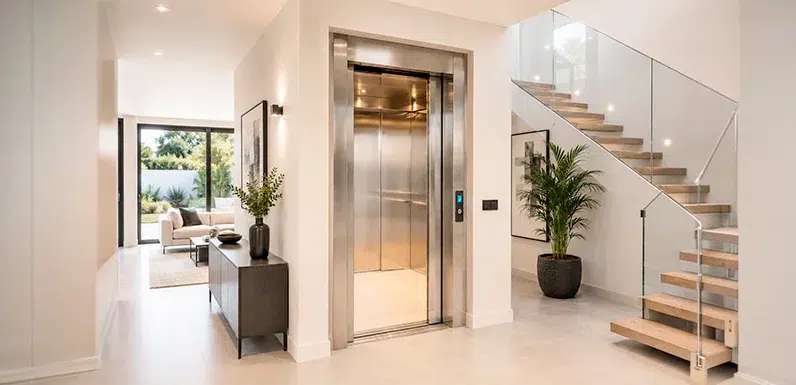
In the single-family homes, as they do not require a high speed and have moderate use, hydraulic elevators are the most common option in multi-story houses or chalets.
- Space saving: They do not need extra space above the elevator shaft, which allows you to make better use of the top floor or the attic of the house.
- Efficient consumption: They only consume electricity when they go up. To go down, the elevator takes advantage of the force of gravity. In addition, today there are models equipped with battery systems. These batteries allow the elevator to operate with conventional single-phase current (normal for any home) and can even be connected directly to photovoltaic solar panels, making the cost of each trip practically zero.
Residential buildings

On the other hand, in the residential buildings- low or medium height apartment blocks (typically up to 5 or 6 floors), the hydraulic system offers great advantages, whether the building is new or added years later.
- In new construction: The weight of the elevator rests on the pit floor, not the roof structure, simplifying the construction of the building.
- In rehabilitations: If the community does not have an elevator and it must be installed in the light well or stairwell, the hydraulic model is the easiest to fit because its machinery can be placed in a small closet on any floor.
Public buildings
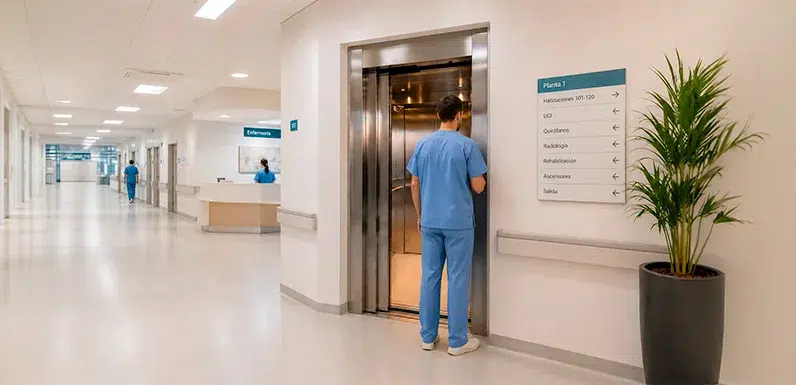
In places with a continuous traffic of people, as may be the case of public buildings, priorities shift towards comfort and space.
- Smoothness on the trip: The oil pressure system allows the elevator to start and brake very smoothly, avoiding uncomfortable jerks for users.
- Use of the gap: By not having counterweights in the space, the cabin can be larger and more accessible for people in wheelchairs or baby strollers.
Special facilities
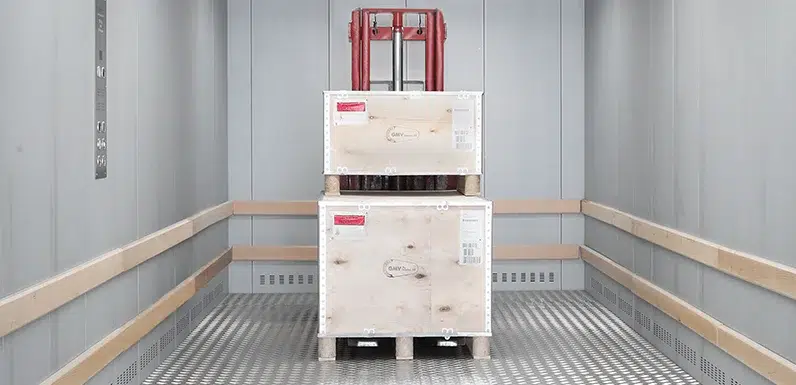
In special facilities, the hydraulic system is the undisputed king when what is needed is to move a lot of weight on short journeys.
- Forklift: Used in factories or warehouses to move heavy goods or pallets.
- Stretcher: Essential in hospitals and residences. Its size is longer and its stop is millimeter so that the stretchers enter and exit without potholes.
- Car mount: The car lift they are large elevators that are used to move vehicles between the different basements of a parking lot.
Technical requirements and basic regulations
For a hydraulic elevator to be legally commissioned, it is not enough to install it; must exceed a strict regulatory framework that guarantees the safety of people and the accessibility of the property. The key regulations that you should know are the following:
UNE-EN 81-20 and UNE.EN 81.50 standards
These are the two major European technical guidelines that regulate how modern elevators should be manufactured and installed.
- What do they demand? They dictate very strict measures on the resistance of the cabin materials (which must be fire resistant) and the lighting of the shaft. For example, they require that the interior of the cabin have a minimum of lighting 100 lux (double what was required a few years ago) to avoid dark areas and guarantee the safety of users.
- Active security systems: Under this regulation, current hydraulic elevators must be included security systems that prevent uncontrolled movements of the cabin when the doors are open and photoelectric barriers on the doors (sensors that detect even the smallest object to avoid entrapment).
The accessibility law: Technical building code (CTE DB.SUA) and Standard UNE-EN 81-70
The Basic Safety of Use and Accessibility Document (DB-SUA) of the Technical Building Code determines when an elevator is officially considered «accessible» for people with reduced mobility.
- Minimum dimensions: In a standard neighborhood community, the law usually requires a cabin with minimum measurements of 1.10 meters wide by 1.40 meters deep, which guarantees space for a wheelchair and a companion. Doors must offer free passage of at least 0.80 meters.
- Mandatory cabin elements: To comply with accessibility regulations, the elevator must have a handrail at a height of 90 centimeters, a mirror in the background (so that wheelchair users can see obstacles when leaving on their backs) and voice systems that announce the floor it is on.
Elevators Directive 2014/33/EU
The Elevators Directive 2014/33/EU It is the European law that requires that every elevator have it Ce marking, a legal certification that demonstrates that each and every component of the installation has passed safety tests in official laboratories before going on the market.
The New ITC AEM 1 (Royal Decree 355/2024)
The new ITC AEIM 1 it is a Complementary Technical Instruction that regulates both new and existing elevators. Its main objective is to force old blocks to reach the safety levels of modern buildings. If you live in a community with an elevator of a certain age, the new ITC will force you to make improvements with strict deadlines.
The most important requirements it introduces are:
- Millimeter leveling (avoid trips): The regulations require that the floor of the cabin and the landing be practically aligned (with a stopping precision of ±10 mm. This is key to avoiding falls when entering or leaving, especially for elderly people or strollers. baby. Older single-speed elevators are greatly affected by this measure and need to be updated.
- Protection against uncontrolled cabin movements: This is one of the most important measures of the new law. It requires the installation of safety systems that completely block the cabin if it tries to move unexpectedly (for example, up or down due to a technical failure) while it is at rest and with the open doors. This prevents very serious accidents when passengers enter or leave the elevator.
- Measures to increase security based on previous legislation: The law does not start from scratch, but rather unifies and makes mandatory improvements that were already partially required in past regulations. In this way, it ensures that all elevators in Spain (regardless of whether they were installed 10, 20 or 30 years ago) are updated under the same current safety criteria.
- Infrared curtains on doors: The typical mechanical pivot on the edge of the door that «collided» against you is no longer enough to reopen. A barrier of invisible optical sensors is now required that detect the presence of any person or object (from 25 mm to 1.60 meters high) before the door touches it.
- Load control devices (loadweighers): It is mandatory that the elevator has a system that prevents it from starting if the maximum permitted weight is exceeded, notifying users through an acoustic or visual signal in the cabin.
- Two-way communication: The cabin rescue system must allow anyone (including those with hearing or vision disabilities) to communicate with the assistance center in a clear and accessible manner in an emergency.
Differences between new construction vs rehabilitation vs old building
The ease of installation depends entirely on when you decide to install the elevator:
- New construction: Everything is planned from the beginning. The architect leaves the gap with the exact measurements and the installation is quick and clean.
- Rehabilitation (Existing building with hole): An already available space is used (such as the stairwell). Sometimes it requires adapting the electrical installation to support the power of the motor.
- Old Building (Without prior space): It is the most complex challenge. It often involves doing major work, such as pulling flights of stairs or installing a metal structure on the outside of the façade or in the light well to create the gap from scratch.
Literature
European Elevators Directive (2014/33/EU): Directive 2014/33/EU of the European Parliament and of the Council, of February 26, 2014
Technical Building Code (CTE) — DB-SUA: Safety of use and accessibility: CTE DB-SUA — Safety of Use and AccessibilityCode
Safety information manual in lifting systems: Elevator Manual — Facilities and safety (INSST)
Royal Decree 355/2024: RD 355/2024 — ITC AEM 1 Elevators (Ministry of Industry)

Postgraduate in Product management at Eada Business School. Qualification in Project Manager and Community Manager from Cecot. Responsible for Marketing and Communication at GMV Eurolift SAU since 2010.



22 Responses
Hello
Could you tell me in which written regulations the possible installations of hydraulic lifts that you list above appear?
Thank you
Hi Jose Carlos,
EN 81.2 is the European standard that governs the installation of hydraulic lifts and which you can easily consult online.
Greetings,
Please see if you can resolve an additional question for me.
Can a HYDRAULIC ELEVATOR be installed in a multi-family building or in a block with two neighbors?
Thank you
Hi Jose Carlos,
You can install a hydraulic lift without any problem in this type of home that you describe. Keep in mind that if you want to regulate the use of the lift, you can always install a lift (or elevator) with a key so that only certain people or tenants have access.
Greetings,
Hello Mar Gual!
I was fascinated to find this forum on such an interesting and important topic for the best use of resources, and to have a person of your experience and generosity in the answers. Here are my questions:
1. Are hydraulic lifts used exclusively in the EU, or can they also be found in other latitudes? (In Colombia, for example).
I ask this question because in our area we see electric elevators, and in Bogotá, in a new building with 40 offices, with areas between 25 and 45 m2 each, two electric elevators have been installed for 9 stops.
2. Is monthly preventive maintenance required for electric elevators? I think that, as with hydraulic elevators, the frequency of preventive maintenance will depend on the hours of use, applied load, etc., which would justify the decision to carry it out every month or every two months.
I ask you question number two, because in addition to the case of the office building mentioned above, where I believe that the periodicity of maintenance should not be mandatory monthly "per se", I live in a residential complex of 6 apartment towers, each with 17 floors (20 stops), with two elevators in each tower; 2 towers have 4 apartments per floor, and 4 towers have 2 apartments per floor, and maintenance on the 12 elevators is done monthly. I have proposed to the Board and the Administration that in the towers with 2 apartments per floor, the elevator maintenance be done alternately (one month on No. 1, another month on No. 2), thus obtaining a 33.3% reduction in maintenance costs, in an item that is one of the most significant in the annual budget of the co-ownership. Total silence has been their response.
A hug, and thank you in advance for your answers.
JIV
Hello Jorge!
Answer 1: Hydraulic elevators are used all over the world. The only condition is the distance: hydraulic elevators are installed up to 9 or 10 stops (approximately 24 or 25 meters). For short distances (4 or 5 stops, which is equivalent to a distance of approximately 16 to 18 meters), the hydraulic elevator is one of the most optimal solutions.
Answer 2: In Spain, and generally throughout Europe, elevator maintenance is mandatory and in no case will it depend on the load or traffic. In Spain, for example, it is mandatory to do it monthly in the case of hydraulic and electric elevators, and every three months in the case of lifts ( you can see the difference between the two here ). I recommend that you consult the law that regulates elevators in Colombia to find out if it is feasible to alternate the maintenance of both elevators. In any case, keep in mind that an elevator with monthly maintenance can be less expensive in the long run than one with less maintenance.
Thank you very much for your comment. I hope the answer has resolved your doubts!
Hello, good afternoon. What should be the minimum width and length required for the pit through which the cabin of a hydraulic elevator moves?
Good morning.
We already have an elevator in our building.
Our property has a ground floor plus a mezzanine, plus 6 floors, plus an attic and an upper attic. Total 10 with the ground floor,
On the floor that goes up to the roof, there is no elevator because of the engine room.
Could a hydraulic lift be installed?
We have been having frequent breakdowns lately.