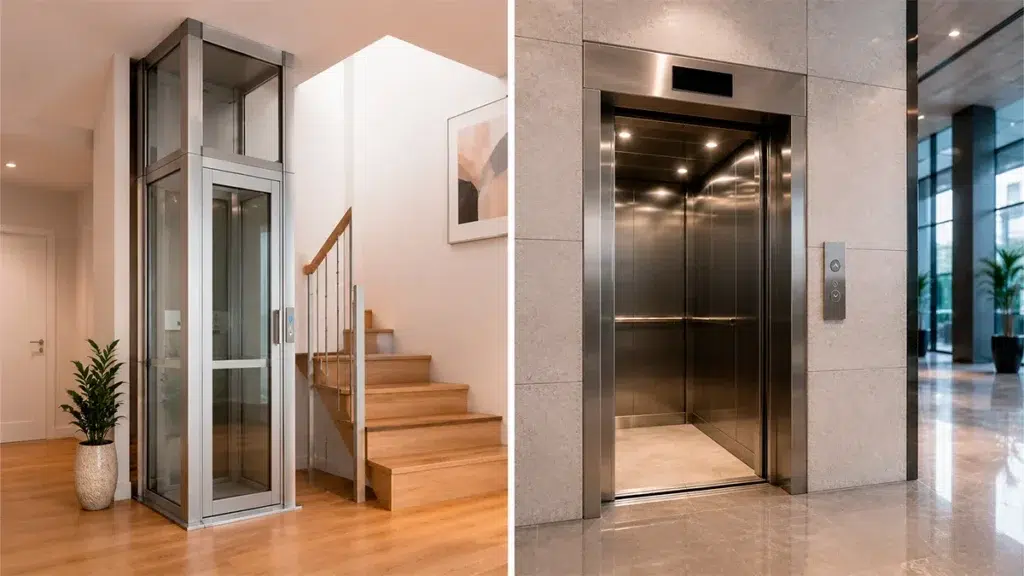
Article updated: 21-07-2026
Summary:
The domestic elevator (hydraulic or electric) is governed by the Machinery Directive 2006/42/EC, is limited to 0.15 m/s with sustained pulsation, operates with a single-phase 220V power supply, needs a pit of only 10-20 cm, is checked every 3 months and serves for 2-6 stops (12-15 m), while the conventional elevator complies with Directive 2014/33/EU and EN 81-20/50 standards, circulates at 0.63-1 m/s or more with automatic call, is usually three-phase, requires a 100-120 cm pit, 24-hour rescue telephone, automatic doors and monthly maintenance with OCA inspections. The elevator is between 30% and 50% cheaper due to its lower civil works and contracted power and fits into single-family homes and communities of 2 to 4 homes or old buildings without pit space, while communities, offices and high-traffic public buildings require an elevator, and any equipment exceeding 0.15 m/s becomes an elevator for all purposes. Your ally to choose between elevator and lift according to traffic, available space and budget, without overpaying or falling short.
Ensuring accessibility and comfort in any type of building is a fundamental challenge. However, when looking for a vertical mobility solution, it is It is very common to confuse terms such as domestic elevator (also known as a passenger forklift or single-family elevator) and conventional elevator.
At first glance, both teams serve a similar function: transporting people and cargo from one level to another. However, in technical, regulatory, speed and cost terms, there are substantial differences that should be known in order to make the appropriate decision according to each need.
Next, we analyze in detail what each device is, how they differ, and what the ideal option is for each type of property.
What is a domestic elevator or single-family elevator
A domestic lift or reduced speed lift is equipment intended to raise, lower or move people or loads between different levels using a lifting system optimized for low or medium traffic use.
At the drive level, as with conventional elevators, there are two main technologies for domestic elevators:
-
Hydraulic lift: He hydraulic lift For elevators, it works by means of a piston fed by a pump. It's the most widespread solution in single-family homes for its smooth ride, use of space and ease of performing manual rescues in case of power outage (simply by opening a valve so that the cabin lowers by gravity).
- Electric lift (or electromechanical): The electric elevator It is moved by means of an electric motor (usually with Gearless technology or without a reducer) that Move the cabin using cables or tapes. They have extremely low energy consumption in standby and do not require an oil tank.
Unlike traditional elevators, elevators (whether electric or hydraulic) are specifically designed to solve problems of accessibility in private or low-traffic spaces. They are characterized by requiring significantly less civil works: they need a very small moat (in many cases just 10 to 20 centimeters) and a much tighter free space on the top floor (escape). Its operation is smooth and its electrical consumption is comparable to that of a conventional appliance.
What is an elevator and what types there are
A conventional elevator is a vertical transport vehicle designed for the intensive movement of people and objects, meeting speed and capacity standards.
As with elevators, the driving force of a conventional elevator is divided into two key technologies, although sized to withstand much higher loads and speeds:
- Hydraulic elevator: In a hydraulic elevator The energy required to lift the cabin is transmitted by a pump driven by a motor that propels a hydraulic fluid into a cylinder. To descend, the system takes advantage of gravity by regulating the fluid outflow. They are very safe equipment, with an extremely smooth start and stop, ideal for low or medium height buildings (up to 7 floors) with moderate traffic.
- Electric elevator (or traction): In a electric elevator The cab is moved by means of cables or traction belts driven by a tractor unit and a counterweight. They are the ideal option for high-rise buildings or buildings with very heavy traffic due to their high speed and energy efficiency on long journeys.
Differences between a domestic elevator and an elevator
To fully understand the operational and functional differences between both systems, it is necessary to analyze their technical characteristics point by point.
Maximum speed
Speed is one of the clearest differentiating factors:
- Domestic elevators: Su maximum speed is limited by regulations to 0.15 m/s (meters per second). This slower movement ensures user safety without the need to incorporate the complex braking systems of a traditional elevator.
-
Conventional elevators: In its standard range, They start at speeds of 0.63 m/s to 1 m/s, being able to far exceed these figures in high-rise buildings.
Control system and pushbuttons
The way the user interacts with the button panel varies significantly:
- Elevator: It works usually by constant (or sustained) pulsation. This means that the user must maintain pressure on the button throughout the journey for the cabin to move.
-
Elevator: It has an automatic call and registration system. Simply press the button once for the cabin to come and make the entire journey autonomously.
Periodic inspections and maintenance
Although new safety legislation (such as the Lifting Equipment Regulation in Spain) has unified safety requirements with respect to maintenancePreventive review intervals vary depending on use and equipment:
- Elevators: When having a use less intensive and a simplified mechanism, planned preventive maintenance is usually carried out every 3 months in domestic environments.
-
Elevators: They require monthly preventive maintenance reviews, in addition to being subject to mandatory Periodic Technical Inspections carried out by authorized control bodies.
Power supply
- Elevators: They usually work with single-phase power supply at 220V, the same one that any private home has. Its energy consumption is low (between 1.5 kW and 2.2 kW), so it rarely requires contracting additional power with the electricity company.
-
Elevators: The diet is usually three-phase at 380V, although there are modern low-consumption models single-phase. However, they generally require a higher contracted power term due to engine demands in fast starts.
Rescue telephone number and mandatory security
The security It is essential in both cases, but the mandatory equipment varies:
- Elevator: Although regulations require two-way communication and rescue systems, solutions in a single-family environment can be adapted to conventional lines or direct dialing systems. Cabin doors in some countries were optional in the past with photoelectric barriers, although today it is highly recommended and standard to install them completely.
- Elevator: The two-way rescue telephone connected 24 hours a day to an emergency care center is strictly mandatory, as is the presence of automatic telescopic doors in the cabin and landings.
Comparative table with the differences between an elevator and an lift
| Single-family elevator | Elevator conventional | |
| Traction | Hydraulic or electrical | Hydraulic or electrical |
| Normative | Machinery Directive 2006/42/EC | Directive 2014/33/EU/EN 81-20/50 |
| Speed | 0.15 m/s | 0.63 m/s – 1 m/s |
| Push button | Constant pulsation / maintained | Automatic with call registration |
| Food | Single-phase (220V) | Mostly three-phase (380V) |
| Pit required | Minimum (10 to 20 cm) | Deep (100 to 120 cm) |
| Rescue phone | Optional | Mandatory |
| Cabin doors | Optional | Mandatory |
| Maintenance | Quarterly | Monthly |
| Recommended use | Single-family homes and low traffic | Communities, offices and public use |
Applicable regulations for the elevator and elevator
The legal framework is what determines the construction and testing requirements for each device.
Machinery Directive 2006/42/EC (elevators)
Domestic elevators are covered by the Machinery Directive 2006/42/EC. This European standard regulates the essential health and safety requirements for machines with vertical travel speeds equal to or less than 0.15 m/s. It allows for more flexible designs and significantly lower pit and escape requirements, facilitating its integration into existing home renovations.
Directive 2014/33/EU and UNE-EN 81-20/50 standards (elevators)
The elevators that They exceed a speed of 0.15 m/s and must strictly comply with Directive 2014/33/EU and the technical specifications contemplated in the UNE-EN 81-20 and UNE-EN 81-50 standards. These regulations impose rigorous criteria on material strength, pit and roof safety spaces for maintenance technicians, and mechanical parachute and high-speed wedging systems.
Where can an elevator be installed and where can an elevator be installed?
The choice between one or the other depends on the type of building and the expected user flow.
Single-family home
In one private house with several floors, the logical option is the domestic elevator. It requires little work, makes the most of the available space, connects to the house's existing electrical network and its reduced speed is more than enough to save 2 or 3 floors comfortably.
Neighborhood community: elevator or elevator?
- Elevator: It's the sstandard and ideal smell for communities with multiple neighbors. It supports a continuous flow of travel and offers the speed residents expect.
- Elevator: It can be one alternative valid in small communities (2 to 4 homes) or in old buildings where there is no physical space to make the standard pit required by a conventional elevator, serving mainly as an accessibility solution for people with reduced mobility.
Public and office buildings
In shopping malls, hoSpitals, corporate headquarters and high-traffic public buildings, the installation of conventional elevators is essential. A domestic elevator is not designed to withstand continuous intensive use or to ensure the smooth flow of dozens of people simultaneously.
How much does an elevator cost versus an elevator?
The total cost of the installation covers the equipment itself, associated civil works and subsequent maintenance:
- Initial investment and work: The domestic elevator It is usually between 30% and 50% cheaper than a conventional elevator. This is due not only to the lower manufacturing cost of the machine, but also to the drastic savings in civil works (it does not require digging deep pits or modifying the roof structure for the upper escape).
- Energy consumption: A elevator requires a contracted power similar to that of any appliance standard, while an elevator may require hiring more three-phase power, which makes the monthly electricity bill more expensive.
- Maintenance cost: The monthly maintenance fees for a conventional elevator are higher due to the greater technical frequency of visits and the cost of mandatory Periodic Technical Inspections.
Frequently Asked Questions
Is it legal to install an elevator in a neighborhood community?
Yes, it is legal as long as the use of the property and the flow of traffic allow it, and the project complies with local accessibility regulations. In existing buildings where there is no space for a conventional pit, the elevator is an excellent approved solution.
How many stops can an elevator have?
Typically, a domestic elevator is optimized to serve 2 to 6 stops (about 12 to 15 meters maximum travel). For higher heights, a conventional elevator is recommended.
Is it mandatory to contract maintenance for an elevator?
Yeah. Although elevator maintenance is usually carried out quarterly rather than monthly, current legislation requires that any lifting device that retains the function of transporting people have a maintenance contract in force with an authorized conservative company.
Why do you have to keep the button pressed on an elevator?
It is a safety measure established by the Machinery Directive. Since it does not have the same high-speed active safety equipment as an elevator, presence control (press and hold) ensures that the user is attentive to the maneuver throughout the journey.
Can an elevator go up to more than 0.15 m/s?
No. If lifting equipment exceeds the speed of 0.15 m/s, it is automatically classified as an elevator and must comply with Directive 2014/33/EU, requiring a full pit, standard escape and monthly maintenance.
Literature
European Parliament and Council of the EU. Directive 2006/42/EC on machinery.
Directive 2006/42/EC of the European Parliament and of the Council of 17 May 2006 on machinery and amending Directive 95/16/EC (recast). OJ L 157 of 9.6.2006, pp. 24–86.
Full text in EUR-Lex: Directive 2006/42/EC — EUR-LexEUR-Lex ⚠️ Validity note: Directive 2006/42/EC has been repealed by Regulation (EU) 2023/1230, although it will remain applicable until 19 January 2027.
European Parliament and Council of the EU. Directive 2014/33/EU on elevators and safety components for elevators.
Directive 2014/33/EU of the European Parliament and of the Council of 26 February 2014 on the harmonization of the laws of the Member States relating to elevators and safety components for elevators (recast version). OJ L 96 of 29.3.2014, pp. 251–308.
Full text in EUR-Lex: Directive 2014/33/EU — EUR-Lex
AENOR. UNE-EN 81-20 Standard: Safety rules for the construction and installation of elevators. Part 20: Elevators for people and cargo.
File in AENOR store (payment rule):
UNE-EN 81-20:2020 — AENOR Store
Ministry of Industry, Trade and Tourism. Regulations for Lifting and Maintenance Appliances and ITC AEM 1 «Elevators». This reference groups two different regulations that should be separated: The Royal Decree 2291/1985, of November 8, which approves the Regulation on Lifting and Maintenance Apparatus, was largely repealed by RD 1314/1997. The current regulations in Spain for elevators are the RD 355/2024, which approves the ITC AEM 1 «Elevators» currently in force: Ministry of Industry and Tourism
- ITC AEM 1 current (RD 355/2024): BOE-A-2024-7258
- Regulations for original lifting and maintenance equipment (RD 2291/1985, articles still in force): BOE-A-1985-25787

Postgraduate in Product management at Eada Business School. Qualification in Project Manager and Community Manager from Cecot. Responsible for Marketing and Communication at GMV Eurolift SAU since 2010.



64 Responses
I liked it. And the best thing is the differences that are better understood from there, such as the regularity of maintenance or the legislation that regulates its operation.
Thank you very much for your comment. We believe that it is worth explaining the differences that exist between both concepts since they are based on different concepts.
All the best!
Thank you for pointing out the differences... I work in a call center and it is to give general information, and there is always the idiot who calls to ask or request information that no one knows. You made my day by rubbing the differences between the two of us in their faces over the phone... thank you...
Hello Manuel,
We are glad that the article was helpful to you! If you have any further questions, please feel free to contact us again.
Greetings!
Hello,
I have a question, do you know if there is any regulation that requires the use of an elevator instead of a lift in a public building of less than 350m2 (childcare centre) and consisting of a ground floor and one floor where there are only two classrooms?
thank you so much
Good morning Anna,
We are not aware of any regulations requiring the installation of a lift instead of an elevator in a public building. We believe that it is possible to install an elevator in the children's centre.
Greetings!
I FIND THE DEVELOPMENT YOU HAVE EXPLAINED ON THE DIFFERENCES BETWEEN ELEVATORS AND LIFTS VERY INTERESTING.
I HAVE A QUESTION THAT I WOULD APPRECIATE YOUR SOLUTION TO:
IS SELLING LIFTING EQUIPMENT MORE ECONOMICAL THAN AN ELEVATOR?
AND IN YOUR CASE, IF THE DECISION TO INSTALL A DEVICE DEPENDED ON YOU, WHICH OPTION WOULD YOU CHOOSE?
THANK YOU FOR YOUR COLLABORATION.
Good morning Jose Manuel,
The market price of a lifting platform, because it does not have the same characteristics and does not have to comply with the regulations of an elevator, is substantially lower.
The decision to install a platform lift or an elevator must be assessed from several aspects: whether it is a home for private or public use, the number of stops, the interior or exterior location, the dimensions, security, etc. For this reason, we recommend that it is best to seek advice from an elevator specialist who will recommend the best solution for each installation.
Greetings!
My company wants to develop elevators for plasma and LCD TVs. Could this be possible in your company?
Good morning Edward,
Thank you for the offer, but we are manufacturers of hydraulic equipment. However, if you send us information about these components, I can forward it to the technical department so that they have information about your products.
Greetings,
I have had a hydraulic lift installed in my single-family home for 4/5 years. It has detectors in the shafts that stop the lift immediately if the barrier is crossed.
Having this security measure, am I obliged to keep the button pressed constantly, or will the detector be sufficient?
On the other hand, how much can the speed be increased?
Thank you for your reply.
Hello Miguel,
If you have a lift that is 4 or 5 years old, you will need to validate its certificate (or the technical file of the lift itself) to find out which directive it was issued under (machinery directive 98/37/EC or lifts directive 95/16/EC) and which one contemplates the safety measures adopted (such as the maximum travel speed, as well as its characteristics).
At this time, the current directive for lifting platforms (2006/42/EC) does not allow a displacement greater than 0.15 m/s. The use of a photoelectric barrier in the cabin does not exempt the use of the constant button. Only in the case of having the cabin completely closed, that is, with doors in the cabin (automatic or bus type), is use with the button interlocked allowed (it is not necessary to keep the button pressed constantly).
We hope this answer helps you. Best regards!
good morning
To install an elevator there is a maximum number of stops or a maximum height.
thanks and greetings
Good morning Felix,
There is a difference in travel between an elevator and a hydraulic lift. The hydraulic lift can reach up to 5 stops (approximate travel of 14 meters), while the latter can reach up to 8 stops (approximate travel of 20 meters).
Greetings!
Good morning,
I understand that it is not legal to install an elevator in a community of neighbors, that it must be an elevator. Is that so? And why are there subsidies for elevators and not for lifts?
Thank you
Good morning Juan,
The lifts are designed in accordance with the Machinery Directive 2006/42/EC, the aim of which is to adapt facilities in private or public buildings for the accessibility of people with reduced mobility, but under a series of restrictions (to accommodate architectural barriers) and under the responsibility of the owner of the facility.
An elevator requires a series of particularities, such as: a maximum speed of 0.15 m/s, the user must constantly hold down the button from inside the cabin to go from one floor to another, it is not necessary to have a connection to a rescue centre, etc.
However, elevators must comply with other regulations, such as: they must include a call and rescue system in case a passenger is trapped, include anti-vandalism systems, a higher speed than in the case of an elevator (0.63 - 1 m/s), etc.
In other countries, elevators are being installed for communities of 2 or 3 neighbors who are responsible for the elevator. Each neighbor has an access key to the elevator to restrict use to unauthorized personnel and which allows them to have an elevator without having the costs of an elevator.
Depending on the type of community you have, it is recommended to install an elevator instead of an elevator, due to its characteristics.
Currently in Spain, subsidies depend on the Autonomous Community. There are subsidies for the installation of lifts, also known as lifting platforms, as well as elevators. You just need to find out what types of subsidies your Community has.
Check out the following links, they may be very useful.
– Aid for the installation of elevators in existing buildings according to Autonomous Community
– Aid from Autonomous Communities and Town Councils (Renewal Plan)
We hope we have helped you.
Greetings,
Hello
In the community of neighbours everyone wants to install a lift because it is cheaper than a lift, but yesterday the architect said that it is not legal to put in a lift. I don't believe it, so could you tell me where I can look to see if it is legal or not? I have looked at the directive that you mentioned, Machinery Directive 2006/42/EC, but it doesn't say anything.
Could you confirm whether or not it is legal to install an elevator in a community of neighbors and if it is legal, what law is it covered by? Thank you.
Good morning Blanca,
Directive 2006/42/EC only specifies the characteristics that a machine must meet in order to be able to transport people as a lifting platform, but does not identify the scope of application. Currently, the scope of application of lifting platforms is restricted according to the specific regulations of each Autonomous Community.
In the case of the Community of Catalonia, the technical instruction identifies the characteristics that the building must meet in order to be able to install a platform or an elevator.
If you tell us in which Autonomous Community the installation will be carried out, we can check which technical instructions apply.
There are currently a number of European regulations in process that may lead to changes in the application of this type of lifting platforms, currently restricted to use in residential buildings where people who need a platform because they have a certain degree of reduced mobility reside.
We hope this information will be of help to you.
Greetings!
Hello.
I live in Pontevedra. I belong to a community of property owners and we would like to install a lift/elevator. Our space is small, approximately 1m x 1.50m. One of the apartments in the building is owned by an elderly couple who spend a lot of time on holiday here. It is a building with 10 apartments and most of the year only 2 neighbours live in it, 3 apartments are completely uninhabited and 5 are holiday homes.
Due to:
1.- The reduced use that it would have,
2.-The power requirements of the machinery (single-phase current)
3.-the maintenance requirements (quarterly reviews 500-600€/year depending on the salesperson),
we have a predilection for the elevator.
My question is:
Would it be possible to install an elevator instead of a lift due to the age of the owners of one of the houses or some other characteristic?
Salespeople from various companies have come and each one gives us their version.
If I understand correctly, you have mentioned that the regulations for the installation of elevators are the responsibility of the autonomous community.
Where can I find "real" information on the regulations in Galicia?
Thank you very much for your attention.
Good morning Mari,
Due to the characteristics you have mentioned (small dimensions, type of use, etc.), the most advisable option is to install a lift. Based on what you have explained, there should not be any problem that would prevent you from installing a lift instead of an elevator. On the other hand, the cost of installation and maintenance (quarterly and not monthly checks) is lower than in the case of an elevator. Depending on the existing needs, we recommend that you configure the elevator to facilitate access and use as much as possible for all possible users.
The installation of a hydraulic lift is regulated at European level by the Machinery Directive 2006/42/EC (which replaces the old Directive 95/16/EC), while the EN 81-2 standard is responsible for regulating the installation of lifts.
However, each Autonomous Community has its own specific regulations. On the website of the Ministry of Industry, Tourism and Trade you can find the following links where all these laws on lifting equipment appear depending on the type of lifting equipment in question:
• http://www.ffii.nova.es/puntoinfomcyt/legislacionsi.asp?idregl=54
• http://www.ffii.nova.es/puntoinfomcyt/legislacionsi.asp?idregl=53
• http://www.ffii.nova.es/puntoinfomcyt/legislacionsi.asp?idregl=52
We hope we have resolved your doubts.
Greetings!
Hello again.
The problem that SOME houses with lifting systems have is that the law prohibits the installation of an ELEVATOR for a community of owners, since this type of machine must be a single-family home or a single-owner home. They tell us that for a community of owners an ELEVATOR must be installed. Is this also the case in Galicia? Could you tell me if there is any case in which an exception to this rule could occur?
Thank you very much again for your attention.
Hello, I live in a small community of 6 houses and two of them need the installation of a lift or elevator because people with reduced mobility and disabilities live there. We have considered the possibility of installing a lift, but as the community is so small the maintenance costs are very high. That is why we are thinking about installing a lift, since it will be used minimally, only those two people and the occasional other neighbour. In addition, one of the properties is empty most months of the year.
The problem comes when it comes to insuring the mechanism, since the insurance company we asked says that it is not legal to install elevators in a community of neighbors and therefore does not want to insure us if we install one.
I live in Castilla La Mancha and I would like to know if it is legal to install an elevator in my neighborhood community, especially considering the disability situation of two of its neighbors, in order to know whether or not I can take out insurance that will cover us in case of an accident.
Thank you.
Good afternoon Alberto,
The European standard that governs the construction and installation of elevators is UNE-EN 81-41:2011, and refers to vertical lifting platforms for use by people with reduced mobility.
This regulation only allows the installation of lifts for private use, i.e. in single-family homes, chalets, etc. This is because the regulation requires that a physical person assume responsibility for the installation. However, EN 81-41 also provides for the installation of lifts in buildings for public use (for example, museums or residential communities), but in this case the regulation also requires that their use be restricted either by means of a key or other similar devices.
In any case, the obligation to comply with EN 81-41 depends on each Autonomous Community, for example in Catalonia it is mandatory. You should check if it is also mandatory in Castilla La Mancha. If it is, you could ask your lift operator if there is any solution to restrict the use of the lift.
We hope we have been able to help you.
Greetings!
Hello, we are building a house with two apartments and three floors and we are undecided between an elevator and a lift. Is it true that the lift, after going up to a floor, always comes down to the first floor from a standstill? In all lifts you have to travel the whole way by pressing the button. Do they have a more abrupt braking than lifts? If you could answer these questions I would be very grateful. Good evening.
Hello Ana,
We answer your questions:
1- According to regulation 2006/42/EC, an elevator must descend to the lowest floor of the house after 20 minutes from the last trip.
2- The same regulations indicate that the cabin button panel must have at least the "man-present" mode, that is, the button must be pressed for the elevator to operate. However, it is possible to choose the automatic call mode (like elevators), which is a more expensive option.
3- As for sudden braking, it will depend on the performance of the machinery itself or the valve group, if it is hydraulic. In our case, GMV has a very comfortable electronic valve group that smooths the lift's journey, being very smooth both at start-up and at stop.
All the best.
Very good.
We are studying the possibility of carrying out a project to equip a multi-family building with an elevator in the autonomous community of Andalusia. The community consists of 6 residents and the dimensions for the location are very small (approximately a space of 0.80x1.50).
The main problem is that the community does not have a very good financial health and therefore they would only decide on one lift. After looking at the current machinery directive, it only differentiates between lifts by speed (0.15 m/s), to differentiate when one and the other are defined.
The inability to see the UNE-EN 81-41 does not give us the option of knowing what requirements are necessary for the installation of the elevator.
– Is it possible to install the elevator with these requirements?
– Must this UNE-EN be complied with in Andalusia?
– and if so, what requirements would I have to meet?
– Is subsequent maintenance mandatory?
– Could the project be called “elevator installation” even though an elevator was going to be installed later (due to compliance requirements of other regulations)?
– If it could be installed, would access have to be limited to the owners with a key or some mechanism or could anyone go up?
– Does the installation company have to give us any subsequent certificate stating that people can climb on it?
Thank you very much in advance.
Hello, my company is dedicated to the installation of air conditioning and cooling systems, and since we usually work on construction sites, we have been asked more than once if we could install single-family elevators. The problem is that we don't know if we can do it or not. What requirements are needed to install elevators, in terms of studies or certificates? We have spoken to people in the sector and they tell us that you need to have engineers working. I hope you can advise us or tell us where we can find out about all these issues.
Thank you
Greetings
Hello,
I'm Laura and I'm studying a course on forklifts, lifting platforms, etc. because I think it's very important to have training in these subjects before starting to work in the industry. I found your blog post very interesting!
Greetings,
Laura
Good evening, I found everything I read very interesting and it helped to dispel many of my doubts, although I have to say that I still have many.
We are considering the idea of installing an elevator in my parents' house, they are elderly. It is a three-story house, the first and third floors are empty and only they live on the second. It could not be installed inside, given the characteristics of the staircase and it would have to be outside.
The address would be in Bembibre (León), I would like to know a little about whether there are community regulations regarding this and I am also concerned about the maintenance that they would have to pay for themselves, could you tell me more or less how much this is normally?
Thank you so much,
hello !
We have had a hydraulic lift at home for 1 year and it works perfectly.
I would like to know how many annual check-ups are mandatory, as it has not been made clear to me.
thank you
Royal Decree 88/2013 has recently been published, approving the Complementary Technical Instruction AEM 1 "Elevators" of the Regulation of lifting and handling equipment, approved by Royal Decree 2291/1985.
In said Technical Instruction, in point 5.3.2 it indicates:
“ 5.3.2 Deadlines.
Maintenance companies must carry out visits for preventive maintenance of elevators, at least, within the following periods:
5.3.2.1 Elevators in single-family homes and elevators with a speed not exceeding 0.15 m/s: every 4 months.
…
5.3.2.2 Elevators installed in community buildings for residential use with up to six stops and elevators installed in public buildings with up to four stops, which are less than twenty years old: every 6 months.
5.3.2.3 Other elevators: every month.”
Remember that it is mandatory to keep a maintenance record.
At my age I still didn't know the difference, but it was only now that I had an interview with a company in the sector that I started to get informed and I finally know the difference between an elevator and a lift! 😛
We are very happy to hear comments like yours.
A place!
Good morning, I would like to know if an elevator is required to be inspected by an OCA, whether it is for use in homes or in public buildings.
greetings
Good afternoon
I find the comments and solutions given very interesting.
I have had a hydraulic lift in a single-family home for a year.
It is mandatory by law to contract maintenance, or the company that installed the elevator is obliged to carry out maintenance on the elevator it has installed.
I have a 65% disability.
Thank you in advance for your reply.
Good morning!
As indicated in the complementary technical instruction ITC-AEM 1 published in the BOE-A-2013-1969 of last February 22, the owner of the lift is responsible for signing a maintenance contract with a lift maintenance company. The requirements that the maintenance company must meet are defined in the same technical instruction, but in no case is the installation company obliged to do so; the owner can choose the company that performs the maintenance. One point to take into account is the type of contract/agreement that has been made with the installation company before the installation of the lift and that has somehow linked both the installation and the maintenance.
We attach a link to the BOE where you can consult the complementary technical instruction ITC-AEM 1
http://www.boe.es/boe/dias/2013/02/22/pdfs/BOE-A-2013-1969.pdf
All the best!
I just came for my homework 😀 and thanks to the page.
Hello, I live in Monterrey, Mexico and I bought a new 2-story house. I need a system for my disabled brother who uses an electric wheelchair. He would be the only one to use it and I am very willing to perform maintenance on it as many times a year as necessary. From what I have read on this site, a lifting platform would be better for me, but I don't know how safe it would be. They offer me an option with additional batteries in case of a power failure and it also has a piston so that it lowers automatically without light. What do you recommend?
Good morning Luz,
First of all, we would like to thank you for the interest you have shown in our company and the products we sell. Our sales representative will contact you to answer your query personally. In the meantime, we send you our best regards.
An interesting comparison. There are different types of lifts, both fixed and mobile, such as lifting platforms, which facilitate the performance of work at height. Regards.
Thanks for your contribution, it is a very common doubt.
The details given in response to the various queries are quite clear, but as the answers are very detailed, I do not know the conditions for installing an elevator in my case: My brothers and I own a fairly old building in Valladolid, with a ground floor and two flats, all of them rented out. There is space to install an elevator or lift in the courtyard and we are interested in doing so. Due to the cost of both installation and maintenance, we are inclined to install an elevator, but we have been told that it can only be installed in single-family homes. From your answers, I seem to understand that it can be installed in communities of neighbors under certain conditions. I would like you to inform me if in this case it is possible to install an elevator instead of an elevator and what conditions are necessary for this.
First of all, we would like to thank you for taking us into account when resolving your query. According to current regulations in Castilla y León, an "elevator" cannot be installed in a public or residential building that has more than two floors, unless it is owned by a single owner and is not divided into different dwellings. In your case, according to what you have explained to us, the building has three floors and there are several dwellings, so it will not be possible to install an "elevator".
Greetings,
Good afternoon,
I would like to know if in Catalonia it is possible to install an elevator in a block of flats that consists of a ground floor and 4 more floors (on the first and fourth floors there is 1 floor each and on the 2nd and 3rd floors there are 2 floors each, a total of 6 floors). I have read that this is not possible in some autonomous communities, only elevators.
The block belongs to one owner, but all the apartments are rented except the first floor where the owner lives.
I can only wait for your response and thank you for your explanations, which have certainly helped many people.
According to the instructions you have given us, and taking into account that in Catalonia it is not possible to install lifts with more than 5 stops, in your case you would have to install an elevator. If you have any other questions, do not hesitate to contact us again.
We hope we have helped you
Hello,
I am Gondemaro, from the previous message and there is something I have not understood.
You tell me that in Catalonia it is not possible to install an elevator if there are more than 5 stops. In the case that I propose, there would be 5 stops (ground floor and 4 more floors), could an elevator be installed?
In the event that there is no stop on the top floor (there is a ground floor and 3 floors), could an elevator be installed even if it is a block of flats?
Thank you very much for your answers and your kindness in helping me.
HELLO. I AM LOOKING FOR AN ELEVATOR FOR A 5-STORY BUILDING. I NEED A TECHNICAL STUDY AND A BUDGET. IT IS URGENT.
Hello Monica, thank you for contacting us with your enquiry. To request a quote like the one you mentioned, we recommend that you contact a lift company in your area. If you have any other questions, we will be happy to help you.
Hello pserrano,
I am from a town in the province of Tarragona and I would like to know if it is possible to put an elevator in a block of flats that has 5 stops (ground floor, 1st floor, 2nd floor, 3rd floor and 4th floor) where there is 1 dwelling on each floor.
I have read the answer you have given to Gondemaro and, as he himself says in his answer, it is not entirely clear to me whether or not an elevator can be installed in a block of flats in Catalonia.
The truth is that I had no idea that the two concepts were different!
And what about pneumatic lifts? I would love a post about them, a mention with some information… Thank you very much.
This information is no longer valid. Nowadays, both an elevator and an "elevator" must undergo a minimum maintenance every 4 months and an inspection every 6 years.
The truth is that in Spain the term elevator is often used for what you are talking about and it is more common in industrial settings. Where we can find manual load elevators, automatic ones, hydraulic tables or conveyor belts . While in certain Latin American countries it is also used to refer to what we know as elevators. Otherwise the information is really complete. Greetings!
I have a recently installed elevator
For two floors
And they tell me that the hydraulic group they have installed is a hydraulic platform.
GMV brand is not maintained in the plant
And it is very abrupt to start it
It's right