
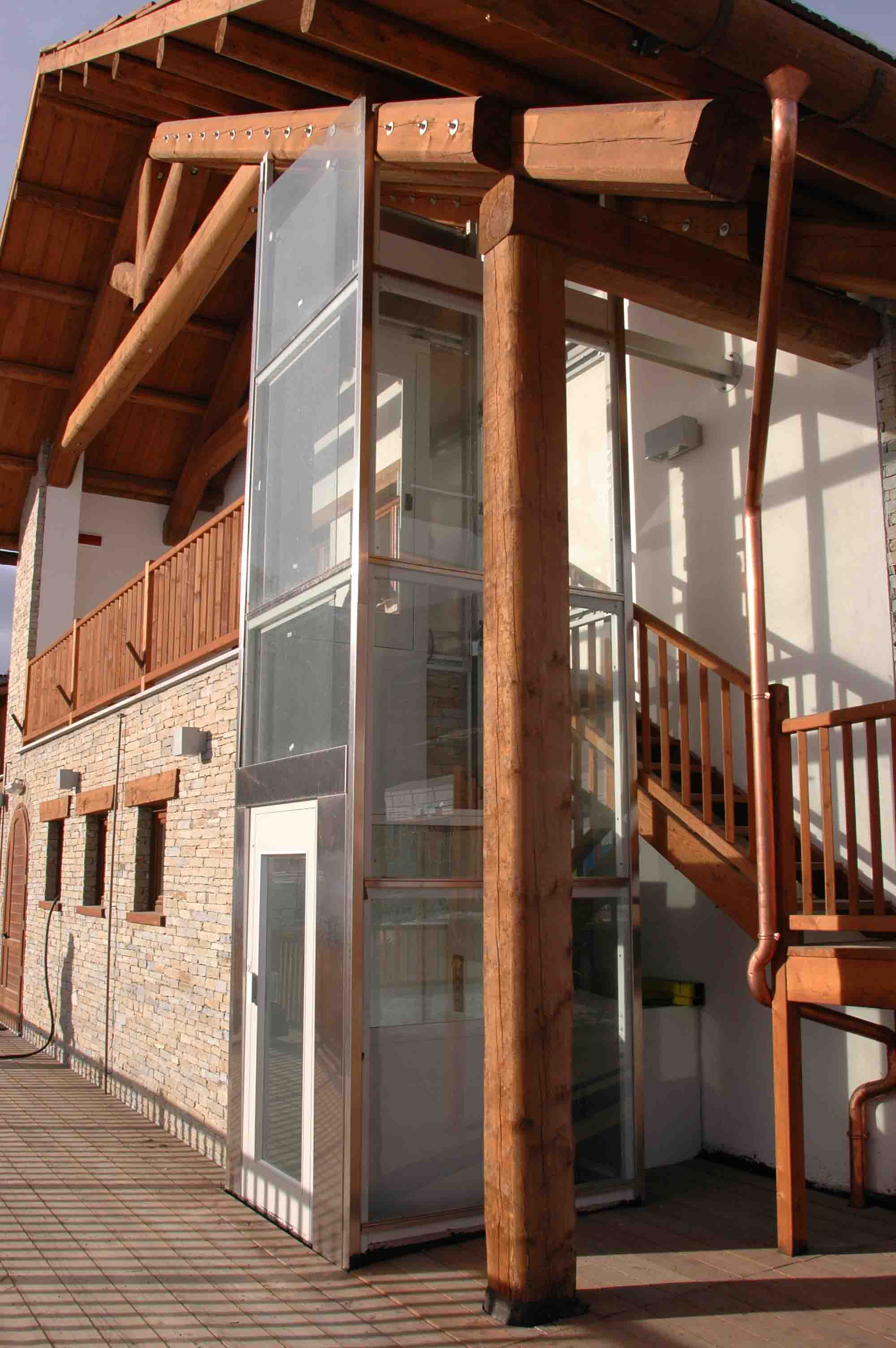
We understand Homelift to be any type of domestic elevator designed to be installed in single-family homes, chalets, duplexes, premises or low-rise buildings.
Difference between elevator and home lift
There are technical differences between the concepts of elevator and lift.
Although both are used to transport people or goods, the main differences are speed, regulations and the maintenance required after installation during their useful life. In the article differences between elevators and lifts we explain their differences in more detail.
Types of Home Elevators
As with elevators, there are two types of home elevators on the market:
1. Hydraulic single-family elevators
They are driven by a piston that moves thanks to a motor and a pump that inject pressurized oil||They are the most common single-family elevators due to its adaptability to different sizes of spaces and comfort||In the article Advantages of installing a hydraulic elevator we break down the most significant advantages of this type of elevator.
2. Electric single-family elevators
Are those domestic elevators that are driven by a motor that rotates a pulley, on which one or more steel cables hooked to the cabin are pulled. They usually take up a little more space, although their consumption is very low.
3. Pneumatic single-family elevators
They are single-family elevators , in which the cabin is inside a tube , through which it moves due to the suction that a motor makes through that tube. They are aesthetically very light and small. They require a space, normally outside the home, or in a basement, where the pneumatic machinery can be placed.
Features of a hydraulic lift
The main features of the hydraulic lift are:
- They can be installed in very small spaces
- Energy consumption similar to any other household appliance .
- They can be made to measure
- Low maintenance cost
- Low noise level
- The machinery can be installed inside a specific cabinet anywhere in the home.
- They work by using a system that uses biodegradable oil or fluid
To learn more about the hydraulic elevator, you can consult the article How a hydraulic elevator works .
GMV Hydraulic Homelifts
Some Homelifts, such as the GMV HomeLifty, are manufactured and designed to be quick and easy to install, making them a Plug&Play installation. It is a good solution for removing architectural barriers and facilitating access for people with reduced mobility, whether in new or existing single-family homes.
Standard features of a private GMV elevator
- Very small dimensions : reduced pit 150mm
- Consumed like a household appliance : single-phase or three-phase motor
- Solution for new buildings or existing self-supporting structures .
- Minimum route of 2 floors and maximum of 4 (the most common facilities have a route of three floors)
- Load capacity : between 2 and 3 people
- Adapted for people with reduced mobility
- Speed : According to the Machinery Directive 2006/42/EC, a Homelift cannot have a speed greater than 0.15 m/s.
Other Homelifts available from GMV:
| Homelifty | Standard |
| Homelifty MRL | Without machine room |
| Homelifty MRL Slim | Without machine room and reduced dimensions |
| Homelifty ZW | Powered by solar panels and batteries |
Where to install a home elevator
We must give great importance to the decision of where to locate the elevator, since the amount of work to be done and the need or not to redistribute the home will depend on this, with the cost that both things represent.
The main installation points are:
- Stairwell , if it exists and has sufficient dimensions.
- Any interior or exterior patio or garden (including installation on the façade of the home).
- Interior of the home enabling the necessary space for this.
Cost of maintenance of a homelift
Its easy installation and small size reduce the cost of a single-family elevator, both in terms of assembly and maintenance, compared to a conventional elevator.
The cost of maintaining a home elevator would be around €50.
What is the Regulation?
As regards regulations, the installation of lifts is governed by the Machinery Directive 2006/42 . However, for a lift, the Directive 2014/33/EU and the EN-81.20 and EN-81.50 standards must be followed.
Related posts:




4 Responses
Hello, I need to buy an elevator, can you give me a quote for one?
Very interesting, they have a distributor in Colombia
I want an elevator like this small, they are in Argentina
Hi, I need an elevator for an integral space, how much do they cost? Are they certified?