Article updated: 07/02/2026
Summary:
The soft starter (soft-starter) starts the elevator motor with progressive electronic control of voltage and current using thyristors, without steps or peaks, and allows programming the starting time, torque, current and power limit (maximum setting of 90% of the current and 80% of the direct starting torque, compared to 33% of both in star-triangle). It incorporates protections against phase failure, line failure, thyristor failure and unconnected motor, does not carry maintenance on the power circuit, reduces mechanical stress and water hammer in hydraulics, and is recommended in modernizations with limited network, residential buildings and hospitals, and motors of more than 7.5 kW (standard from 11-15 kW). Its use fits with the REBT (ITC-BT-47), with the electromagnetic compatibility standards EN 12015 and EN 12016 and with EN 81-20/50. Your ally to start the engine without current spikes, protect the network and equipment and extend the useful life of the engine group.
In another article we explained what he was direct start or star-triangle. In this article we explain a third type of start that eliminates intensity peaks.
What is a soft-starter soft starter
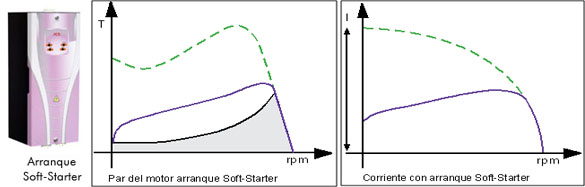
The Soft-Starter boot bases its use on the ease of being controlled, stop produce smooth and progressive starts according to the needs of the elevator, electronic controller to achieve variable voltage and current limitation. See operating curves:
In which applications it is advisable to use a Soft-starter
- In modernizations with network limitations: When the building has an old electrical connection or a very fair contracted power that does not withstand the voltage drops of a direct start.
- Is highly recommended in residential buildings and hospitals: Using it guarantees silent operation for neighbors.
- Reduces wear in hydraulic elevators: Helps better manage the behavior of the fluid in the valve block during the start of the march, avoiding unnecessary overheating of the oil to maintain constant equipment performance.
Features of Soft-starter starters
As we mentioned, soft-starter starters represent a modern alternative to traditional starting systems, such as direct or star-triangle, by replacing sudden switching with progressive electronic control of the voltage and current that reaches the motor. This allows you to precisely adjust how the engine behaves during starting and configure its parameters according to the needs of each installation, in addition to incorporating protection mechanisms that detect electrical anomalies before they can lead to a breakdown. Below are its main characteristics:
- Smooth starts without transitions no jumps, electronic control.
- Parameter programming engine start:
- Boottime
- Engine starting torque
- Consumption current.
- Power limiter of the engine.
- Incorporates engine protections:
- Protections in case of phase failure.
- Line failure.
- Thyristor failure.
- Engine not connected.
When to use a soft-starter instead of direct boot or star-triangle
When a soft-starter is incorporated into the installation, it is achieved:
- Eliminate current peaks: Reduces the intensity consumed by the engine at start-up, allowing the control panel protections to be sized tightly to save on additional component costs.
- A progressive and continuous start: Unlike the star-triangle starter, the soft-starter regulates the voltage using thyristors in a linear manner and without mechanical or electrical jumps.
- A reduction in mechanical stress: By controlling the starting torque, you avoid water hammer in hydraulic installations and premature wear in the transmission, reducing technical assistance due to breakdowns or readjustments and increasing the useful life of the entire engine group.
Comparison and graph of electricity consumption
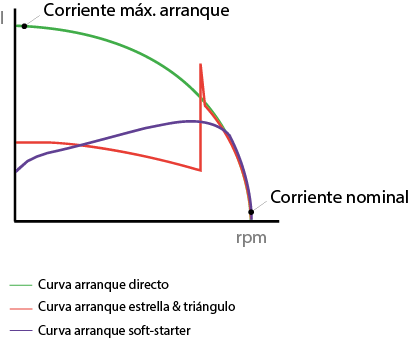
Below we can observe in comparison the behavior of a direct start, star-triangle and soft-starter:
Direct start, star-triangle, Soft-starter
| Power (kw) | Nominal Current (A) | Direct start current (A) | Star triangle start current (A) | Soft-starter current (A) |
| 2,2 | 7,1 | 21,3 | 11,3 | 10 |
| 14,7 | 31,8 | 81,9 | 45,5 | 47 |
| 22 | 48 | 148 | 69,1 | 72 |
| 58,8 | 127 | 369 | 197,4 | 190 |
Starting modes of an electric motor
| Variables | Direct | Triangle star | Soft-starter |
| % direct start current | 100% | 33% | maximum fit 90% |
| % direct start torque | 100% | 33% | maximum setting 80% |
| starting steps | 1 | 2 | no steps |
| line overload | 5 to 8 ln | 1,65 n | maximum setting 5xln |
Boot Mode Comparison Chart
For what engine power is it advisable?
- General technical limit: From 7.5 kW motors (10 HP) onwards, direct starting is no longer a viable option due to the excessive initial consumption demanded by the network.
- The efficient alternative to the star-triangle: Although the star-triangle starting system was traditionally used for medium and large powers, the soft-starter has become the standard for powers greater than 11 kW or 15 kW in modern lifting installations. Its use optimizes space in the frame and ensures total electronic control.
Advantages of using a soft starter
- Maintenance-free component in your power circuit.
- Protection devices that do not need to be installed in the control panel.
- It includes: Protection of the motor against overloads as well as against incorrect operating conditions such as loss of a phase or blocked motor.
- Increases engine productivity and reliability by preventing sudden starts and stops.
- Malfunction signal.
What regulations apply to elevators?
- Electrotechnical Regulations for Low Voltage (REBT – ITC-BT-47): This Spanish regulation regulates the starting of motors and explicitly limits the maximum starting current allowed depending on the nominal power. This requires installing soft start systems or electronic controllers so as not to disturb the public distribution network.•
- Electromagnetic Compatibility (EN 12015 and EN 12016 Standards): Lifting-specific soft starters must comply with these electromagnetic emission and immunity directives. This ensures that the operation of the engine does not cause interference or breakdowns in the electronic control panels or in the elevator communication devices.
- Safety and design standards (EN 81-20 /EN 81-50): The integration of a soft-starter with internal protections against phase failures, line failure or blocked thyristor facilitates compliance with the strict security requirements required for the delivery of the installation.
Literature
- Ministry of Science and Technology (Spain): Royal Decree 842/2002, of August 2, which approves the electrotechnical Regulation for low voltage, text consolidated in BOE: BOE-A-2002-18099 — REBT. ITC-BT-47, Installation of receivers. Engines, full text: ITC-BT-47 (Normatia)
- European Committee for Standardization (CEN): Harmonized standards UNE-EN 12016:2014 — Electromagnetic compatibility. Product family standard for elevators, escalators and moving platforms. Immunity: File in AENOR store; UNE-EN 12015 (Issue, complementary to the previous one): can be consulted along with its file in the Aenor store searching «UNE-EN 12015»; UNE-EN 81-20:2020 — Safety rules for the construction and installation of elevators. Part 20: Elevators for people and people and loads: File in AENOR store; UNE-EN 81-50:2020 — Exams and essays. Part 50: Design rules, calculations, examinations and tests of elevator components: File in AENOR store
- Component Engineering Manuals: Siemens SIRIUS 3RW soft starters, official product page: Siemens — SIRIUS 3RW; ABB PSTX soft starter, official website: ABB — PSTX; ABB PSR soft starter, official website: ABB — PSR; Blain Hydraulics GmbH, specialized since 1971 in valves for hydraulic elevators, official website: Blain Hydraulics (Spanish version)
- Fraile Mora, J. (2012): Electrical Machines. McGraw-Hill Publishing House (Fundamentals of insertion currents and torque control in asynchronous motors).https://www.casadellibro.com/libros-ebooks/jesus-fraile-mora/39908

Is the current standard. The cables and relays are replaced by one or more electronic boards integrated with microprocessors, very similar to those of a current computer.



2 Responses
Excellent information, thank you..