Article updated: 07/06/2026
Summary:
When starting, the elevator motor generates a peak intensity that causes voltage drops in the network, mechanical and hydraulic stress (water hammer blows on the pump) and pulling in the cabin. Direct starting is the simplest and cheapest, but it absorbs 5 to 8 times the rated current (369 A in a 58.8 kW motor versus 127 A rated) and overheats the motor The star-triangle reduces the peak to about 2-3 times the nominal one (197 A in that engine) but generates a second peak when switching and needs more contactors and timers, and the soft-starter raises the ramp voltage with thyristors, without peaks or jumps, protects the engine and reduces the oversizing of the line, although its initial cost is higher. The choice must comply with UNE-EN 81-20/50 standards, the Electromagnetic Compatibility Directive 2014/30/EU and ISO 25745 on energy efficiency. Your ally to start without shaking, protect the building network and extend the life of the engine and pump.
What is a peak intensity and why it occurs
He elevator motor it is the component in charge of carrying out physical work more demanding: overcoming gravity, moving the cabin with passengers, withstanding sudden changes in load and ensuring that the trip ends safely. However the way this engine is started every time someone presses the call button it is a key technical factor that determines the durability of the machinery and the electrical stability of the building.
In the day-to-day life of an elevator, especially in hydraulic and electromechanical systems, the initial connection of the motor produces a phenomenon known as peak intensity. Understanding how different methods of starting the engine work helps you understand why some elevators move smoothly while others experience small jerks when starting.
Causes of intensity peaks in an elevator
When an electric motor starts from full rest, it must generate one initial strength (called starting torque) capable of breaking the inertia of all the mobile elements of the system: the cabin, the counterweight, the cables and the engine mechanism itself. If this start-up is not managed progressively, effects occur that affect the installation at three different levels:
- Fluctuations in the building's electrical network: During uncontrolled starting, the engine demands a large amount of power in a few milliseconds. This can cause sudden, temporary drops in voltage, often perceived as flickering in building lights or interference to sensitive electronic equipment connected to the same line.
- Mechanical and hydraulic stress: The impact of a dry start is transmitted to the entire traction system. In the hydraulic equipment, the pump receives a sudden pressure impact; In electric ones, couplings, pulleys and cables suffer. This continued stress accelerates the natural wear of bearings and joints.
- Loss of comfort during the trip: A sudden increase in force translates into vibrations, noises in the engine room and, above all, a jolt or «pull» that passengers clearly perceive in the cabin at the moment the elevator - forklift, elevators... starts the march or stops.
The economic consequences can be considerable: every technical problem and every stoppage costs money, both in terms of repair and in terms of lost productivity. The soft starters known as Soft-Starter they are the ideal and simple solution for these problems. With this type of starters it is possible to start and stop smoothly, reducing electrical and mechanical stress to a minimum.
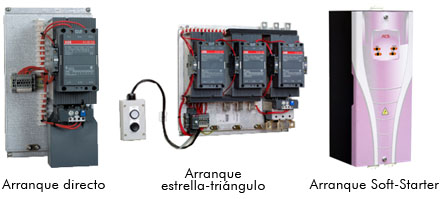
The advantages and disadvantages of the three starting modes of a car are summarized below electric motor: direct start, star-triangle start, soft-starter start.
Boot methods
Electrical engineering has developed different methods to start asynchronous motors (the most common in the sector). Each offers a different balance between mechanical simplicity, economical cost and current control.
What is direct boot
It's the method simpler and more traditional. Consists of connect the motor directly to the general electrical network through an electromechanical switch called contactor. When the elevator is ordered to move, the contacts close and the motor receives 100% of the voltage at once, going from zero to its maximum speed in a fraction of a second.
How direct boot works
The line voltage is applied directly to the motor terminals by contactors (electromechanical component that establishes or interrupts the flow of current). See operating curves.

Advantages
- Simplicity and low cost: It is the most economical system to install and maintain, since it requires very few components in the control panel.
- High current peaks: When starting, the motor can absorb between 5 and 8 times its rated current. For example, a high-power motor may momentarily demand hundreds of amps, requiring the building's overall electrical installation to be properly sized.
- Temperature wear: All this initial energy generates rapid heating in the motor windings, which in the long term reduces the useful life of the internal insulation if the elevator makes a very high number of trips per day.
- Lack of regulation: Acceleration depends solely on the cabin load, so starting is usually immediate and firm.
Disadvantages: electricity consumption
- A motor starting at half or full load can draw 5 to 8 times the rated current.
Example: If we perform a direct start with a 58.8 Kw motor, the installation would have to be designed to absorb 369 A, the equivalent of having more than 10 elevators installed with a power of 2.2 Kw.
| Power (kw) | Nominal current (A) | Direct start current (A) |
| 22 | 7.1 | 21.3 |
| 14.7 | 31.8 | 81.9 |
| 22 | 48 | 148 |
| 58.8 | 127 | 369 |
- Excess torque applied: During engine start, a series of sudden torque oscillations occur as speed increases. This excess can cause mechanical shocks and water hammer in the bomb that result in a sudden start of the elevator.
- Huge engine overheating: Overcurrent can cause sudden drops in voltage on low-capacity lines and requires proper contactors and fuses to be sized to avoid damage.
- Additional engine heating: causes premature engine wear.
- Line sizing cost.
- There is no engine control.
What is the STAR-DELTA start?
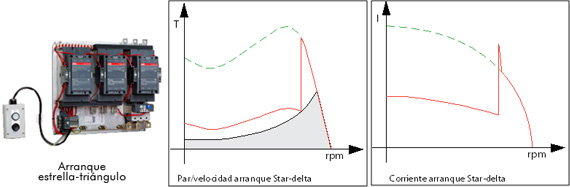
To reduce the high electrical demand of direct start, the star-triangle system. This method takes advantage of the fact that the windings of three-phase motors can be connected in two ways: in star (the motor receives a reduced voltage, approximately 58% of the total) or in triangle (receives the total voltage of the network). The process is carried out in two automatic stages using three contactors and a timer:
- Star Phase: The engine starts connected to a star. By receiving less voltage, the initial current peak decreases noticeably.
- Triangle Phase: After a few seconds, when the motor has gained speed, the timer changes the connection to triangle so that the motor delivers all its working power.
Advantages
- Reduction of initial impact: The first peak current is reduced by a third compared to direct starting, relieving the load on the building protections.
- The transitory of change: At the precise moment the system switches from star to triangle, the motor is disconnected from the grid for a few milliseconds and reconnected. This usually generates a second secondary intensity peak that must be managed correctly with adequate protections.
- Perceptible transition: The jump between the two stages produces a change in engine strength that experienced users may notice as a small variation in pace within seconds of starting the ride.
- Greater volume of components: Requires more space in the control panel due to the use of multiple contactors and time relays.
How star-triangle starting works
The star-triangle starter is connected to the engine in two strokes to reduce initial consumption by contactors. See operating curves.
Disadvantages: electricity consumption
- A motor starting at half or full load can draw 2 to 3 times the rated current.
| Power (kw) | Nominal current (A) | Direct start current (A) | Star-triangle starting current (A) |
| 22 | 7.1 | 21.3 | 11.3 |
| 14.7 | 31.8 | 81.9 | 45.5 |
| 22 | 48 | 148 | 69.1 |
| 58.8 | 127 | 369 | 197.4 |
- Se they must mount timed relays to make the connection change.
- Se they produce very high peak current during the change from star to triangle.
- Se produces high mechanical stress of the engine.
- Line sizing cost.
- There is no engine control.
What is the soft starter or Soft-starter
The soft starter replaces the mechanical switches with power electronics. It uses semiconductor components called thyristors installed in the engine phases. These components function as electronic regulators capable of dosing the flow of current and voltage accurately.
Instead of applying energy all at once or in two rigid blocks, the Soft-Starter deliver one very low initial voltage and increases it linearly and continuously (ramp-shaped) for a couple of seconds. The engine accelerates progressively until it reaches its speed.
Advantages of installing a soft-starter
- Current control: Eliminates sudden transient peaks, since the current rises in a staggered and gentle manner, avoiding overloads in the building network.
- Smooth mechanical ride: By applying force gradually, vibrations and the phenomenon of «water hammer» (pressure spikes) in hydraulic elevator pipes are reduced, protecting the joints and internal components of the pump.
- High comfort: The start of movement and deceleration are fluid, minimizing jerks in the cabin for passengers.
- Initial investment: As it is an advanced electronic device, its initial cost is higher than that of traditional mechanical systems, although it requires less oversizing of the building's power lines.
If you are interested in learning more about soft starters, we have created a specific article about it Softstarter.
Current regulations
The choice and implementation of these systems depends not only on technical preferences, but also on compliance with a strict regulatory framework that ensures the quality and safety of the facilities:
- UNE-EN 81-20 and UNE-EN 81-50 standards: These harmonized European regulations dictate the safety rules for the construction and installation of elevators. They require that all mechanical and electrical elements respond safely and predictably to any charging situation.
- Electromagnetic Compatibility Directive (EMC – 2014/30/EU): Regulates the disturbances that electrical appliances can introduce into the public network. Starting systems must be designed (and sometimes incorporate additional filters) to avoid generating electrical noise that affects other users on the network.
- Energy Efficiency Standards (ISO 25745): This international regulation evaluates and classifies the energy consumption of elevators. Reducing the energy lost in the form of heat during starts is a key factor for the installation to obtain better energy certification.
Literature
Rockwell Automation (Allen-Bradley): Official White Paper on when to use soft starter vs. frequency converter in induction motors: When to use a soft starter or variable speed drive — Rockwell Automation
Electrotechnical Regulation for Low Voltage (REBT) — voltage drops at receiver start-up Royal Decree 842/2002 — REBT (BOE)
CEN — Harmonized standards EN 81-20 and EN 81-50. CEN — UNE-EN 81-20:2020 — AENOR Store. UNE-EN 81-50:2020 — AENOR Store
IEEE Transactions on Industry Applications — hydraulic transients in lifting systems. Study on Pressure Transients in Low Pressure Water-Hydraulic Pipelines — IEEE Xplore. IEEE Transactions on Industry Applications — IEEE Xplore

Is the current standard. The cables and relays are replaced by one or more electronic boards integrated with microprocessors, very similar to those of a current computer.



7 Responses
Good morning Mar,
It is very good because I see that you have condensed and structured the concepts very well and adapted the ideas to our sector.
I see that you are gradually improving, I have even stayed with the suspense of seeing how the story will end on May 7th.
On the operational side, this blog will do very well.
Good job
Thank you very much!
Excellent article, with valuable information.
All the best !
Benedict
I have a recently installed GMV hydraulic lift and it starts up very abruptly, it is single-phase.
Can I put a delayed contactor?
The elevator technician says there is no solution.
He says that the speed can be lowered
If you can, please let me know as soon as possible.