Article updated: 07-02-2026
Summary:
A hydraulic elevator consists of a hydraulic power plant (motor, pump, tank and valve group), conduits, piston, operating panel, technical cabinet, chassis, cab, guides and doors. The power plant can be submerged (silent and the most common in homes) or with a DRY external engine (up to 20% energy saving and less oil heating), and the valve group, mechanical or electronic, regulates flow, direction and pressure so that the movement and stopping are smooth (the electronics compensate for temperature and load). The piston can be direct, indirect 2:1 or telescopic (hydraulic for panoramic, mechanical with chains for forklifts and car lifts), the pipes support more than 40-50 bar, and the fluid, mineral or biodegradable, must maintain its viscosity between 0 and 40 °C so that the elevator works the same all year round. The chassis assumes the stresses and guidance, and a lightweight cab that complies with EN 81-20 reduces the required pressure, electrical consumption, and wear on gaskets and pumps. Your ally to learn about each part of the hydraulic elevator and choose the configuration that offers the most silence, efficiency and reliability.
Before explaining how a hydraulic elevator, it is necessary to know what are the essential elements that make it up and allow its operation. Very briefly and in a simplified way we will name 7 basic components to understand the structure of hydraulic equipment in an elevator.
The hydraulic power plant, a set formed by a motor-pump, is the tank where all the oil necessary to move the cabin is stored. The valve group, installed in the plant, is the brain of all operations (along with the electrical panel). It regulates the oil flow and consequently the speed of the cabin, which reaches the piston through a line. When the oil enters the interior of the piston, its pressure causes an upward displacement of the rod and consequently in the cabin.
Components of a hydraulic elevator
The essential components of a hydraulic elevator are:
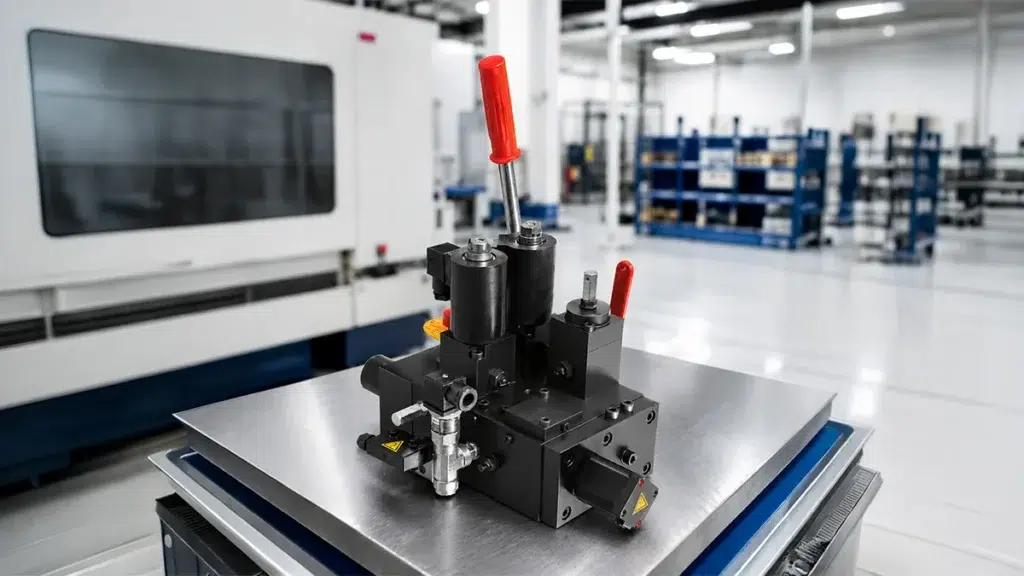
- Valve group: Controls the speed, direction and pressure of hydraulic fluid up and down.
- Hydraulic power plant: assembly consisting of electric motor, pump, oil tank and valve group, which generates and regulates the circuit pressure.
- Hydraulic conduits: hoses and pipes that connect the plant with the piston.
- Hydraulic piston: element that transmits the force of the pressurized fluid to raise or lower the cabin.
- Maneuverboard: electronic system that manages calls, movements and elevator protections.
- Technical cabinet: in installations without a machine room, it concentrates the hydraulic plant and the control panel in a compact space located in the hole or on the ground floor.
- Cabin: cabin where passengers travel or cargo is transported.
- Metal guides: rails fixed to the walls of the opening that direct the vertical path of the cabin.
- Cabin and floor doors: accesses that guarantee boarding and disembarkation security at each stop.
Hydraulic power station
The hydraulic power plant (or motor-pump group) is responsible for generating the force. It consists of a metal tank filled with mineral fluid inside which an electric motor and a pump are housed.
When the elevator has to go up, the engine starts, activates the pump and it sucks the oil from the tank to send it under pressure towards the piston. To lower, the engine does not need to be started: a series of valves and solenoid valves are simply opened and the weight of the cabin itself pushes the oil back into the tank by gravity.
Types of plants according to their engine
- Submerged Power Plants (in oil): It is the most common system in residential buildings. The electric motor works completely submerged inside the oil tank itself. The great advantage of this design is that the oil almost completely dampens noise and cools the engine, making the elevator extraordinarily quiet for the neighbors.
- Power Plants with Exterior Engine (DRY Engine): In this case, the engine is outside the oil tank. They are commonly used in high traffic or industrial elevators. Its key advantages are:
- Outstanding energy savings: Since the engine is not submerged in the oil, it does not suffer the resistance or friction of a viscous fluid when rotating, which allows the installation's electrical consumption to be reduced by up to 20%.
- Thermal control: The oil is prevented from overheating after continuous use.
Valve group
If the fluid simply pushed the elevator uncontrollably, the ride would be chaos filled with jerks, sudden braking, and unevenness. He valve group it is the component responsible for regulating the passage of oil. Decide how much fluid passes, in what direction it goes, and at what pressure.
Basically, it controls the speed of the cabin, ensures that it accelerates and brakes smoothly, and ensures that it stops exactly at the ground level of each floor.
Types of valve groups
- Mechanical Valves: They are the traditional. They work through valves and solenoid valves that move the shutters inside the Valve Group to manage the flow of the circulating fluid. They are very robust systems, easy to repair and economical. However, its accuracy may vary slightly if the oil is very cold or very hot (as the oil changes density with temperature).
- Electronic Valves: They are the modern version. They use sensors and a microprocessor to adjust the oil flow in real time automatically. It doesn't matter if it's cold, hot or if the elevator is full or empty; The trip will always be millimetrically smooth and the perfect stop.
Hydraulic piston
He hydraulic piston it is the component that performs the physical pushing effort. It consists of a hollow metal cylinder that houses a polished steel plunger or bar inside. When pressurized oil enters the cylinder, it pushes the bar outward, causing the elevator to rise. When the oil returns to the tank, the bar is reintroduced into the cylinder and the cabin lowers.
Types of pistons according to their installation:
-
Direct Throw Piston: The piston directly pushes the cabin. It can be buried in the ground just below the elevator (requiring digging a deep pit) or installed on the side of the shaft.
- Indirect Shooting Piston (with cables): Instead of pushing the car directly, the piston pushes a pulley through which steel cables tied to the elevator pass. This system allows the elevator travel to be doubled using a piston half as long, which avoids having to make deep pits.
-
Telescopic Pistons: They unfold in several independent sections or stages, much like how a selfie stick extends. They are the perfect solution when the space in the pit or at the top of the hole is very limited. To coordinate the ascent and descent of its different sections at the same speed, they are divided into two technologies: ç
- Hydraulic Synchronization: The coordination of the sections is carried out internally by the oil pressure itself, without cables or external chains. Offering a completely clean and polished exterior aesthetic, they are ideal for panoramic glass elevators (in hotels or shopping centers) where the machinery is visible to the public.
- Mechanical Synchronization: They use a chain system to force the exact and simultaneous deployment of all stages. They are extraordinarily robust and stable systems during loading, which is why they are used indispensable in forklifts, car lifts or stretcher lifts, ensuring that the cabin does not pitch or suffer unevenness when putting heavy weights. Thanks to its design, it allows you to maximize the surface area of the cabin
Driving
The pipes or hoses are the responsible for transporting high-pressure oil from the plant to the piston and vice versa.
Since they must withstand very high operating pressures (usually exceeding 40 bar or 50 bar, they are made of extremely resistant materials. They are usually rigid steel pipes in the fixed parts of the route and flexible hoses reinforced with metal meshes at the joining points. This flexibility is key, since it absorbs small vibrations from the pump, preventing annoying noises from being transmitted to the building structure.
Fluent
The function of hydraulic fluid function is to transmit hydrostatic power from the plant pump to the interior of the piston. It is not a simple lubricant. The fluid must withstand high continuous working pressures without losing its physical properties, without generating foam and without degrading the internal components.
The viscosity is the most critical characteristic of the fluid. If the fluid changes density drastically with changes in ambient temperature, the behavior of the elevator will become unstable. A low-quality fluid becomes too liquid in the summer heat. This causes the elevator to become out of adjustment by a few centimeters when stopping on the floor, forcing constant readjustments.
On the contrary, in winter it goes uphill faster because the cold fluid becomes denser and the pump pumps more flow.
Using the proper fluid and keeping it free of impurities ensures that the elevator operates exactly the same at 0°C as it does at 40°C. This eliminates customer complaint calls for sudden stops or unevenness.
Types of fluids
Technological evolution and environmental regulations have diversified the types of fluids available for hydraulic elevators:
-
Traditional mineral oils: They are the petroleum-based fluids more widespread on the market due to their excellent lubrication capacity and competitive cost.
- They offer a gran resistance to aging and they effectively protect metal components against internal corrosion.
- They require constant temperature monitoring from the engine room, sometimes requiring the use of refrigerators to maintain optimal viscosity in high traffic buildings.
-
Ecological or biodegradable fluids: Generally formulated based on synthetic esters or technologically modified vegetable oils.
- Are specifically designed to decompose naturally and quickly in the environment in the event of an accidental leak in the pit.
- The use of ecological fluids avoid serious administrative sanctions, complies with the most demanding environmental regulations and protects the subsoil from pollution, a key selling point for buildings with green certifications.
It is also important to keep in mind what correct maintenance must have the fluid during its life cycle.
Chassis
No cab can hang directly from the cables or rest directly on the piston. It is the chassis that assumes all the mechanical stress, the weight of the load and the inertial forces during the trip.
The chassis is there equipped with skirting boards or guides, which are the elements that slide on the hole guides to guarantee that the path is perfectly vertical.
Use a crobust and precisely cut hasis ensures balanced load sharing. For the technician, this means quick installation that requires no adjustments to the elevator shaft.
For the end customer, an optimal chassis translates into total elimination of structural noises. The elevator moves silently, conveying a feeling of high-end safety and comfort.
Cabin
The car is the only component of the elevator with which the end user interacts directly. It is the cabin designed for the safe transportation of passengers or goods.
Although aesthetics (mirrors, panels, button panels) is what the customer perceives, the cabin is, above all, a safety element subject to strict international regulations (such as EN 81-20).
It must have mechanical ventilation systems, autonomous emergency LED lighting and a design that optimizes useful space without compromising structural resistance.
From a technical perspective, cabin weight (empty mass) is a critical factor. An excessively heavy cabin forces the hydraulic plant to work at higher pressure than necessary on each trip.
Installing cabins made of light materials but with high structural resistance drastically reduces the load on the entire hydraulic system.
Less own weight in the cabin directly translates into lower kilowatt consumption on the building's electricity bill and longer life for the piston and pump seals.
Literature
Miravete & Larrodé: Elevators: Principles and innovations — Reverté Editorial
Hydraulic elevator specifications guide available at Construmática: Hydraulic Elevator Specifications Guide (GMV/Construmatic)
Standard UNE-EN 81-20: Safety rules for the construction and installation of elevators File in AENOR store (payment rule): UNE-EN 81-20:2020 — AENOR Store
NTP 761 (INSST) — Pressure equipment: design, marking and certification: NTP 761 — INSSTBOE.es
NTP 460 (INSST) — Preventive maintenance of facilities NTP 460 — INSST

Is the current standard. The cables and relays are replaced by one or more electronic boards integrated with microprocessors, very similar to those of a current computer.



58 Responses
Hi, I'm from Venezuela. I work for a small company that is currently looking to work in the production of hydraulic elevators! I'm researching the manufacture of a hydraulic elevator using differential propulsion. I'd like to know how you could help me or what bibliographical material you would recommend so I know where to start with the design. Thank you very much!
Good morning Gerardo,
We recommend some books, both practical and theoretical, on elevator calculation and design:
– Transport facilities (by Jesus Sanchez Criado)
– The book of vertical transport; Elevators: principles and innovations (both books by Antonio Miravete and Emilio Larrodé)
– Elevator traffic Handbook (Gina Car Barney – in English)
– L'ascensore idraulico (by Ricardo Paolelli – in Italian)
We hope this helps! Best regards
Hello, I have a small elevator company and I want to
Install an EN3010 block in a central unit that currently has a BLAIN. The query is the electrical connection of the EN3010 solenoids to be controlled with a Spanish asp116 electrovitory maneuver.
MeM..
Good morning Mauricio,
If you change the entire valve assembly, you should also change the solenoid valve coils and tell us their voltage (48-60; 110 or 180 VDC). We would also need to know the type of engine start (direct or star-delta), since in our 3010 assemblies, one of the solenoid valves changes depending on the type of start.
We hope we have answered your question. If you have any further questions, please do not hesitate to contact us.
Greetings!
Good morning, I need to make a model of a hydraulic elevator and I really can't figure out how to do it. I wanted to know if you have any material that could help me. I am a civil engineering student and I would appreciate any kind of help.
Hello Lourdes,
We regret to inform you that we do not have any model (or similar) of a hydraulic lift. However, if you have any questions at a conceptual level, we can help you, so do not hesitate to contact us again. Best regards!
Greetings, we have technically recovered some hydraulic elevators with Blain brand pumps in Caracas, Venezuela. One of them does not keep the cabin level because the piston goes down due to the weight of the cabin despite the seals having been changed. We would appreciate any information that would help us solve the problem or contact someone who provides technical service in Venezuela preferably. Sincerely, Mr. Eduardo.
Good morning Eduardo,
To avoid problems with equipment that has not been maintained and as manufacturers of hydraulic equipment, we recommend that you opt for modernizing the hydraulic equipment. For this we have different solutions available that can be very useful:
– NGV conversion kit: allows the valve group controlling the lift to be modified in just 2 hours, thereby modernising the entire hydraulic equipment (small kit for export and transport).
– Replacing the hydraulic equipment: replacing it with a new hydraulic unit, this way you can increase the lifespan of the elevator and extend its warranty.
For Venezuela we can offer service from our headquarters in Brazil. For more information, please do not hesitate to contact us.
We hope we have helped you. Regards,
Hello, cordial greetings, from Ecuador Guayaquil, our company is dedicated to agricultural and industrial maintenance and repairs, in addition to the construction of industrial parts and assembly, we hope to be in contact with you for the purchase of various spare parts for hydraulic elevators WITH MAINTENANCE UNITS of the GMV brand, hoping for your help with various maintenance catalogs for them.
Sincerely.
Eng.Manuel Velez V
General manager
REPAI S.
Hello Manuel,
Our Sales Department will contact you in the next few days. You can also consult the Online Product Catalogue .
Thank you for your interest!
Hello, I have a GMV valve, I need to check the pressure and the pressure gauge does not work, I installed a new one and it still does not show the pressure, in what other port can I take the pressure?
Hello Raul,
From your comment, we understand that the elevator is working properly and that it only has a problem with the pressure gauge. You should check if screw no. 6 is open: this screw opens or closes the passage of oil to the gauge. You can take the pressure at the place where the pressure switch is.
We hope this answer helps! If you have any questions, please contact us again.
Greetings,
HELLO, I WANT TO BE IN CONTACT WITH YOU GMV BRAZIL. WE ARE FROM THE WEST OF ARGENTINA AND WE ARE VERY INTERESTED IN YOUR PRODUCTS.
WE SELL BLAIN BRAND EQUIPMENT BUT WE WOULD BE MORE INTERESTED IN YOU STARTING TO USE GMV
THANK YOU AND I LOOK FORWARD TO YOUR RESPONSE
Hello Jesus,
We appreciate your interest. Our Sales Department will contact you as soon as possible.
Thank you very much. Best regards,
Hello, I am building a hydraulic elevator and I would like help on how to obtain the valve group. Thanks, I look forward to your responses!!
Hello Hugo,
First of all, please excuse the delay in our response.
You will find all the necessary technical information on the different valve groups in the Online Product Catalogue , you only have to register (for free). If you need more documentation than what you will find in the Catalogue , you can contact our Sales Department by email or through 902 345 234 / +34 937 745 455 .
Greetings and sorry again for the delay in our response.
The topics are very well focused and with a very clear explanation for experts and even for those who have basic notions of the subject.
In my case (micro mechanics and electronics technician), I am about to build a small elevator in my house (a half-cabin elevator), for my wife who has small difficulties, and this literature supports me in what I could apply based on my experience.
I feel more confident about what I am going to do by applying my own experience and the knowledge of technicians and engineers who have been in the field for many years.
I would like to continue enjoying news and information that would expand my desire to broaden such knowledge.
I thank whoever is responsible for these responsibilities…
Atte, Caesar
Friends, I congratulate you for the very good information.
I have a GMV 3010 unit with a star-delta motor that starts. I would like to know if I can install a frequency converter and if I need to change any valves. The problem is that it has a very strong upward start.
Thank you
Hello Felipe,
From what you tell us, it is only a matter of adjusting the valve group and the upward start would be solved.
You can contact us through sat@es.gmvgrupo.com
All the best!
Hello friends of GMV, I am writing my thesis on electro-mechanical and hydraulic lifting equipment and while reviewing information on the latter, the following question came to my mind: are the group of valves installed on the oil tank the so-called operating valves? And where are the safety valve and the parachute valve installed?
Thank you in advance!
Good morning Diego,
The valve group on the tank contains the speed and oil flow control valves as well as the safety valves, except for the parachute that goes on the piston.
All the best!
hello
I am building a didactic pneumatic elevator but I cannot find a book or website that can help me with the calculations. Could you help me with information about this? Thank you very much.
Good morning,
First of all, we would like to thank you for visiting our blog. GMV Eurolift is dedicated to the hydraulic lifting sector, so we cannot advise you on your query about pneumatic lifts. We hope to be able to help you with future queries.
Greetings,
Good morning, we have a hydraulic lift with an EN3010 unit. I am being asked for a manual for changing the oil in this unit so that it can be included in our catalogue as standard.
Could you help me with this document and your recommendations?
thank you
Good afternoon,
We inform you that we are processing your request. We would appreciate it if you could provide us with a contact email so that we can send you the document you need.
Greetings,
Greetings, I have a bad oil pump on my GMV brand elevator. I would like to know a supplier to buy the part.
Good morning Andri, thank you for contacting us with your query. One of our sales representatives will contact you shortly to assist you with your request.
Good morning, I am from Ecuador and I work in elevator maintenance. I have a problem with a hydraulic elevator that uses a GMV pump. The problem is that everything starts normally but the hydraulic pressure does not make the elevator go up.
Please if you help me with a possible solution, thank you very much.
Good morning Diego, thank you for your comment. Our technical service department will contact you to clarify your query.
Good morning, I have a 3010 unit, which presented me with the problem of a burned-out engine. I am diagnosing possible causes and everything works in optimal conditions. The current operating time is 8,500 hours since it was put into operation. If any of you can give me suggestions on the cause, I would appreciate it. I will be showing images of the engine when I disassemble it.
Good morning Alexander,
First of all, we would like to thank you for your enquiry. In reference to it, we wanted to tell you that the fact that the installation has 8500 hours of operation means that it has a high traffic, so you would have to check the condition of the oil, which will have already been operating at high temperatures. We also recommend that you check the correct connection of the thermistor protection. We hope that these suggestions are useful to you.
Hello:
I am from Argentina, Buenos Aires. We installed a four-stop hydraulic elevator, which although it worked, always had the problem of abrupt takeoff.
Now it is added that sometimes with more than three people it stops on a mezzanine.
I don't know how to regulate the valves, if that is the reason, the electrical panel is from Automac, and it doesn't seem to offer any faults that we can detect.
I would appreciate any relevant information.
Sincerely, Architect Maria Luisa Inzerra
Hello Maria Luisa, in order to help you, we need more information about the elevator, among other things if it is a GMV elevator, since the solution to the problems you mention will vary depending on the machinery you have in the installation. You can contact us directly by email info@es.gmvgrupo.com
Hello, we are trying to fix an Enienter GMV brand elevator. It is hydraulic and does not answer calls from the buttons. In addition, it goes over a level because a magnetic device for leveling and deceleration appears to be damaged.
I hope you help us
Hello Rodolfo, as a manufacturer, our advice is that you contact the company Eninter, since from the description you have given us of the fault we cannot know if the problem comes from the hydraulic unit or from another part of the installation. To rule out that it comes from the hydraulic unit, you can do the following:
– During an up/down journey, remove the VML valve connector. If the lift changes speed, this means that the valve group is working correctly.
Greetings,
Hello, my name is Carlos, I am helping out at the cathedral in my neighborhood, with the elevator.
Its movement is by means of a hydraulic control unit, with a solenoid valve incorporated into the 3-way pump and a single-acting piston.
This means that to go down the solenoid valve opens and due to the weight of the elevator the oil returns to the container.
The problem is that the piston has no shock absorber and when it reaches the lower level it produces a sharp blow.
Although the elevator works, older people cannot use it because of the loud bang.
What can I do to improve braking?
Greetings Carlos
A lift valve group must be prepared to ensure the best comfort; 3-way 2-position hydraulic valves do not fulfil this task. On the other hand, GMV pistons do not have a shock absorber to improve comfort during stops; it is the valve group that is responsible for carrying out this task. To improve the operating comfort of your equipment, the ideal would be to install a lift valve group.
A hydraulic elevator can be given more speed so that it rises faster.
Hello, good afternoon, would it be very expensive to repair the Idealulica power plant that is leaking oil?
It is from a single-story thynkergruop elevator
Hello, good afternoon, we are an elevator company in Venezuela, we have several units with the gmv10 card, in one of the elevators when reaching the top floor it makes a loud noise in the central, we have already checked the oil level and it is fine, any suggestion that could be generating that noise is only when reaching the top floor
Good morning. Please could you help me understand the operation of a GMV valve (3010 EN -1″ ¼ 35-022) (LR58995-3). It seems that there are 3 valves that are identified with the following letters: VMD, VMP and VML. Please could you help me by telling me what the meaning or operation of each valve is?
Also, if it is possible to know what voltage these valves are supplied with. I appreciate your attention in advance. Regards.